dbt Core v2.0: A Rust Rewrite That Changes What dbt Is
dbt enables data analysts and engineers to transform their data using the same practices that software engineers use to build applications.
At a glance
- What is it?
- dbt Labs has rewritten its core transformation tool in Rust, shipping v2.0 as a single binary that trades Python flexibility for speed and strictness. This review covers what the rewrite means for analysts, engineers, and teams evaluating the upgrade.
- Who is it for?
- Adopt dbt Core v2.0 if you need an Apache 2.0 licensed transformation tool that runs as a single binary, if your projects are large enough that parse and compile time matter, and if you can accept a package whose pyproject.toml still classifies it as alpha. Do not adopt it if you rely on Windows ARM, need a stable production tool today, or depend on Python-based plugins or custom macros that may not survive the stricter language spec.
- Can I use it commercially?
- Yes. Apache-2.0 is a permissive licence: you can use, modify and sell software built on it, as long as you keep its copyright and licence notices.
- Is it still maintained?
- Yes. The repository received new commits within the last day.
- What is it written in?
- Mainly Rust, according to GitHub's language statistics.
Answers come from the project's GitHub data, last synced on November 15, 2026, and from our analysis. They are not legal advice.
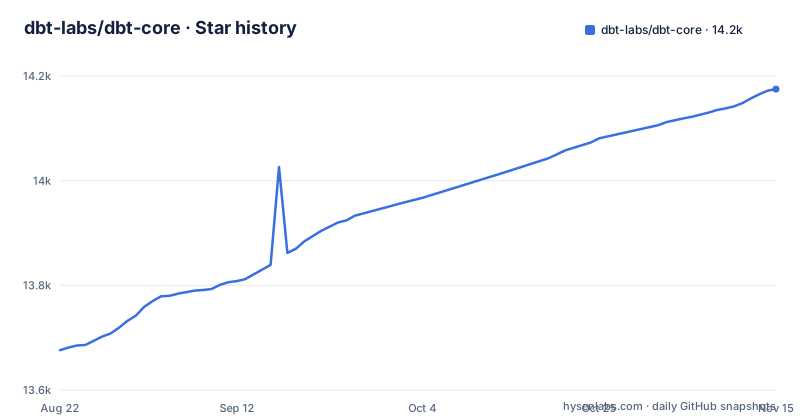
Star history
- dbt-labs/dbt-core14,175 ★ · +499
| Repository | 2026-08-22 | 2026-11-15 |
|---|---|---|
| dbt-labs/dbt-core | 13.7k | 14.2k |
499 Stars in the last 85 days, measured from the daily GitHub snapshot. Compare with other projects
Editorial analysis
What dbt Core v2.0 Actually Is
dbt Core v2.0 is a ground-up rewrite of the familiar Python dbt in Rust. The README is explicit: the main branch now contains the Apache 2.0 source code of dbt v2.0, a ground-up rewrite of dbt in Rust. The Python implementation continues on the 1.latest branch. This is not a incremental improvement. It is a different piece of software that shares a name and a language specification. The rewrite targets a specific pain point: parsing, compiling, and running projects in a fraction of the time compared to v1. If you have ever watched a large dbt project sit through a long parse, you know why this matters. The target audience is data analysts and engineers who want software engineering practices applied to data transformation, but the rewrite shifts who can run it. No Python runtime is required. That removes a whole class of environment problems.
The Architecture Shift: Rust, Single Binary, Stricter Spec
The most visible change is the language. dbt Core v2.0 is written in Rust and distributed as a single self-contained binary. The README lists five shifts from v1; three of them are architectural. First, speed: parse and compile times are dramatically improved, especially on large projects. Second, strictness: a tightly-defined language specification enforces correctness at parse time. That means errors that would have appeared at runtime in v1 surface earlier, which is a trade-off. You get safer projects, but you lose some of the leniency that let v1 projects bend the rules. Third, artifacts: v2.0 produces Parquet artifacts that can be queried, joined, and analyzed. The JSON artifacts like manifest.json are still produced for backwards compatibility, so existing tooling that reads JSON should keep working. The Parquet format is a deliberate move toward making project metadata a first-class data asset, not just a debugging output.
Installation and Platform Support: What You Can Run Today
Installation is simpler than v1 because there is no Python environment to manage. You download a binary for your operating system and architecture. The README includes a support matrix with two categories: supported today and not yet supported. macOS works on both x86-64 and ARM. Linux works on both. Windows works on x86-64 but not ARM. That is a concrete limitation. If you are on Windows ARM, you cannot run v2.0 yet. The README also distinguishes the source in this repository, which is available under the standard Apache 2.0 license, from dbt the product, which it describes as a distribution of the repository with dbt-specific customizations released under a dbt product license.
How You Actually Use It: Models, Tests, and the Workflow
The core workflow is unchanged from v1. Analysts write select statements, called models, and dbt turns them into tables and views in a data warehouse. Models build on each other, and dbt manages those relationships through ref. You can visualize the relationships and assure data quality through testing. The README points to documentation for ref, testing, and documentation features, but it does not give a full command reference. What is clear is that the language specification is now stricter, so your existing v1 models may not parse without changes. That means you should not treat v2.0 as a drop-in replacement. You need to run your project through the v2.0 parser and fix any violations of the tighter spec. The good news is that the single binary makes it easy to test side by side with your v1 installation, as long as you keep the branches separate.
The Real Limitation: Beta Status and Platform Gaps
The first thing to check is maturity: pyproject.toml still carries the classifier "Development Status :: 3 - Alpha", even though the release list already includes v2.0.8. The second limitation is Windows ARM support. The matrix marks it as not yet supported, which is a hard blocker for a segment of users. Third, the stricter language specification is a double-edged sword. It enforces correctness, but it also means v1 projects that relied on loose parsing or undocumented behavior will break. The README does not provide a migration guide here, only a pointer to the 1.latest branch. If you have a large v1 project with many custom macros or Jinja patterns, you should expect to spend time reconciling it with the new spec. The README does not mention whether all v1 features are present in v2.0, so you should verify feature parity before switching.
Alternatives and the Python Branch
The most direct alternative is the Python implementation of dbt Core on the 1.latest branch. That is not a competitor; it is the previous version of the same tool. The difference in approach is stark: v1 is a Python application with a runtime and dependency management, while v2.0 is a Rust binary. If you need Python extensibility or run on Windows ARM, v1 is the practical choice. For a different tool altogether, you might look at SQLMesh or Dataform, but the README does not mention them. The key comparison here is between v2.0 and v1. The README claims v2.0 is faster and stricter, but it does not provide benchmark numbers. You would need to run your own project through both versions and measure.
Maintenance, License, and Upgrade Cost
The license is Apache 2.0, which means you can use, modify, and distribute the code freely, with attribution. That is a permissive license, and the README emphasizes that you can review every line of code. For teams with strict licensing requirements, this is a strong point. You will need to track releases, and the release list shows active development with recent releases like v2.0.8, v1.12.6 and v1.11.16, all dated 2026-10-14. That signals ongoing work on both v2 and v1. Upgrade cost is potentially high for existing v1 projects. The stricter language spec is the main breaking change. The README says the JSON artifacts continue to be produced for backwards compatibility, which reduces the cost for tooling that reads manifest.json. But you should still plan to test your models against v2.0 before committing. The single binary installation reduces operational overhead, but you trade that for the need to manage a new artifact format and a new set of runtime behaviors. There is no mention of a migration tool in the README, so you should expect manual work.
Editorial conclusion
Adopt dbt Core v2.0 if you need an Apache 2.0 licensed transformation tool that runs as a single binary, if your projects are large enough that parse and compile time matter, and if you can accept a package whose pyproject.toml still classifies it as alpha. Do not adopt it if you rely on Windows ARM, need a stable production tool today, or depend on Python-based plugins or custom macros that may not survive the stricter language spec. Before committing, verify that your existing dbt projects parse without errors under v2.0, test artifact generation with the new Parquet format, and check the release notes for the 1.latest branch to confirm which v1 features are still missing. The rewrite is a real departure, not a cosmetic update, and it will reshape the dbt ecosystem.
Frequently asked questions
What is dbt Core?
dbt enables data analysts and engineers to transform data using the same practices software engineers use to build applications. Analysts write select statements and dbt turns them into tables and views in a data warehouse. The main branch of this repository now holds dbt v2.0, a ground-up rewrite in Rust.
What is dbt Core used for?
The select statements you write are models, and they form a dbt project where models frequently build on top of one another. dbt manages relationships between models, visualizes those relationships, and tests transformations for quality.
Is dbt Core still available?
Yes, in two forms. dbt v1 development has moved to the 1.latest branch, which holds the v1 Python implementation of the dbt framework, while main carries the dbt v2.0 rewrite in Rust under the Apache 2.0 license.
How do I install dbt Core?
The README carries no install command. It links to the install page on docs.getdbt.com with a version=2 query and notes that v2.0 ships as a single self-contained binary with no Python runtime or dependency management required.
How do I install dbt Core on Windows?
Windows on x86-64 is supported today and Windows on ARM is not yet supported, because dbt v2.0 and its drivers are compiled per operating system and architecture. The actual steps are on the install page at docs.getdbt.com, linked from the README.
What are the key differences between dbt Core and dbt Cloud?
The repository describes the hosted dbt platform as an enhanced collaboration experience and points to a page for its features, without a feature comparison. The concrete difference stated in the README is licensing: source in this repository is Apache 2.0, while the dbt distribution carries dbt-specific customizations under a dbt product license.
Official sources
Add this badge to your README
If you maintain this project, the badge below links readers to this analysis and shows its maintenance status from the daily GitHub snapshot. Paste the markdown into your README; add ?metric=license or ?metric=stars to the image URL for a different field.

[](https://hysenlabs.com/projects/dbt-labs-dbt-core)Star history chart for your README
[](https://hysenlabs.com/projects/dbt-labs-dbt-core)Was this useful?