django-hijack: Django admin user impersonation
With Django Hijack, admins can log in and work on behalf of other users without having to know their credentials.
At a glance
- What is it?
- Django Hijack lets authorized administrators enter a Django application as another user without knowing that user's password. Version 3 adds Django admin integration, but its current Python and Django requirements sharply limit compatible deployments.
- Who is it for?
- Django Hijack is appropriate for organizations that intentionally grant support staff controlled access to user sessions and can meet the Python 3.14 and Django 5.2 requirements. It is unsuitable for a deployment that needs anonymous impersonation, a lightweight password reset workflow, or broad compatibility with older Python and Django releases.
- Can I use it commercially?
- Yes. MIT is a permissive licence: you can use, modify and sell software built on it, as long as you keep its copyright and licence notices.
- Is it still maintained?
- Yes. The repository last received commits 1 day ago.
- What is it written in?
- Mainly Python, according to GitHub's language statistics.
Answers come from the project's GitHub data, last synced on November 7, 2026, and from our analysis. They are not legal advice.
Star history
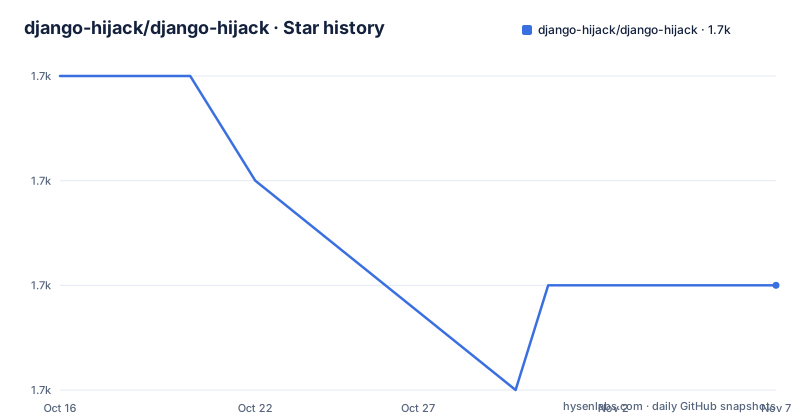
- django-hijack/django-hijack1,745 ★ · -2
| Repository | 2026-10-16 | 2026-11-07 |
|---|---|---|
| django-hijack/django-hijack | 1.7k | 1.7k |
-2 Stars in the last 22 days, measured from the daily GitHub snapshot. Compare with other projects
Editorial analysis
Django Hijack's controlled account-entry problem
Django Hijack addresses a specific support problem: an administrator may need to inspect or reproduce an issue inside a user's account without receiving or resetting the user's credentials. The project describes this as impersonation, meaning that the administrator works on behalf of the selected user through the Django application. This is aimed at application administrators, support personnel, and developers who already have privileged access but need temporary access to another user's state.
The distinction from ordinary staff login matters. A staff member does not merely gain a route into the admin site. The package changes the effective identity used by the application for the hijacked session, allowing the person to encounter account-specific data and behavior as that user would. The README includes an image identified as the notification shown while another user is being hijacked, which indicates that the interface includes an explicit indication of impersonation.
This is not an authentication bypass intended for unauthenticated visitors. The repository metadata identifies Django, authentication, security, admin, and impersonation as its subject areas, while the stated starting point is an administrator acting as a user. The README does not define authorization rules, session duration, notification recipients, or an audit record. Those are security boundaries that an adopter cannot infer from the project description alone.
Version 3 compatibility breaks common upgrade paths
Django Hijack has two documented release lines, v2.x and v3.x. The README characterizes v3 as a complete rewrite with a security-first design, built-in Django admin support, customization, dark mode, and easier integration. It also warns that all former APIs are broken. An existing v2 integration therefore should not be treated as source-compatible with v3 simply because the package name is unchanged.
The current `pyproject.toml` requires Python 3.14 or newer and Django 5.2 or newer. It classifies the project for Django 5.2, 6.0, and 6.1, and for Python 3.14 and 3.15. The test extra includes `pytest`, `pytest-cov`, and `pytest-django`. Documentation can be installed with `mkdocs==1.6.1`, although the README does not include an installation command for that dependency.
The repository is not archived. Its last push was on 2026-10-14. The listed releases include 3.8.0 on 2026-10-10 and 3.7.9 on 2026-10-01, while the version history also lists 3.7.8 on 2026-04-19. These dates show recent package changes, but they do not establish compatibility with a particular third-party Django authentication backend. Version 3.x should be treated as its own integration target rather than a drop-in upgrade from v2.x.
Installing the package without inventing setup steps
The package is named `django-hijack`, and its Python module is named `hijack`. The README does not provide installation commands, configuration snippets, environment variables, URLs, or a first-use walkthrough. The project points readers to its documentation at `https://django-hijack.readthedocs.org/en/stable/`, so the package index and that documentation are the authoritative places to consult for setup details. An invented `INSTALLED_APPS` block or management command would not be supported by the README.
The package metadata confirms that the distribution is built with `flit_gettext.scm`, requires Python 3.14 or newer, and depends on `django>=5.2`. A development installation may also need one of the optional dependency groups declared in `pyproject.toml`. The repository contains `tests/`, `docs/`, and a Python package directory named `hijack/`, which indicates separate implementation, documentation, and test areas.
The first real use cannot be reproduced from the README and package metadata alone. The README does not show how an administrator starts a hijack, how the target user is selected, how the impersonated identity is stored, or how a hijacked session ends. Those details must come from the stable documentation or the installed package's configuration interface. Until they are confirmed, adding the package should be treated as an incomplete integration step rather than a ready-to-deploy feature.
Repository layout points to a Django package with frontend tooling
The visible repository layout gives architectural clues without exposing the full runtime path. The `hijack/` directory contains the Python module, `tests/` contains automated tests, and `docs/` contains documentation sources. `pyproject.toml` maps the distribution name `django-hijack` to the `hijack` module and declares Django as a runtime dependency. This is a conventional Django package layout, but the README does not identify middleware classes, URL routes, admin integration points, templates, or signals used during a hijack.
The JavaScript files deserve separate attention because the repository includes frontend tooling. `package.json` defines `prettier`, `prettier-plugin-jsdoc`, `jsdom`, and `global-jsdom` as development dependencies. Its scripts include `prettier . --check`, `prettier . --check --write`, and `node --test`. The package declares `fetch` and `FormData` as global test identifiers and uses the `type: module` setting.
This does not establish that browser-side JavaScript performs the impersonation itself. It shows that the repository has JavaScript assets and a Node-based test or formatting toolchain, possibly for the notification interface or documentation-facing assets. The available files do not say which assets are shipped to applications, which JavaScript runs in production, or how frontend state communicates with Django. An engineer evaluating the package should inspect those files and the stable setup documentation before assuming that admin integration requires a custom frontend build.
Admin support creates policy questions the README leaves open
The strongest documented benefit is reduced credential handling for privileged support work. Instead of asking a user for a password or creating a replacement credential, an administrator can use the package's supported impersonation path. That can simplify investigation of account-specific behavior while keeping ordinary user authentication separate from administrative entry.
The trade-off is that impersonation increases the consequences of an incorrectly authorized or poorly monitored account-entry feature. The README does not document which Django permission model is required, whether hijacks are logged, whether the target user receives a notification, how long the session remains active, or how an administrator returns to their own identity. The screenshot's reference to a hijacking notification is evidence that a visible notification exists, but it is not a specification of the notification's coverage or timing.
The package calls v3's design security-first, but that phrase does not replace an application-specific review. A correct implementation must decide who may impersonate whom, which users are excluded, whether the feature is enabled in production, and how impersonated actions are identified in logs and support procedures. The README and package metadata do not define those policies. They are the first items to verify in the project's detailed documentation and in the host application's authorization configuration.
Django Hijack compared with password-based support access
A real alternative is to have a support administrator reset or temporarily issue the target user's credentials. That approach does not require a new Django package, but it changes the security model. Credentials may be copied, stored, forgotten, or associated with the wrong account. It also gives the support person a reusable secret rather than a controlled session established through an administrative action.
Another alternative is to reproduce the problem with a dedicated test account. This keeps production impersonation out of the workflow and can be appropriate for support procedures that do not require access to a particular user's data. Its limitation is direct: a synthetic account cannot expose the permissions, preferences, records, and state that caused the original user's problem.
Django Hijack sits between these choices. It is intended for an authorized administrator who needs the target account's existing context without knowing its password. It should not be selected merely to bypass normal login controls or to give every support representative unrestricted access. The package description, admin integration statement, and impersonation notification point to a deliberate administrative workflow, while the missing policy details leave the exact trust boundary for the adopter to establish.
Maintenance and MIT licensing affect adoption planning
The project uses the MIT license. That is a permissive license, and the repository includes a `LICENSE` file. The README does not provide legal interpretation or details about how the license interacts with an application's own licensing, so the license text remains the source to review.
Maintenance activity is recent according to the repository metadata. It is not archived, and its last push was on 2026-10-14. Version 3.8.0 was released on 2026-10-10, while version 3.7.9 was released on 2026-10-01. The presence of multiple recent releases and an active repository status supports checking the changelog and security documentation during upgrade planning. It does not, by itself, guarantee compatibility with a particular Django project.
Upgrade cost comes mainly from the v3 rewrite. The README says former APIs are broken, so an application carrying v2 hooks, templates, permissions, or custom integration may require code changes. The Python and Django minimums can be the larger constraint. Before upgrading, compare the application's Django version with the metadata, inspect the release notes for migration instructions, and review `SECURITY.md` for reporting and security guidance.
Editorial conclusion
Django Hijack is appropriate for organizations that intentionally grant support staff controlled access to user sessions and can meet the Python 3.14 and Django 5.2 requirements. It is unsuitable for a deployment that needs anonymous impersonation, a lightweight password reset workflow, or broad compatibility with older Python and Django releases. Before adoption, verify that your authentication system supports the documented hijack mechanism, confirm which administrators may enter accounts, and review the project's SECURITY.md and release notes for the exact deployment version.
Frequently asked questions
What problem does Django Hijack solve?
It lets administrators log in and work on behalf of another Django user without knowing that user's credentials. The project presents this as an impersonation feature for administrative support.
What are the installation requirements for Django Hijack?
The current package metadata requires Python 3.14 or newer and Django 5.2 or newer. The README does not include an installation command or configuration snippet; it points to the stable documentation instead.
Can Django Hijack version 3 replace version 2 without code changes?
The README says version 3 is a complete rewrite and that all former APIs are broken. Existing version 2 integrations should therefore be reviewed for required changes before migration.
Does Django Hijack include Django admin support?
The README lists out-of-the-box Django admin support as a feature of version 3.x. It does not document the exact permission model or admin workflow, so those details need to be checked in the project's documentation.
Official sources
Add this badge to your README
If you maintain this project, the badge below links readers to this analysis and shows its maintenance status from the daily GitHub snapshot. Paste the markdown into your README; add ?metric=license or ?metric=stars to the image URL for a different field.

[](https://hysenlabs.com/projects/django-hijack-django-hijack)Star history chart for your README
[](https://hysenlabs.com/projects/django-hijack-django-hijack)Was this useful?