free-v2ray-public-list: A 15-Minute Refresh Cycle for Public Proxy Configs
A simple and always-updated list of free, working V2Ray servers. including SS, SSR, Trojan, VLESS, VMess, TUIC, and Hysteria2. Just copy, paste, and connect — no signup, no payment, no nonsense. ⏰ Updated every 15 minutes . Also on Telegram: https://t.me/AbdalV2rayBot
At a glance
- What is it?
- This repository publishes a rotating set of free V2Ray-compatible server configs across seven protocols, updated every 15 minutes. It is a convenience layer for users who want copy-paste access, but it carries real trust and stability trade-offs.
- Who is it for?
- Adopt this repository if you need a quick, no-signup source of public proxy configs for casual browsing or testing, and you accept the risks of using third-party servers. Do not use it for sensitive traffic or production workloads, because the configs are public, unverified, and change every 15 minutes.
- Can I use it commercially?
- Not without permission. GitHub finds no licence file in the repository, and without a licence all rights are reserved by default: you may read the code but not reuse it. Check the README, or ask the authors, before using it.
- Is it still maintained?
- Yes. The repository last received commits 5 days ago.
- What is it written in?
- GitHub does not report a main language for this repository.
Answers come from the project's GitHub data, last synced on October 17, 2026, and from our analysis. They are not legal advice.
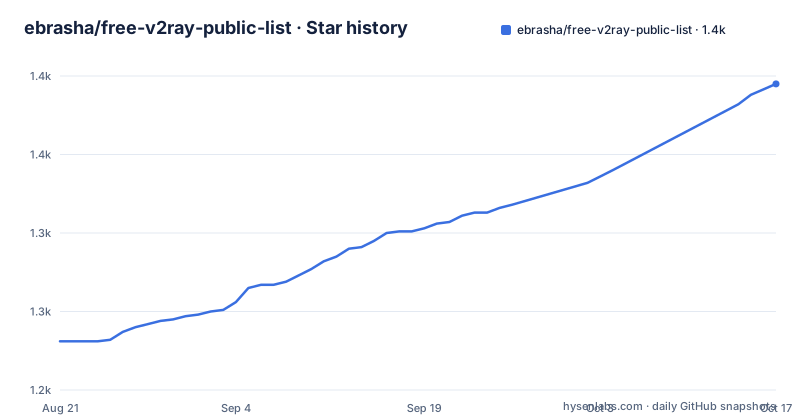
Star history
- ebrasha/free-v2ray-public-list1,395 ★ · +164
| Repository | 2026-08-21 | 2026-10-17 |
|---|---|---|
| ebrasha/free-v2ray-public-list | 1.2k | 1.4k |
164 Stars in the last 57 days, measured from the daily GitHub snapshot. Compare with other projects
Editorial analysis
What This Repository Actually Provides
The project is a plain-text list of proxy server configurations. It supports seven protocols: SS, SSR, Trojan, VLESS, VMess, TUIC, and Hysteria2. The README positions it as a source for free, working V2Ray configs, updated every 15 minutes. The intended audience is users in restricted regions, particularly Iran, who need a fast way to get a working proxy without signing up or paying. The repository does not host any software; it only stores configuration strings in text files. The core value is the refresh cycle, which removes expired or non-working configs automatically, according to the README. That claim is central to the project's usefulness, but the README does not explain how the removal is verified or how often the list is actually tested.
The Mechanism: Raw Text Files as a Subscription Feed
The repository works as a static file server. Each protocol has its own text file, plus an all-types file. For example, V2Ray-Config-By-EbraSha-All-Type.txt contains everything, while vmess_configs.txt holds only VMess links. Users copy the raw GitHub URL into a client app that supports subscription import. The app fetches the file and parses the configs. The README recommends Nekoray or V2rayN on desktop, V2rayNG or Hiddify on Android, and Streisand or ShadowRocket on iOS. The data flow is one-way: the repository updates the files, clients poll the URLs. There is no API, no authentication, and no server-side filtering beyond what the bot offers. This design is simple and transparent, but it also means the list is only as good as the last push.
Getting Started: Commands and Client Setup
The README gives direct raw URLs for each protocol file. For a quick start, copy the all-types link: https://raw.githubusercontent.com/ebrasha/free-v2ray-public-list/refs/heads/main/V2Ray-Config-By-EbraSha-All-Type.txt. Open your client, choose 'Import from Clipboard' or the '+' button, paste the URL, and connect. There is no command-line tool or installation step for the repository itself. The Telegram bot at https://t.me/AbdalV2rayBot offers an alternative delivery method: send /start, pick a config type, and receive the details. The bot also supports filtering by country, platform, and port, which the raw files do not. If you prefer to use the files directly, you can also fetch them with curl or wget, though the README does not mention that. The setup is intentionally minimal, which matches the 'no nonsense' tagline.
Update Frequency and the Trust Problem
The 15-minute refresh cycle is the project's main differentiator. The README states that expired or non-working configs are removed automatically. That is a strong claim, because it implies a health-check system. The repository layout does not show any test scripts or verification logs. The only evidence is the claim itself. This matters because public config lists often contain dead endpoints or, worse, malicious servers. Without visible verification, the user must trust that the maintainer is actually testing each config. The Telegram bot's 'anti-spam and advanced protection' suggests some effort, but the raw files offer no such protection. For a user in a hurry, the convenience is real, but the trust model is thin. You are connecting to servers operated by unknown third parties, and the list changes every 15 minutes, so a config that works at noon may be replaced by a different one by 12:15.
A Genuine Limitation: No Quality Guarantee and No Filtering
The raw files contain all configs, with no way to filter by speed, uptime, or location. The README claims 'verified server health and uptime', but the files themselves do not carry metadata. The Telegram bot offers filtering, but that is a separate interface. For a user who needs a low-latency server for a specific region, the raw list is a gamble. You may have to try several configs before finding one that works well. Also, because the list is public, the servers can be blocked by ISPs at any time. The 15-minute update helps, but it does not prevent a server from being throttled or taken down between updates. This repository is not a substitute for a private server or a paid VPN service. It is a stopgap for casual use, not a reliable infrastructure component.
The Alternative: A Self-Hosted Subscription Aggregator
A different approach is to run your own subscription aggregator, such as subconverter or a similar tool. These projects let you combine multiple subscription sources, filter by protocol or region, and generate a personalized subscription URL. Unlike free-v2ray-public-list, which gives you a fixed set of public configs, an aggregator gives you control over which servers you use and how they are tested. You can add your own private servers alongside public ones. The trade-off is setup effort: you need to host the aggregator, maintain it, and configure your client to use the generated URL. For a user who wants a quick, no-config solution, the public list is easier. For a user who wants consistency and control, an aggregator is the better fit. The README does not mention this alternative, but it is a common pattern in the V2Ray ecosystem.
Maintenance, Licensing, and Upgrade Path
The repository is actively maintained, with a last push that is not shown in the supplied material, but the README references a Telegram bot and a donation channel, which suggests ongoing operation. The license is listed as unknown, which is a red flag for any serious adoption. Without a license, you have no legal clarity on how you can use the configs or the repository code. The maintenance cost is low for the user, since the files are static and the client handles updates automatically. However, the upgrade path is unclear: there is no versioning, no changelog, and no release history. The only way to know if the list has changed is to compare timestamps or content. If the maintainer stops updating, the list will quickly become stale. Before using it in any regular workflow, check the repository's commit history and license file directly on GitHub.
Editorial conclusion
Adopt this repository if you need a quick, no-signup source of public proxy configs for casual browsing or testing, and you accept the risks of using third-party servers. Do not use it for sensitive traffic or production workloads, because the configs are public, unverified, and change every 15 minutes. Before relying on any config, check the raw file's timestamp and test the connection with a client like Nekoray or V2rayNG; also verify the repository's license and code history, since neither is documented in the supplied material.
Frequently asked questions
What is ebrasha/free-v2ray-public-list?
A collection of plain-text files holding public proxy server configurations for seven protocols, kept current by an automated process, together with a chat bot that sends the same configurations on demand and on a schedule. The repository contains no code: the tree is one readme, eight text files and three directories of chunks.
How often is ebrasha/free-v2ray-public-list updated?
The page does not agree with itself. Its title, opening paragraph, repository description and a dedicated section all say every fifteen minutes, while two other passages describe the updates as daily. Expired or non-working entries are removed automatically, and the last commit is dated 2026-10-02.
Does the list cover every protocol ebrasha/free-v2ray-public-list advertises?
No. Seven protocols are named in the title and repeated in the protocol list, but only five have a dedicated file at the top level. The two newest protocols named there have no file of their own and appear only if the combined all-types file includes them.
Where do ebrasha/free-v2ray-public-list users get configurations from?
From plain-text files served at the repository's raw file endpoint, and from a chat bot where sending a start command returns a generated configuration. Both are described as requiring no registration, no login and no payment, and both are built around always-latest content rather than a fixed revision.
Does ebrasha/free-v2ray-public-list say who runs these servers?
No. The page names one maintainer and describes the lists as verified for server health and uptime, but it does not say where the configurations come from, who operates the servers, or whether those operators agreed to be listed.
Official sources
Add this badge to your README
If you maintain this project, the badge below links readers to this analysis and shows its maintenance status from the daily GitHub snapshot. Paste the markdown into your README; add ?metric=license or ?metric=stars to the image URL for a different field.

[](https://hysenlabs.com/projects/ebrasha-free-v2ray-public-list)Star history chart for your README
[](https://hysenlabs.com/projects/ebrasha-free-v2ray-public-list)