elastic/protections-artifacts: Endpoint Detection Rules and YARA Content
Elastic Security detection content for Endpoint
At a glance
- What is it?
- elastic/protections-artifacts is Elastic's repository for detection logic used by Elastic Security Endpoint. It contains EQL behavior rules, YARA malware protection rules, and ransomware protection artifacts, but it is generated content rather than a standalone endpoint security application.
- Who is it for?
- Adopt or track this repository if you operate Elastic Security Endpoint and need visibility into its published detection artifacts. Do not treat it as a standalone scanner, an installation package, or a place for direct pull requests.
- Can I use it commercially?
- Check first. The repository uses a licence we do not classify automatically, so read its LICENSE file before any commercial use.
- Is it still maintained?
- Yes. The repository last received commits 2 days ago.
- What is it written in?
- Mainly YARA, according to GitHub's language statistics.
Answers come from the project's GitHub data, last synced on November 7, 2026, and from our analysis. They are not legal advice.
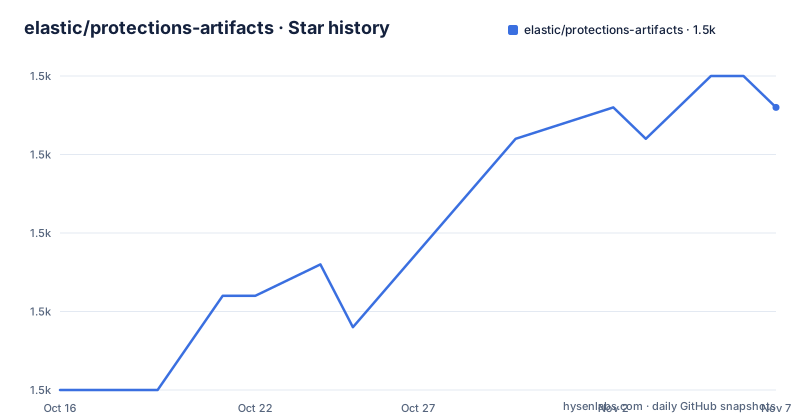
Star history
- elastic/protections-artifacts1,509 ★ · +9
| Repository | 2026-10-16 | 2026-11-07 |
|---|---|---|
| elastic/protections-artifacts | 1.5k | 1.5k |
9 Stars in the last 22 days, measured from the daily GitHub snapshot. Compare with other projects
Editorial analysis
Published Elastic Endpoint Protection Logic
elastic/protections-artifacts addresses a narrow but important part of endpoint security: the published detection content behind Elastic Security for Endpoint. The README says this is the home for detection logic, including rules and YARA content, for that product. It is aimed at people who want to inspect Elastic's malware and ransomware protections, understand the types of artifacts distributed there, or follow changes to the generated detection set. The repository does not present itself as a complete endpoint agent or as an alternative deployment for the Elastic Security product.
The contents are divided by detection approach. The `behavior/` directory contains EQL based malicious behavior rules. The `yara/` directory contains YARA rules for malware protection. The `ransomware/` directory holds an Elastic ransomware protection artifact. This separation gives reviewers a useful model of the repository: behavioral detections, file or malware-oriented YARA content, and ransomware protection are not stored as one undifferentiated collection.
The repository is not archived. Its last push was on 2026-10-12. That supports describing it as recently pushed, but it does not establish a release cadence because GitHub releases are not present. More importantly, the README says the repository is automatically generated and that pull requests are not accepted at present. Its usefulness therefore comes from transparent inspection of Elastic's artifacts rather than from a conventional community contribution workflow.
EQL, YARA, and Ransomware Artifact Boundaries
The directory structure reveals that the artifacts answer different detection questions. EQL rules in `behavior/` are based on Elasticsearch Query Language and are described as malicious behavior rules. That places this content in the event and behavior analysis side of Elastic Security Endpoint. The README does not document individual rule fields, event sources, schedules, or exclusions, so those details must be checked in the files and applicable artifact documentation rather than inferred from the directory name.
The `yara/` directory has a different stated purpose: YARA rules for malware protection. The repository's primary language is YARA, but that does not mean every artifact in the project is YARA content. The EQL rules and ransomware artifact sit alongside it. Any review process should identify the artifact type before choosing an appropriate parser, validator, or test method.
The ransomware directory contains an Elastic ransomware protection artifact. The README does not explain its internal format, update mechanism, operating-system coverage, or relationship to the separate YARA collection. It would therefore be inaccurate to describe this repository as a ransomware engine. The defensible interpretation is narrower: Elastic publishes ransomware-related artifact content here for inspection, while the product-specific mechanics remain outside the README.
This division is useful when tracking security coverage, but it also limits what the repository can answer on its own. It does not document the full endpoint lifecycle, agent installation, response actions, detection loading, quarantine behavior, or platform support. Those are product concerns, not facts established by this repository.
Reading the Generated Repository Without Treating It as Software
The README does not provide installation commands, package names, environment variables, configuration files, or a runnable entry point. As a result, there is no documented installation tutorial for turning this repository into a local endpoint scanner. The repository says it contains artifacts for Elastic Security Endpoint, and it does not say that cloning it enables a standalone deployment. A user should begin by locating the relevant artifact directory and reading that artifact's README, because the top-level README directs contributors and reviewers to the applicable artifact documentation.
There is also no documented first-run command that can be copied without invention. The honest first-use procedure is therefore a repository inspection rather than a launch procedure: determine whether the content you need is an EQL rule, a YARA rule, or a ransomware artifact, open the matching directory, and read its README before evaluating individual files. If the goal is to run protections on endpoints, the README points to Elastic Security for Endpoint as the product with which these artifacts are associated.
This distinction matters for security engineering. Detection logic has a different adoption path from an agent binary. It may need product-specific fields, event context, metadata, packaging behavior, or compatibility guarantees that are not presented in the top-level README. The repository layout is sufficient for finding the content, but it is not a complete specification for reproducing Elastic's runtime detection behavior.
Issue Reporting Instead of Direct Repository Changes
The contribution model is unusually strict, and prospective contributors need to notice it before planning an integration workflow. The README says feedback and contributions can be submitted through an issue using one of the provided templates. It also says that pull requests cannot be accepted because the repository is automatically generated. That means the repository is not positioned as a normal path for submitting a modified rule through a merge request.
This design affects maintenance cost for downstream users. Changes are generated, so copying a rule into a local fork does not create an upstream contribution path, and assuming that a pull request can carry a proposed correction would conflict with the documented process. The available route described by the project is an issue report. The top-level entries include `.github/`, which is consistent with issue templates and repository automation, but the README does not document the generation pipeline itself.
The repository was not archived, and the last push was on 2026-10-12. However, there are no GitHub releases, so repository consumers cannot use release tags or release notes from this project to identify a published artifact version. Consumers who need reproducible rule revisions should preserve their own commit references and review repository changes through Git rather than assuming a packaged release exists.
Elastic License 2.0 Constraints for Artifact Review
The repository is covered by a custom license classification on GitHub, but its README identifies the applicable terms as the Elastic License 2.0. It says that Elasticsearch B.V. or contributors license the artifacts under one or more contributor license agreements, and that users may not use the artifacts except under the Elastic License 2.0. Contributors must sign a Contributor License Agreement before contributing code to any Elastic repository.
That wording matters when an engineer considers copying rules into an internal detection system or redistributing modified versions. The repository permits review and use only within the stated license terms. This article does not interpret those terms or provide legal advice. The authoritative files for an adoption decision are `LICENSE.txt` and the licensing statements in `README.md`, rather than GitHub's broad "Other" category.
There is also a distinction between accepting contributions and accepting outside pull requests. The README documents a CLA requirement for contributors, yet it separately says this generated repository cannot accept pull requests at present. Users reviewing the content should therefore keep two questions separate: whether a proposed artifact would be covered by the contributor terms, and whether the repository offers a channel for that proposal. The documented answer to the second question is an issue template rather than a pull request.
Why This Repository Is Not a Standalone Scanner
The clearest limitation is the boundary between detection content and endpoint runtime. elastic/protections-artifacts publishes rules and related artifacts, but the README does not claim that the repository can scan files, monitor processes, block ransomware, quarantine endpoints, or send alerts. Those operations would require a product or test environment whose behavior is not specified here.
A real alternative is to use Elastic Security for Endpoint as the consuming product rather than attempting to treat the repository as an independent scanner. The difference is architectural. The product is identified as the environment for which these protections artifacts are intended, while this repository supplies or exposes detection logic. Using the product preserves the connection between the artifacts and its endpoint protection scope. Using only the repository may support inspection, but it does not by itself establish runtime coverage.
The repository is also the wrong tool for teams seeking a conventional open source workflow with accepted pull requests. Issues are available for feedback and suggestions, but pull requests are explicitly unavailable. Teams that need to maintain local YARA or EQL content should treat repository copies as references and preserve their own validation process. Nothing in the README promises compatibility with third-party scanners, command-line YARA execution, or another EQL-compatible product.
Editorial conclusion
Adopt or track this repository if you operate Elastic Security Endpoint and need visibility into its published detection artifacts. Do not treat it as a standalone scanner, an installation package, or a place for direct pull requests. Review LICENSE.txt, inspect the artifact-specific README files, and confirm how Elastic Security consumes a given rule before building local checks around it.
Frequently asked questions
What does elastic/protections-artifacts contain?
It contains Elastic detection artifacts for Elastic Security Endpoint: EQL based malicious behavior rules, YARA rules for malware protection, and a ransomware protection artifact.
Can I install elastic/protections-artifacts as a standalone scanner?
The README does not document an installation process or standalone runtime. It presents the repository as detection content for Elastic Security Endpoint.
Can I submit a pull request to elastic/protections-artifacts?
No. The README says pull requests cannot be accepted because the repository is automatically generated. It directs feedback and suggestions to an issue template.
Which license applies to elastic/protections-artifacts?
The README identifies the Elastic License 2.0 and points contributors to the Contributor License Agreement. It also references `LICENSE.txt`.
Official sources
Add this badge to your README
If you maintain this project, the badge below links readers to this analysis and shows its maintenance status from the daily GitHub snapshot. Paste the markdown into your README; add ?metric=license or ?metric=stars to the image URL for a different field.

[](https://hysenlabs.com/projects/elastic-protections-artifacts)Star history chart for your README
[](https://hysenlabs.com/projects/elastic-protections-artifacts)Was this useful?