esbuild: a Go bundler for JavaScript, CSS and TypeScript, kept buildable on Go 1.13 on purpose
GitHub describes it as An extremely fast bundler for the web. The repository metadata lists Go as its primary language. The metadata lists the MIT license. This article stays within the project description and details documented in the GitHub repository README.
At a glance
- What is it?
- evanw/esbuild is an MIT-licensed web bundler written in Go with CLI, JavaScript and Go APIs. Its speed claim is the headline, but the repository's go.mod pin to Go 1.13, its reproducible-build Makefile and its split between quick and release test suites say more about how it is run.
- Who is it for?
- esbuild fits projects that bundle JavaScript, CSS, TypeScript and JSX, want tree shaking, minification and source maps from one tool, and value a fast build that does not depend on a cache. It is a poorer fit if your build relies on file types outside its built-in content types and you are not prepared to write plugins.
- Can I use it commercially?
- Yes. MIT is a permissive licence: you can use, modify and sell software built on it, as long as you keep its copyright and licence notices.
- Is it still maintained?
- Yes. The repository last received commits 98 days ago.
- What is it written in?
- Mainly Go, according to GitHub's language statistics.
Answers come from the project's GitHub data, last synced on November 15, 2026, and from our analysis. They are not legal advice.
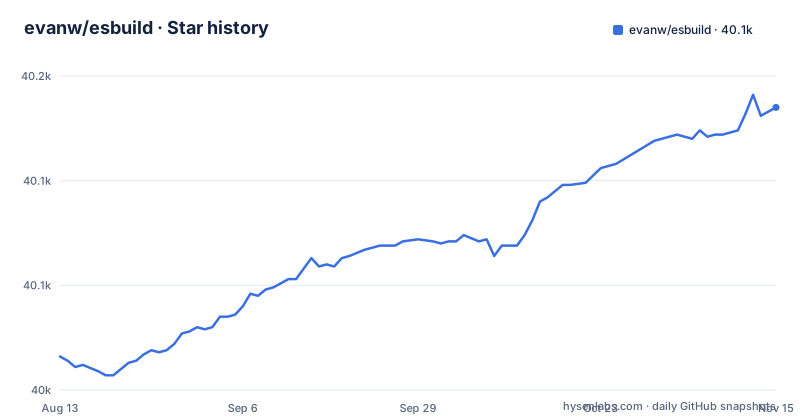
Star history
- evanw/esbuild40,135 ★ · +119
| Repository | 2026-08-13 | 2026-11-15 |
|---|---|---|
| evanw/esbuild | 40k | 40.1k |
119 Stars in the last 94 days, measured from the daily GitHub snapshot. Compare with other projects
Editorial analysis
Speed without a cache is the design goal, and the benchmark is the project's own
esbuild exists because, in the project's words, current build tools for the web are 10-100x slower than they could be. Its stated goal is a new era of build tool performance plus an easy-to-use modern bundler. The first feature it lists is extreme speed without needing a cache. That distinction matters in practice: tools that are fast only on a warm cache can be slow on a clean CI runner or after a dependency change, while esbuild's speed claim is about the cold build. Treat the 10-100x figure as the maintainers' benchmark rather than a promise for your codebase. The benchmark chart in the repository's images/ folder is theirs, and the only way to know what it means for your project is to time a build of your own code.
One Go engine behind CLI, JavaScript and Go APIs
esbuild offers a single API surface in three forms: a command line tool, a JavaScript API and a Go API. The Go module path is github.com/evanw/esbuild, and the repository layout follows that split. cmd/ holds the command line entry point, pkg/ and internal/ hold the Go code the binary is built from, and lib/ and npm/ sit alongside them for the JavaScript side. The Makefile's esbuild target rebuilds whenever files under cmd/esbuild, pkg/*/ or internal/*/ change, or when go.mod does. For Go programs this means esbuild can be called in process rather than shelled out to. For JavaScript users the same engine runs behind the npm-facing code, so option names and behaviour follow the API documentation at esbuild.github.io/api rather than separate per-language manuals.
go.mod is frozen at Go 1.13, and golang.org/x/sys cannot be upgraded
The go.mod file declares go 1.13 and carries a comment explaining that this is deliberate, so people can build esbuild themselves for old OS versions, and asking contributors not to change it. The single dependency is pinned as well:
require golang.org/x/sys v0.0.0-20220715151400-c0bba94af5f8The comment above it says this dependency cannot be upgraded or esbuild would no longer compile with Go 1.13, and points to esbuild.github.io/faq/#old-go-version for the reasoning. The consequence for teams that run dependency scanners: that x/sys version from 2022 will keep showing up as old, and a pull request that bumps it will be refused. If your policy requires current x/sys, you would have to maintain a fork, which gives up the old-OS build support the pin exists to protect.
Release builds pin a Go version and strip build paths for reproducibility
The Makefile reads the esbuild version from version.txt and the Go version from go.version, and its check-go-version target fails with Please install Go version followed by that number if your installed toolchain differs. Builds run with CGO_ENABLED=0, and two flag lines aim at reproducible output:
GO_FLAGS += "-ldflags=-s -w -buildid=" -buildvcs=false
GO_FLAGS += -trimpath
The first strips debug info and clears the build id, the second keeps the build path out of the executable. For anyone verifying a release binary, this is the part that counts: the same source, Go version and flags are meant to produce the same output. The trade-off is that stripped binaries carry no debug symbols, so crash investigation on a release build has less to work with than a local debug build would.
make test skips the slow suites that a release has to pass
Running make test executes test-common with six parallel jobs: test-go, vet-go, no-filepath, verify-source-map, end-to-end-tests, js-api-tests, plugin-tests, register-test, node-unref-tests and decorator-tests. The Makefile labels these as the tests for development. A release uses test-all, which adds ts-type-tests, test-wasm-node, test-wasm-browser, lib-typecheck and test-yarnpnp, left out of the default target because they are slow. A contributor whose change passes make test has therefore not yet exercised the WebAssembly builds in Node and the browser, the TypeScript type definitions or Yarn Plug'n'Play. The Makefile also warns against adding -race by default, because the Go race detector only works on a short list of OS and CPU combinations and not necessarily on older OS versions such as macOS 10.9.
Built-in content types stop at JavaScript, CSS, TypeScript and JSX
Out of the box esbuild handles JavaScript, CSS, TypeScript and JSX, bundles both ESM and CommonJS modules, and bundles CSS including CSS modules. On top of that come tree shaking, minification and source maps, plus a local server, watch mode and plugins. That list is also the boundary. If your project imports file types beyond those built-in content types, the work moves to the plugin API documented at esbuild.github.io/plugins, and you own that plugin code. Check the content types page on esbuild.github.io against every kind of file your build imports before you switch, because finding a gap after migrating means writing or sourcing a plugin under deadline pressure.
Still a 0.x project, so read CHANGELOG.md before each upgrade
The three most recent releases are v0.28.0 on 2026-04-02, v0.28.1 on 2026-06-11 and v0.28.2 on 2026-08-08, and the last push to the repository was on 2026-08-09. The version number has not reached 1.0. The repository keeps its history split by year, with CHANGELOG-2020.md through CHANGELOG-2025.md beside the current CHANGELOG.md, so the notes for recent releases are in CHANGELOG.md and older behaviour changes are in the dated files. Pin an exact esbuild version in your project and read the changelog entries between your version and the target before upgrading. Install steps are not printed on the GitHub page; the getting started guide at esbuild.github.io/getting-started covers them.
Editorial conclusion
esbuild fits projects that bundle JavaScript, CSS, TypeScript and JSX, want tree shaking, minification and source maps from one tool, and value a fast build that does not depend on a cache. It is a poorer fit if your build relies on file types outside its built-in content types and you are not prepared to write plugins. Before adopting or upgrading, read CHANGELOG.md for the 0.28.x release you are moving to, and if you build from source or scan dependencies, expect the deliberately old golang.org/x/sys pin in go.mod.
Frequently asked questions
Does esbuild do tree shaking?
Yes. esbuild lists tree shaking among its built-in features, together with minification and source maps.
What is esbuild written in?
esbuild is written in Go. Its go.mod declares the module github.com/evanw/esbuild and deliberately targets Go 1.13 so people can build it for old OS versions.
What is esbuild used for?
esbuild bundles JavaScript, CSS, TypeScript and JSX for the web, handling ESM and CommonJS modules and CSS modules. It also provides minification, source maps, a local server, watch mode and plugins.
How do I install esbuild?
esbuild points new users to the getting started instructions at esbuild.github.io/getting-started. Building from source uses the repository's Makefile, which compiles ./cmd/esbuild with Go.
Official sources
Add this badge to your README
If you maintain this project, the badge below links readers to this analysis and shows its maintenance status from the daily GitHub snapshot. Paste the markdown into your README; add ?metric=license or ?metric=stars to the image URL for a different field.

[](https://hysenlabs.com/projects/evanw-esbuild)Star history chart for your README
[](https://hysenlabs.com/projects/evanw-esbuild)Was this useful?