EverOS: A Markdown-First Memory Layer for AI Agents
One portable memory layer for every AI agent: local-first, Markdown-native, user-owned, and self-evolving across apps, tools, and workflows.
At a glance
- What is it?
- EverOS stores agent memories as editable Markdown files and syncs local SQLite and LanceDB indexes for retrieval. This review covers its architecture, setup, and where its local-first approach fits or falls short.
- Who is it for?
- Adopt EverOS if you want an agent memory system that is human-readable and versionable, and if you can live with its local-first stack and the need for an OpenRouter or other OpenAI-compatible LLM endpoint. Skip it if you need managed cloud storage or if your agents run in environments that cannot run a local server process.
- Can I use it commercially?
- Yes. Apache-2.0 is a permissive licence: you can use, modify and sell software built on it, as long as you keep its copyright and licence notices.
- Is it still maintained?
- Yes. The repository last received commits 1 day ago.
- What is it written in?
- Mainly Python, according to GitHub's language statistics.
Answers come from the project's GitHub data, last synced on November 15, 2026, and from our analysis. They are not legal advice.
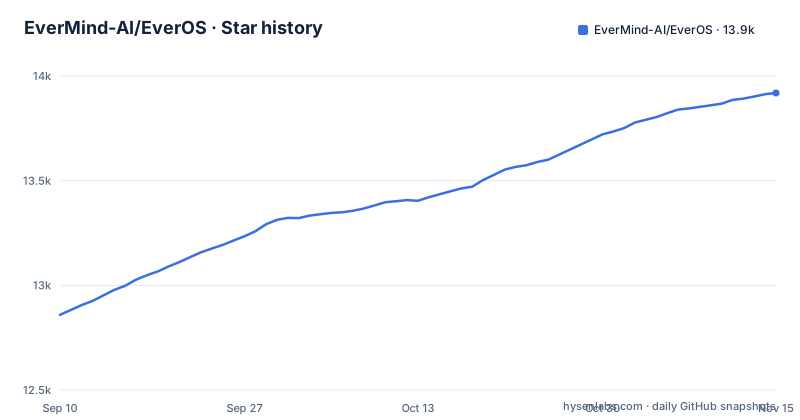
Star history
- EverMind-AI/EverOS13,919 ★ · +1,060
| Repository | 2026-09-10 | 2026-11-15 |
|---|---|---|
| EverMind-AI/EverOS | 12.9k | 13.9k |
1,060 Stars in the last 66 days, measured from the daily GitHub snapshot. Compare with other projects
Editorial analysis
Why a Portable Memory Layer Matters
AI agents often lack continuity between sessions. Each conversation starts fresh, and past decisions or user preferences are lost. EverOS addresses this by providing a single memory layer that works across coding assistants, apps, and workflows. The target user is a developer or maker who builds agents and wants them to remember facts, conversations, and trajectories in a way that is not locked into a single vendor's API. The README emphasizes that memory should be user-owned and editable. That is a specific stance: instead of treating memory as an opaque database, EverOS makes it a set of Markdown files you can open in any text editor.
The Markdown-First Architecture
The core idea is that Markdown files are the canonical source of truth. Conversations, files, and agent trajectories are stored as readable .md files. These files are diffable and can be versioned with Git. A cascade watcher monitors the files and syncs them into local SQLite and LanceDB indexes. This gives you fast retrieval while keeping the source material human-readable. The README contrasts this with other agent memory libraries that rely on API state, vector databases, or dashboard-backed storage. Direct file editing is a first-class operation: you can edit a .md file and the watcher picks up the change. This design is refreshing because it avoids vendor lock-in and makes debugging easier. You can inspect exactly what the agent remembers by reading a file.
Separating User and Agent Tracks
EverOS distinguishes between user memory and agent memory. User data lives in episodes and profiles, while agent knowledge is stored in cases and skills. This separation is more than organizational. It reflects a real difference in how memory is used. A profile might hold a user's preferences, while a skill encapsulates a procedure the agent has learned. The README claims this is a first-class surface, unlike other libraries that focus only on chat history or facts. Retrieval is orthogonal: you can search by user_id, agent_id, app_id, project_id, or session_id. That flexibility is useful when you run multiple agents or apps against the same memory store. You can isolate one agent's cases from another's, or pull up all sessions for a single user.
Getting Started: Commands and Configuration
Installation is straightforward. The README shows uv pip install everos or pip install everos. A standalone demo runs with everos demo and requires no API key. That demo lets you enter a fact and then ask a question to see the ingest, extract, index, and recall pipeline. For a full setup, you run everos init. This creates configuration files at ~/.everos/everos.toml and ~/.everos/ome.toml. The generated config includes a model and base URL for OpenRouter. You only need to replace the empty api_key. The README gives an example with model = "openai/gpt-4.1-mini" and base_url = "https://openrouter.ai/api/v1". After that, everos server start launches the server. You can check health with curl http://127.0.0.1:8000/health and look for "status":"ok". The setup is minimal, but it assumes you have an OpenRouter key for LLM-dependent features.
The Two-Tier Storage Trade-off
EverOS uses both SQLite and LanceDB. The README calls this a local three-part stack: Markdown plus SQLite plus LanceDB. It avoids heavy dependencies like MongoDB or Redis. That is a benefit for local-first deployments. But it also means you run two index systems. The pyproject comments describe LanceDB as providing vector, BM25 and scalar-filter search. The README notes that embeddings and rerank are false until you configure them. So the default experience is keyword search only. That is a limitation if you need semantic retrieval out of the box. You must decide whether the added complexity of LanceDB is justified by your retrieval needs.
Reflection and Self-Evolving Memory
A distinctive feature is offline reflection. The README describes it as memory evolution that merges episode clusters and refines profiles and skills between sessions. The idea is that after many sessions, the system consolidates similar episodes and updates the user or agent models. This is more than retrieval-only memory. Most agent memory libraries just store and fetch. EverOS attempts to improve the memory content over time. Check the documentation for when reflection runs and how to trigger it.
Ecosystem Integrations and Built-In Raven
EverOS also integrates with agent platforms like DeepSeek Harness, Hermes, OpenClaw, and Dify. The README says it comes built into Raven, which appears to be another EverMind project. Each integration has a setup guide. This is a practical approach. You can use EverOS as a library in your own Python agents, or you can plug it into an existing platform. The integrations are listed with links to the plugins repository. That suggests the project is part of a broader ecosystem. If you already use one of those platforms, EverOS may offer a drop-in memory solution. If you use a platform not listed, you will need to build your own integration using the Python API.
Limitations and Wrong Use Cases
The main limitation is the local-first design. EverOS runs as a local server and stores files on your machine. That is wrong for teams that need shared memory across distributed agents. If you need memory that is accessible from multiple machines or by multiple users, you would have to build that yourself. The defaults target OpenRouter, but the configuration template says any OpenAI-API-compatible endpoint plugs in via base_url, naming OpenAI, vLLM and Ollama (OpenAI bridge). Also, the cascade watcher is a background process. If it fails or misses a file edit, your indexes may become stale. Check the documentation for how recovery from such events is handled.
Alternatives and Comparison
The README compares EverOS with other agent memory libraries, which it says usually keep state in an API, vector, graph, dashboard or database rather than Markdown, and often depend on managed services or server stacks. The key difference is that EverOS treats memory as a human-readable artifact that you can edit and version. Alternatives treat memory as a black box that you interact with via API. If you value inspectability and Git versioning, EverOS stands out. If you only need fast semantic retrieval, a direct vector store may be simpler.
Maintenance and License Implications
EverOS is licensed under Apache-2.0. That is permissive, allowing commercial use and modification. You can fork it and integrate it into proprietary products, as long as you preserve the license notice. There is no copyleft obligation. The project is under active development, with releases v1.5.0 on 2026-10-21 and v1.5.1 on 2026-10-22. That suggests a fast release cadence. The README notes that the older /api/v1 prefix is a legacy alias that may be removed in a future major release. The documentation site is separate, so you will need to track changes there. The two-index architecture means ongoing maintenance. You must keep the server running and the watcher healthy. The project is not archived, which is a good sign, but you should verify that the maintainers respond to issues in a timely manner.
Editorial conclusion
Adopt EverOS if you want an agent memory system that is human-readable and versionable, and if you can live with its local-first stack and the need for an OpenRouter or other OpenAI-compatible LLM endpoint. Skip it if you need managed cloud storage or if your agents run in environments that cannot run a local server process. Before adopting, verify that the cascade watcher reliably syncs your Markdown edits in your workflow, and test whether the keyword search meets your retrieval needs without embeddings. The project's active release schedule and Apache-2.0 license are positive signals, but you must assess whether the two-tier setup (SQLite plus LanceDB) adds operational complexity you are willing to maintain.
Frequently asked questions
What does EverOS store, and where does it live?
It stores conversations, files and agent trajectories as readable Markdown files, which are the canonical state, and syncs local SQLite and LanceDB indexes from them for retrieval. No MongoDB, Elasticsearch or Redis is required, and the project states the stack runs locally.
Do I need an API key to try EverOS?
Not for the standalone demo, which runs with no key and no server setup. Writing durable memories through the documented path needs one OpenRouter API key placed in the api_key field of ~/.everos/everos.toml.
Which Python versions does EverOS support?
The package metadata requires Python >=3.12, and the classifiers list 3.12 and 3.13 only, so 3.14 is outside the declared support surface even though the floor would admit it.
Which agent platforms can use EverOS?
Setup guides exist for DeepSeek Harness, Hermes, OpenClaw and Dify, and EverOS comes built into Raven. Each integration links to its own setup guide rather than a single shared configuration.
Can EverOS point at a local model instead of OpenRouter?
The configuration template states that any OpenAI-API-compatible endpoint plugs in through base_url, and names OpenAI, vLLM and Ollama through its OpenAI bridge as alternatives to the OpenRouter default. The same template carries a separate model, key and base_url for multimodal parsing.
Official sources
Add this badge to your README
If you maintain this project, the badge below links readers to this analysis and shows its maintenance status from the daily GitHub snapshot. Paste the markdown into your README; add ?metric=license or ?metric=stars to the image URL for a different field.

[](https://hysenlabs.com/projects/evermind-ai-everos)Star history chart for your README
[](https://hysenlabs.com/projects/evermind-ai-everos)Was this useful?