social-science-paper-writing-skill: a Codex skill that audits papers for research questions and citation risk
social-science-paper-writing is a Codex/ChatGPT skill for writing social-science papers: it helps diagnose topic selection, refine research questions, build outlines, plan literature reviews, manage a CNKI/Google Scholar-to-Zotero workflow, review drafts, revise chapters, and check citation and evidence risks before submission. The goal is not to polish prose into something that merely sounds academic, but to help authors write testable, well-argued research where evidence matches method.
At a glance
- What is it?
- social-science-paper-writing-skill is a Codex and ChatGPT skill for social science papers. It routes a request into one of nine modes covering topic diagnosis, research question refinement, literature review, draft review and citation safety, and returns labelled findings instead of prose commentary.
- Who is it for?
- Use social-science-paper-writing-skill if your weak point is the research question, the method matching or the citation chain rather than the prose. Do not use it as a way to produce a paper you have not researched, because the missing-information rule blocks invented sources but cannot supply the reading.
- Can I use it commercially?
- Not without permission. GitHub finds no licence file in the repository, and without a licence all rights are reserved by default: you may read the code but not reuse it. Check the README, or ask the authors, before using it.
- Is it still maintained?
- Yes. The repository last received commits 143 days ago.
- What is it written in?
- GitHub does not report a main language for this repository.
Answers come from the project's GitHub data, last synced on October 20, 2026, and from our analysis. They are not legal advice.
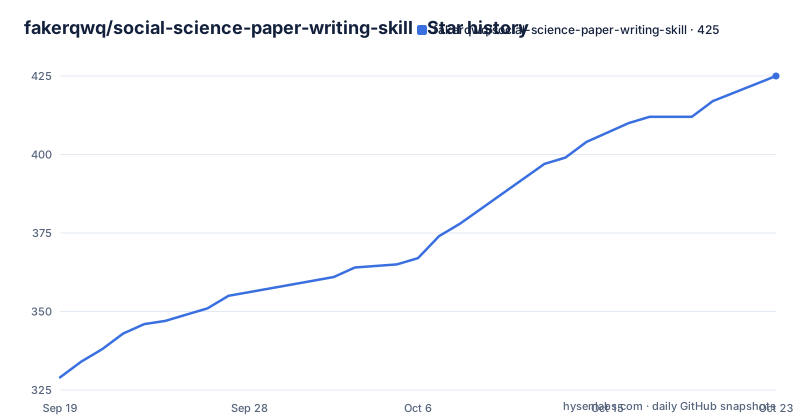
Star history
- fakerqwq/social-science-paper-writing-skill417 ★ · +88
| Repository | 2026-09-19 | 2026-10-20 |
|---|---|---|
| fakerqwq/social-science-paper-writing-skill | 329 | 417 |
88 Stars in the last 31 days, measured from the daily GitHub snapshot. Compare with other projects
Editorial analysis
What it does instead of polishing prose
The README draws the line itself. This is not a tool that makes text read more like a paper. It is a workflow built around the research question, the evidence, the method, the structure and citation safety, and it covers topic diagnosis, research question refinement, outline building, literature review planning, the path from CNKI and Google Scholar searches into Zotero, draft review, section revision, citation and evidence checking, and the pre-submission check.
The stated audience is social science students and researchers writing course papers, proposal reports, theses or journal articles. The pains it names are specific: topics that are still a broad theme rather than a question, literature reviews that read as author A said then author B said, methods where data, variables, samples and case boundaries stay fuzzy, and claims whose citations or causal wording will not survive scrutiny.
Nine operating modes and what each returns
Every request is routed to a mode, and each mode has a declared output.
topic_diagnosis judges whether a topic has research value, feasibility and an evidence base, returning a score, problem labels and two to four redirection options. research_question_refinement turns a broad theme into questions that are researchable, verifiable and writable, stating the data and method each one needs. outline_building builds or repairs the structure from title to conclusion and flags structure drift. literature_review_planning plans search scope, clustering logic and the gap. literature_search_to_review walks from CNKI and Google Scholar through screening and Zotero import to a written review, producing a search log, structured notes, a review matrix and a draft.
draft_review diagnoses argument, structure, literature, theory, method and evidence, and returns a full report with a Pass, Partial or Fail table and prioritized fixes. section_revision rewrites a section without inventing evidence and records what is still missing. citation_and_evidence_check produces a claim-risk table with safe rewrites. pre_submission_check separates blocking problems from cosmetic ones and gives a submit or revise-before-submit judgement.
Problem consciousness comes first
The first design principle is that the skill checks whether a paper answers a real research question rather than introducing a topic. It has four labels for failing that test: Topic Summary for work that only surveys a theme, Weak Problem Consciousness for a problem that is vague, arrives too late or does not matter, Research Question Missing, and Research Question Too Broad for a question larger than the length, data or method can carry.
The literature review rule follows from it. A review is supposed to be an academic dialogue rather than a list of authors, and the skill asks for clustering by controversy or theoretical school, core concept, variables or mechanisms, method type, case or region or period, and the relationship between the research gap and the question being asked.
The matching principle is the third one: whether the method fits the question, whether data, samples, cases, corpora and time ranges are stated, whether concepts have been operationalized into variables, indicators, coding categories or interpretive procedures, whether the analysis matches the variable levels, and whether the conclusion runs past what the evidence and design support.
Citation safety and the source-status ladder
The skill forbids fabricating literature, data, page numbers, DOIs, sample sizes, interviews, statistical results or legal documents, and it sorts problems into four labels. Evidence Gap marks a claim with no support. Citation Risk marks a citation that is missing, unverifiable, second-hand or mismatched with the claim. Quotation Risk marks a direct quotation without source text, quotation marks or a page number. Causal Overclaim marks causal language that exceeds what the design supports.
The source-status ladder is worth adopting even if you never install the skill. During search and Zotero work, a source is marked as candidate source, metadata only, abstract only, full text read, in Zotero, or imported to Zotero. That distinction exists to stop the common failure of treating a Zotero record as proof that the paper was read.
Installing it and running a first diagnosis
Install is a clone into your agent skills directory:
mkdir -p ~/.agents/skills
git clone https://github.com/fakerqwq/social-science-paper-writing-skill.git ~/.agents/skills/social-science-paper-writing
Then invoke it in Codex or ChatGPT:
请使用 social-science-paper-writing skill,帮我诊断这个选题是否适合写一篇社会科学课程论文:

题目:短视频平台对大学生政治参与的影响

要求:指出问题意识、研究对象、可行性、证据风险,并给出 3 个更聚焦的选题方向。
The README gives four more prompt shapes, covering research question refinement, literature review planning, full-draft review and citation checking. The citation one states explicitly that the skill must not fabricate sources and should offer safe wording when evidence is thin.
What it will not do for you
The disclaimer is short and worth repeating. The skill assists writing, diagnosis and revision, and it does not replace reading the literature, collecting data, method training, supervisor judgement or academic integrity decisions. The user is expected to verify every source, data point, quotation, page number, statistic and empirical material.
That constraint shapes the design rather than sitting in a footer. The flow diagram routes every mode through a missing-information rule that forbids inventing titles, data, literature, page numbers and conclusions, so a thin brief produces questions and risk labels rather than confident filler.
How it differs from a general writing assistant, and what to check first
A general assistant asked to review a paper usually produces fluent commentary about argument and structure. This skill trades that for a fixed vocabulary of failure: Topic Summary, Weak Problem Consciousness, Evidence Gap, Citation Risk, Quotation Risk, Causal Overclaim and Structure Drift, each attached to a mode with a declared output. The cost is that you get labelled findings and a Pass, Partial or Fail table instead of an essay about your essay.
The repository is small. It holds a README, SKILL.md, checklist.md, citation_rules.md, methodology_rubric.md, paper_structure.md, revision_workflow.md, self-test.md, two asset templates, three worked examples including a good outline and a weak one, and seven reference documents covering citation safety, data collection, data analysis, key principles, the review rubric, the Zotero workflow and research design. The last push was on 2026-06-02, and the repository declares no licence, so check that before redistributing any of it.
Editorial conclusion
Use social-science-paper-writing-skill if your weak point is the research question, the method matching or the citation chain rather than the prose. Do not use it as a way to produce a paper you have not researched, because the missing-information rule blocks invented sources but cannot supply the reading. Start with topic_diagnosis on your current title, and if it comes back Topic Summary or Research Question Too Broad, fix the question before writing another paragraph.
Frequently asked questions
What is writing in social science?
In this skill terms it means answering a research question with a matched method, stated data and evidence, and verifiable citations. It is not a topic summary, and the skill labels Topic Summary, Weak Problem Consciousness, Research Question Missing and Research Question Too Broad.
How do I install social-science-paper-writing-skill?
Create ~/.agents/skills, clone the repository into ~/.agents/skills/social-science-paper-writing, then invoke the skill by name in Codex or ChatGPT.
Will it write citations for me?
No. It forbids fabricating literature, data, page numbers, DOIs and statistics. Instead it labels problems as Evidence Gap, Citation Risk, Quotation Risk or Causal Overclaim and suggests safe rewording.
Does it work with Zotero?
Yes, through the literature_search_to_review mode, which covers searching CNKI and Google Scholar, screening, importing to Zotero and drafting the review. It tracks whether a source is metadata only, abstract only or full text read.
Official sources
Add this badge to your README
If you maintain this project, the badge below links readers to this analysis and shows its maintenance status from the daily GitHub snapshot. Paste the markdown into your README; add ?metric=license or ?metric=stars to the image URL for a different field.

[](https://hysenlabs.com/projects/fakerqwq-social-science-paper-writing-skill)Star history chart for your README
[](https://hysenlabs.com/projects/fakerqwq-social-science-paper-writing-skill)Was this useful?