MAgent2 builds gridworlds with far too many agents in them
An engine for high performance multi-agent environments with very large numbers of agents, along with a set of reference environments
At a glance
- What is it?
- MAgent2 is a Farama Foundation library for multi-agent reinforcement learning environments where a very large number of pixel agents share a gridworld and fight over it, and it carries the reference environments that used to live inside PettingZoo. The engineering that is unusual is below the Python surface, where a setuptools build shells out to CMake to compile the simulation core.
- Who is it for?
- MAgent2 suits a reinforcement learning researcher who needs many agents interacting, since the reference environments are the ones that were the reason to build the engine, and it suits a team that wants its environments to follow the PettingZoo API so that the standard multi-agent tooling applies. It is a poor fit if you need a pure Python install on Windows, since the build needs CMake and the documentation says the project supports Linux and macOS.
- Can I use it commercially?
- Yes. MIT is a permissive licence: you can use, modify and sell software built on it, as long as you keep its copyright and licence notices.
- Is it still maintained?
- Yes. The repository last received commits 7 days ago.
- What is it written in?
- Mainly Python, according to GitHub's language statistics.
Answers come from the project's GitHub data, last synced on November 7, 2026, and from our analysis. They are not legal advice.
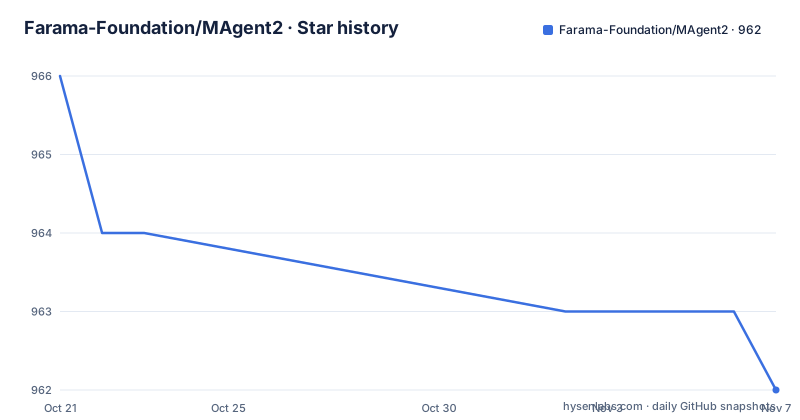
Star history
- Farama-Foundation/MAgent2962 ★ · -4
| Repository | 2026-10-21 | 2026-11-07 |
|---|---|---|
| Farama-Foundation/MAgent2 | 966 | 962 |
-4 Stars in the last 17 days, measured from the daily GitHub snapshot. Compare with other projects
Editorial analysis
Many pixel agents, one gridworld, competitive scenarios
The description is a library for the creation of environments where large numbers of pixel agents in a gridworld interact in battles or other competitive scenarios, and the project summary calls it an engine for high performance multi-agent environments with very large numbers of agents, along with a set of reference environments. The scale is the point. Most multi-agent reinforcement learning work is done with tens of agents, and the environments that exist for those cases are well served by what is already there. A study that wants hundreds or thousands of agents in one simulation needs a different kind of engine, one where the agents are not expensive objects with a Python object each, and that is the problem MAgent2 addresses. The reference environments implement scenarios you would recognise from the literature, adversarial pursuit among others, and they are the reason to look at the project even if your own scenario is different.
The fork, and the environments that moved out of PettingZoo
The history is explained in the readme and it is not just a rename. MAgent2 is a maintained fork of the original MAgent codebase, and it contains a set of reference environments implemented using the PettingZoo API. Those environments used to be included in PettingZoo itself, and they were moved out to exist independently here, with the reason stated plainly, that they are being regularly maintained and will receive bug fixes and support for new versions of Python. The naming history is explained too, because development used to take place at Farama-Foundation/MAgent and was moved to Farama-Foundation/MAgent2 so that the distinction from the original MAgent library is clear to users. So there are two things to keep apart when you read about this area, the original MAgent research platform from 2018 and the modern Farama-maintained engine, and the reference environments that now live with the latter. The citations section in the readme handles this too, giving the original conference paper and a separate citation for the repository with its modifications.
The build is CMake wearing a setuptools costume
The most interesting thing in the repository is the packaging, because the simulation core is not pure Python. The `setup.py` defines a `CMakeExtension` and a custom `build_ext` command, and the first thing that command does is check that CMake is present:
cmake .
make -j threads
move libmagent -> build/
Those three lines are the build process as the script documents it, and if CMake is missing the build stops with an error saying CMake must be installed to build the extensions, listing the names of the extensions that will be affected. The script then works out where the extension should land using the path setuptools computed for it, and passes CMake a build type, either Debug or Release, along with the library, runtime and archive output directories so the artefacts land where setuptools expects them. The version is not in the manifest either, it is read out of the `__version__` line in `magent2/__init__.py`, which is a pattern that keeps the package version and the source of truth in one place.
The Python side is small, and it is built on PettingZoo
The dependency list in the project metadata is three packages long, and they are the whole story. NumPy at 1.21 or newer for the array work, `pygame-ce` at 2.1.0 or newer for the rendering of the gridworld, and PettingZoo at 1.23.1 or newer for the multi-agent API. That last one is the strategically important dependency, because PettingZoo is the interface the reference environments are written against and the interface your own environments would be written against, which means the standard multi-agent tooling applies to an MAgent2 environment. The classifiers also describe the intended audience as science and research, the topic as artificial intelligence, and the development status as production stable. The formatting and import rules are configured in the same file, with isort on the black profile, an indent of four, and the source paths covering both the `magent2` package and the documentation scripts.
The Python floor is stated twice, and the two statements disagree
A small inconsistency in the documentation is worth a paragraph, because it is the kind of thing that costs somebody an afternoon. The requirements section of the readme says MAgent2 supports Linux and macOS and Python 3.8 and later. The project metadata says something different. It sets `requires-python` to 3.11 or newer and lists classifiers for Python 3.11, 3.12, 3.13 and 3.14, so the package you actually install from PyPI will refuse to install on 3.8, 3.9 or 3.10 even though the readme says 3.8 is supported. The classifiers also list Windows as a supported operating system, while the readme's requirements line names only Linux and macOS. Neither statement is fatal on its own, but a reader who trusts the readme and tries Python 3.9 will find the install fails, and the release history explains why, since the 0.3.3 release in 2024 was about Python 3.11 support and installation fixes.
Releases that exist to keep up with Python
The release list is short and each entry describes the point of it. Version 0.3.2 was published in January 2023, 0.3.3 in August 2024 and is described as Python 3.11 support and installation fixes, and 0.3.4 in May 2026 is described as Python 3.14 support. That is a project whose releases are, in effect, a compatibility ledger, which matches the readme's own claim that the environments are regularly maintained and will receive bug fixes and support for new versions of Python. The last push to the repository was on 2026-10-17, so the tree is well ahead of the last tagged release. The governance is Farama Foundation, with a named project manager, Travis Virgil, and the wider Farama team contributing maintenance. The repository carries a code of conduct, a pre-commit configuration, a Justfile, a `mise.toml` for tool versions and a `CMakeLists.txt` at the root, which is the shape of a project that expects a specific development environment.
Who it is for, and what it is not
It helps to say plainly what MAgent2 is and is not. It is not a reinforcement learning algorithm, and it is not a training framework, it is the environment layer, the part that decides where the agents are, what they can see and what happens when they collide. It is not a general purpose simulator either, the reference scenarios are competitive and grid based, and the design assumes that many agents move independently in a shared space. The engine is the part that scales, and the environments are the part that tells you whether the scaling is useful, which is why the fork moved the environments out of PettingZoo rather than leaving them there, since a reference environment that nobody maintains is worse than no reference environment at all. So the sensible way to evaluate it is to run one of the reference scenarios at a scale that makes your own scenario plausible, which is a measure of the engine and a template for your work at the same time.
Editorial conclusion
MAgent2 suits a reinforcement learning researcher who needs many agents interacting, since the reference environments are the ones that were the reason to build the engine, and it suits a team that wants its environments to follow the PettingZoo API so that the standard multi-agent tooling applies. It is a poor fit if you need a pure Python install on Windows, since the build needs CMake and the documentation says the project supports Linux and macOS. Before you adopt it, check three things: which Python you have, since the readme says 3.8 and later while the package metadata requires 3.11, that you can install CMake, because the setup script refuses to build without it, and whether you need the reference environments or only the engine, since the environments were the reason for the fork and the engine is the part that scales.
Frequently asked questions
What is MAgent2 used for?
It is a library for creating environments where large numbers of pixel agents in a gridworld interact in battles or other competitive scenarios, aimed at multi-agent reinforcement learning at a scale that most existing environments do not reach. It also ships a set of reference environments implemented against the PettingZoo API.
Why do the MAgent2 reference environments not live in PettingZoo?
They used to be included in PettingZoo, and they were moved to MAgent2 so that they exist independently and are regularly maintained with bug fixes and support for new Python versions. The fork was also renamed from Farama-Foundation/MAgent to MAgent2 to make the distinction from the original MAgent library clear.
Does installing MAgent2 need anything besides Python?
The simulation core is compiled, so CMake is required. The setup script checks for CMake and stops with an error saying it must be installed to build the extensions. The documented build process is running cmake, making with make and moving the libmagent output into the build directory.
Which Python versions does MAgent2 support?
The readme says Python 3.8 and later on Linux and macOS, while the package metadata requires Python 3.11 or newer and lists classifiers for 3.11 to 3.14. The release history tracks this, with 0.3.3 in 2024 about Python 3.11 support and 0.3.4 in May 2026 about Python 3.14 support.
What does MAgent2 depend on?
Three packages, numpy at 1.21 or newer, pygame-ce at 2.1.0 or newer for rendering, and pettingzoo at 1.23.1 or newer for the multi-agent API the reference environments are written against. The project is MIT licensed, developed by the Farama Foundation, with the last push to the repository on 2026-10-17.
Official sources
Add this badge to your README
If you maintain this project, the badge below links readers to this analysis and shows its maintenance status from the daily GitHub snapshot. Paste the markdown into your README; add ?metric=license or ?metric=stars to the image URL for a different field.

[](https://hysenlabs.com/projects/farama-foundation-magent2)Star history chart for your README
[](https://hysenlabs.com/projects/farama-foundation-magent2)Was this useful?