DAFTAR-API-LOKAL-INDONESIA: a curated index of Indonesian APIs and where its build pipeline fits
Berisi API tentang Data Indonesia ataupun API yang dibuat oleh developer Indonesia <3
At a glance
- What is it?
- This repository is not an API. It is a TypeScript-generated catalogue of Indonesian data APIs, grouped by category and rendered into README tables. Here is what it covers, how the generator runs, and where it stops being enough.
- Who is it for?
- Adopt this index if you are scoping an Indonesian product and need a starting map of prayer-time, news, finance or shipping APIs before you commit to any vendor. Do not adopt it as a runtime dependency, a data source, or a status monitor: the Status column is a table cell whose source is not documented, and the repository ships no client library.
- Can I use it commercially?
- Yes, with credit. CC-BY-4.0 allows commercial use as long as you credit the authors and indicate what you changed. It is written for creative content, so check how it applies to any code.
- Is it still maintained?
- Yes. The repository last received commits 23 days ago.
- What is it written in?
- Mainly TypeScript, according to GitHub's language statistics.
Answers come from the project's GitHub data, last synced on November 25, 2026, and from our analysis. They are not legal advice.
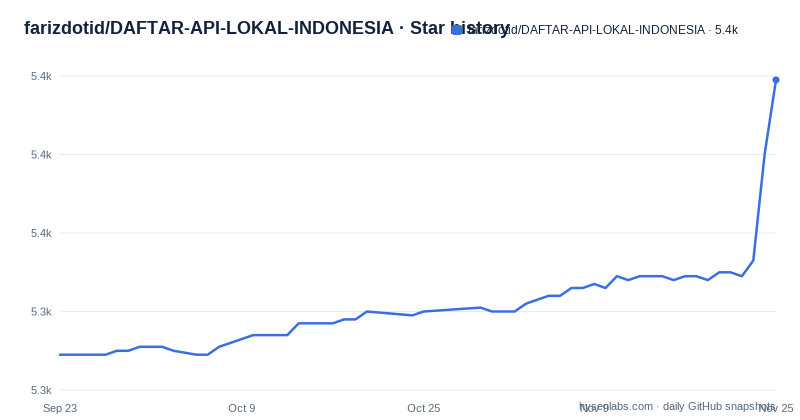
Star history
- farizdotid/DAFTAR-API-LOKAL-INDONESIA5,399 ★ · +70
| Repository | 2026-09-23 | 2026-11-25 |
|---|---|---|
| farizdotid/DAFTAR-API-LOKAL-INDONESIA | 5.3k | 5.4k |
70 Stars in the last 63 days, measured from the daily GitHub snapshot. Compare with other projects
Editorial analysis
What this repository actually is, and who should bookmark it
The name reads like an API, and that misreading costs people time. There is no endpoint at this repository. What exists is a list: the README states it is a collection of APIs about data and information in Indonesia, organised into categories such as Agama Islam, Berita, Buku, Cuaca, E-Commerce, Finansial, Kesehatan, Kripto, Lokasi, Pemerintahan, Pendidikan, Sosial Media and Utilitas. Each category is a table with columns for the API name, the developer, a documentation link, a status marker, a description and an authentication flag.
The audience is narrow and specific. An engineer building an Indonesian consumer app who needs a prayer-time feed, a news feed, or a shipping-rate lookup has to find those vendors one at a time through search engines. This index collapses that search into one page. It is also useful for a different reader: someone evaluating the Indonesian developer ecosystem itself, since the Pengembang column records who built each service and links to their GitHub profiles in several rows.
What it is not is a directory of first-party government services. The entries are a mix of personal projects, small team projects and commercial services, and the repository does not rank them. Rows inside a category are sorted alphabetically by API name, not by quality.
How the catalogue is generated: data files, a Bun build, and a Markdown README
The repository is a generator, not a static document. The top level contains a data/ directory, a src/ directory, index.html, package.json and tsconfig.json. The package.json declares "module": "src/builder.ts" and a script named start that runs "bun run src/build.ts". There is also a script named check that runs "bun run src/check.ts". The README carries HTML comment markers, <!-- API START --> and <!-- API END -->, around the generated table region, which is the shape you would expect from a build step that rewrites a bounded slice of the file rather than the whole document.
The dependency set is small and tooling-oriented: bun-types, commitizen, cz-conventional-changelog, husky, node-fetch and prettier as dev dependencies, with typescript ^5.0.0 as a peer dependency. Husky hooks run on pre-commit as "bun format && git add --all" and on prepare-commit-msg as "exec < /dev/tty && npx cz --hook || true". In practice that means a contributor edits structured data, the build regenerates the tables, Prettier normalises formatting, and the commit is routed through the commitizen prompt.
The practical consequence is that the README is an artefact. Editing the table by hand in a pull request fights the generator.
Running the generator locally and adding one entry
The repository uses Bun. The top level holds bun.lockb (alongside a package-lock.json), and the scripts invoke bun rather than npm, so install Bun first if you do not have it. Clone the repository, then install dependencies. The package.json defines a prepare script that runs "husky install", which fires automatically after the install step.
bun installAfter installation, the build script regenerates the README tables from the data directory. The script name is start, and it maps to src/build.ts.
bun run startThe check script maps to src/check.ts.
bun run checkFormatting is handled separately through Prettier, configured inline in package.json with printWidth 100, singleQuote true, semi false and trailingComma "es5". The format script rewrites the tree.
bun run formatA first real use is adding a category entry: place the record in the appropriate file under data/, run bun run start to regenerate the README section between the API markers, run bun run check, then bun run format. An existing entry in the same category is a working reference for the record format, and the README has a Cara Berkontribusi (how to contribute) section. Read CONTRIBUTING.md before you start, since the repository ships one.
The Status column is a claim, not a health check
Every row carries a Status cell, and in the README those cells render as a check mark. Do not read that as a guarantee that the API is up today: the package.json scripts are a build (src/build.ts) and a check (src/check.ts), and what the check verifies is not stated.
That produces the failure mode this kind of list always has. Third-party APIs retire, move domains, or start requiring a key. The Autentikasi column has the same character: it holds the string "false" for most rows and "API KEY" for at least one, and it is a table cell, not a validated contract. A vendor can change its auth model without the index changing at all.
The second limitation is scope by construction. The README describes the contents as APIs about Indonesian data or APIs built by Indonesian developers. That is a community boundary, not a coverage guarantee. If the service you need was built outside that community and serves Indonesian data, it will not appear. If it was built inside the community but serves something else, it may appear anyway. Treat the index as a starting map, and treat each documentation link as the only authority on that vendor's current behaviour.
Compared with a general free-API directory
The obvious alternative is a broad public API directory, the kind that aggregates free endpoints across every domain and country. Those directories are wider and shallower. They index thousands of services, and their coverage of Indonesian prayer times, Indonesian news RSS feeds, or Indonesian shipping carriers is incidental rather than the organising principle.
This repository inverts that. It is deep on one country and shallow everywhere else: there is nothing here about a payment API in another market, and nothing about a general-purpose utility service unless an Indonesian developer built it or it serves Indonesian data. The other structural difference is the pipeline. A general directory is typically a database behind a web application. This one is a Git repository whose output is a Markdown file, which means the correction path is a pull request, and the review path is a maintainer reading a diff. That is slower than a submission form and considerably more transparent, because every change to the list is a commit with an author attached.
Neither approach is strictly better. If you need one Indonesian prayer-time API today, this index gets you there faster. If you need to survey every free weather API on the planet, it will not help you at all.
Maintenance, licensing and the cost of keeping the list honest
The repository is not archived, and the last push was on 2026-11-02, which is recent enough that the list is being touched. The repository has no published GitHub releases, so there is no version history to reason about; the package.json carries no version field either, which fits a project that is consumed as a document rather than installed as a library.
The licence is CC-BY-4.0, recorded in LICENSE.md. For a data catalogue that is the sensible choice: it permits reuse and redistribution of the list itself provided attribution is given. It does not, and cannot, grant you anything with respect to the third-party APIs the list points at. Each entry is a link to someone else's service, governed by that service's own terms. Reusing the table in your own documentation is a licensing question about this repository; calling the listed endpoints is a separate relationship with each vendor. This is not legal advice, and the LICENSE.md file is the text that governs.
The upgrade cost is the interesting part. Because the output is generated, the maintenance burden is not editing tables. It is verifying that entries still resolve. Every dead link or changed auth requirement has to be caught by someone. A team that mirrors this list into internal documentation inherits that verification work permanently, and should budget for it rather than assume the upstream list stays current.
Editorial conclusion
Adopt this index if you are scoping an Indonesian product and need a starting map of prayer-time, news, finance or shipping APIs before you commit to any vendor. Do not adopt it as a runtime dependency, a data source, or a status monitor: the Status column is a table cell whose source is not documented, and the repository ships no client library. Before you build on any entry, open that entry's own documentation link and confirm its authentication mode, because the Autentikasi column is a string in a Markdown table rather than a validated field.
Frequently asked questions
What is DAFTAR-API-LOKAL-INDONESIA?
It is a repository that collects APIs about Indonesian data and APIs built by Indonesian developers, organised into categories such as Agama Islam, Berita, Finansial, Kesehatan and Lokasi. It is a list with documentation links, not an API you call.
How do I install and run DAFTAR-API-LOKAL-INDONESIA locally?
Clone the repository, install dependencies with bun install, then run the build with bun run start, which maps to src/build.ts. The package.json also exposes bun run check and bun run format, and a prepare script that runs husky install.
Does the Status column in DAFTAR-API-LOKAL-INDONESIA mean the API is online?
Not necessarily. The README shows a check mark in the Status column, and the package.json scripts are a build and a check whose behaviour is not described, so confirm an API is online through its own documentation link.
Can I use the DAFTAR-API-LOKAL-INDONESIA list in my own project?
The repository is licensed CC-BY-4.0, so the list itself can be reused with attribution as set out in LICENSE.md. That licence covers this repository's content only and says nothing about the terms of the third-party APIs it links to.
How do I add an API to DAFTAR-API-LOKAL-INDONESIA?
Add the record under data/, regenerate the README with bun run start, then run bun run check and bun run format before opening a pull request. Read CONTRIBUTING.md and the README's Cara Berkontribusi section first.
Official sources
Add this badge to your README
If you maintain this project, the badge below links readers to this analysis and shows its maintenance status from the daily GitHub snapshot. Paste the markdown into your README; add ?metric=license or ?metric=stars to the image URL for a different field.

[](https://hysenlabs.com/projects/farizdotid-daftar-api-lokal-indonesia)Star history chart for your README
[](https://hysenlabs.com/projects/farizdotid-daftar-api-lokal-indonesia)Was this useful?