3DWorld procedural OpenGL engine: features, build constraints, and adoption fit
3D Procedural Game Engine Using OpenGL
At a glance
- What is it?
- 3DWorld is a C++ and GLSL game engine for procedural worlds, physics, rendering, and playable demos. Its feature set is broad, but missing assets, aging dependencies, and an experimental Linux build narrow its practical adoption path.
- Who is it for?
- 3DWorld fits C++ developers who want to study or extend a substantial procedural rendering engine, especially on Windows with Visual Studio. It is a poor fit for teams requiring reproducible Linux builds, current dependency management, or complete scenes immediately after cloning.
- Can I use it commercially?
- Yes, with conditions. GPL-3.0 is a copyleft licence: if you distribute software that includes it, you must release that software's source code under the same licence. Running it internally without distributing it does not trigger that obligation.
- Is it still maintained?
- Yes. The repository last received commits 2 days ago.
- What is it written in?
- Mainly C++, according to GitHub's language statistics.
Answers come from the project's GitHub data, last synced on November 6, 2026, and from our analysis. They are not legal advice.
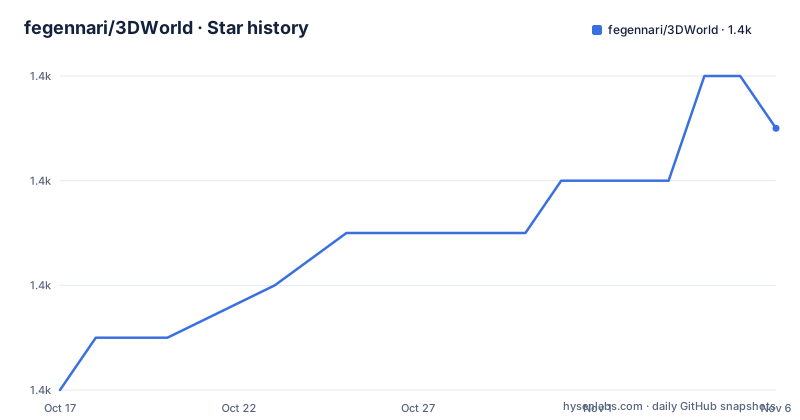
Star history
- fegennari/3DWorld1,435 ★ · +5
| Repository | 2026-10-17 | 2026-11-06 |
|---|---|---|
| fegennari/3DWorld | 1.4k | 1.4k |
5 Stars in the last 20 days, measured from the daily GitHub snapshot. Compare with other projects
Editorial analysis
3DWorld's procedural world and simulation scope
3DWorld addresses developers who want a single C++ codebase for procedural content, real-time rendering, physics, scene interaction, and several playable game modes. The repository is much larger than a conventional rendering sample. It includes terrain and voxel generation, vegetation, cities, roads, buildings, interiors, a universe generator, NPC behavior, path finding, dynamic physics, weather, skeletal animation, material effects, and postprocessing. It also contains game-specific code for a first-person shooter, spaceship and colonization activities, open-world collection, and zombie gameplay.
That scope makes the project interesting to code readers who want to trace how several real-time systems coexist in one engine. It also creates a large adoption surface. The README says the repository is about 1 GB because source code is packaged with textures, sounds, models, scene data, heightmaps, shaders, configuration, and Visual Studio project files. This is an application-oriented engine repository rather than a small library intended to sit beneath another game through a narrow public API. The README does not document SDK boundaries, plugin interfaces, supported external engine integrations, or a formal API compatibility policy.
The intended audience is therefore narrower than the feature list may initially suggest. A C++ graphics developer can inspect concrete systems and potentially reuse parts of the implementation. A small team wanting a supported engine abstraction should first establish whether 3DWorld exposes the integration surface it needs, because the project documentation does not make that case.
OpenGL rendering and procedural content architecture
The engine is based on OpenGL 4.5, with most code written in C++ and shaders written in GLSL. The documented rendering layer includes wrappers around OpenGL, shader generation and processing with hot reload, dynamic shadows, ambient occlusion, postprocessing, reflection, refraction, and support for as many as 1,024 dynamic light sources. Physically based materials are part of the listed material model. These claims describe the intended feature set, not a measured result on a particular graphics driver.
Procedural generation spans several scene scales. Terrain uses noise functions, erosion, heightmap reading and writing, and real-time editing. Voxel terrain supports generation and user modification. City generation combines roads and buildings, while the building generator covers both exteriors and interiors. The universe generator produces galaxies, stars, planets, and moons. Based on the top-level directories, these areas are represented through dedicated C++ source plus scene configuration, shader, texture, heightmap, and model data rather than through one generic asset pipeline.
Simulation is also integrated with the presentation layer. The README lists primitive physics, more than 10,000 dynamic objects, NPC target selection, path finding, navigation, real-time day and night changes, and weather including rain, snow, hail, wind, and lightning. Computer-controlled players and ships are included. The repository layout does not expose a simple event diagram, so it would be unsafe to claim a particular scene-graph or update-loop design. What can be confirmed is that 3DWorld combines rendering, content generation, simulation, and game logic in the same application.
Building 3DWorld in Visual Studio on Windows
The documented primary build path is Microsoft Visual Studio Insiders 2026 Community on Windows 11. The repository includes `3DWorld.sln`, `3DWorld.vcxproj`, project files under `dependencies/`, and prebuilt `lib32/` and `lib64/` directories. Open `3DWorld.sln` in the stated Visual Studio edition, select the appropriate x64 or win32 target, and allow the included dependency projects to build as required by the solution. Both 32-bit and 64-bit targets are described as usable after the relevant project settings are configured.
For a release or debug executable, the README points to the following repository files:
3DWorld_release.bat
3DWorld_debug.bat
The repository also contains corresponding shortcut files, but their targets should be checked in Visual Studio before use. The documentation says DLLs must be copied from `lib64/` into the repository root for the appropriate 64-bit setup, and it also refers to other project-setting changes. It does not supply a complete step-by-step list of every setting, so copying the files alone is not a guaranteed build procedure.
A first real launch should use the default configuration path. The README states that 3DWorld reads `defaults.txt` when no scene configuration is supplied and then uses the configuration files listed there. Start from a configuration that does not depend on the excluded large models. If startup reports missing files, consult the console output and scene configuration rather than assuming the renderer failed.
Linux compilation through the experimental makefile
Linux support is possible through the included makefiles, but the README labels the gcc makefile more experimental than the Visual Studio path. `README.linux` is the intended source for Linux-specific guidance. The repository includes `makefile` and `makefile.msys2`, while the author states that 3DWorld has built and mostly run with gcc 9 on Ubuntu 20.04. That statement should be read as a reported compatibility point, not as proof that the current release builds cleanly on every Linux distribution.
The dependency list requires OpenGL 4.5 and freeglut, with optional OpenAL, freealut, zlib, GLEW, libpng, libtiff, Assimp, and related libraries. Some stripped dependencies are included in `dependencies/`, while other libraries can be downloaded and built separately. The README does not provide a complete dependency installation tutorial, and it warns that newer versions may be needed. Avoid translating the Visual Studio DLL instructions directly into Linux instructions because the loader, library paths, and build settings are different.
Linux is the wrong first platform for a team that needs a short, repeatable setup path. The Windows Visual Studio files are the documented main target, whereas the Linux path may require project changes and may not work with every graphics driver.
Missing models and scene configuration failures
The largest adoption limitation is incomplete scene data. The repository deliberately excludes large models used by some scenes, including references associated with assets such as the Sponza Atrium and Stanford Dragon. As a result, some scene configuration files cannot resolve all referenced data. The author added nonfatal errors for missing models, which can help the application continue, but continuation does not mean that every scene will provide its intended content.
The README points to `image_and_model_credits.txt`, a separate Google Drive package identified as model package version `v10`, and third-party archives including Sketchfab and the McGuire Computer Graphics Archive. Some files in the separate model package use 3DWorld's internal format and should not be reused in other projects. That restriction matters for teams considering content extraction, as not every scene asset is portable even when it can be downloaded.
The first verification step for a selected scene is therefore asset inspection. Check its configuration file and referenced model paths before judging rendering, physics, or procedural generation. A missing asset can turn a feature test into an incomplete scene, while the engine's decision to issue a nonfatal error may make that condition easier to overlook.
Dependency age and the GPL-3.0 distribution boundary
3DWorld ships with aging graphics dependencies and does not present a current dependency-upgrade program. The README calls out the old libpng version, freeglut, OpenAL, GLEW, and other libraries, and states that freeglut should probably be replaced with SDL and image libraries with STB. STB is already used as a fallback, but the documentation says it does not support every image format used by the project. GLM and GLI header-only dependencies are included under `dependencies/`.
This makes dependency management part of the real cost of adoption. A developer may need to rebuild bundled libraries for another Windows or Visual Studio version, replace old libraries, or adjust project settings. The repository's age does not imply that the code is abandoned, but it does mean that modernization cannot be treated as a packaged, one-step task. The last push was on 2026-10-15, and `v1.5-release` was published on 2026-09-27 after `v1.4-release` from 2025-03-01, so the repository has current activity even though its dependency policy remains conservative.
The project uses `GPL-3.0`. Code reuse or distribution may carry obligations under that license, including source availability for covered derivative works. Teams using 3DWorld code in a proprietary product should review the exact license text and determine how their intended linking, modification, and distribution model is covered.
3DWorld versus a small SDL or OpenGL framework
The practical alternative to 3DWorld is a smaller graphics framework that supplies windowing and input while the application owns its engine structure. The README itself suggests replacing freeglut with SDL, but that suggestion concerns the windowing layer, not a complete alternative to all of 3DWorld. A small framework would offer a narrower adoption burden and usually a clearer library boundary. It would not provide the documented collection of procedural generators, physics simulation, scene formats, NPC behavior, playable modes, shaders, and sample content found in 3DWorld.
3DWorld is the better fit when the goal is to work within or learn from a complete procedural game-engine codebase. A smaller framework is the better fit when the requirement is a supported foundation for an unrelated game, minimal platform integration, or predictable dependency management. The trade-off is direct: 3DWorld offers application-scale systems at the cost of a roughly 1 GB repository, old libraries, large asset omissions, and Windows-specific project configuration.
Editorial conclusion
3DWorld fits C++ developers who want to study or extend a substantial procedural rendering engine, especially on Windows with Visual Studio. It is a poor fit for teams requiring reproducible Linux builds, current dependency management, or complete scenes immediately after cloning. Verify Visual Studio compatibility, required DLL placement, optional model downloads, and the behavior of the intended scene configuration before committing the engine to a production project.
Frequently asked questions
Can 3DWorld run on Linux?
The README says the project has built and mostly run on Ubuntu 20.04 with gcc 9 and that a Linux makefile is included. It also describes the Linux build as experimental and warns that graphics-driver compatibility may vary.
Why does a 3DWorld scene report missing models after cloning?
Large models used by some scenes are intentionally excluded from the Git repository. The README points to a separate model package, `image_and_model_credits.txt`, Sketchfab, and the McGuire Computer Graphics Archive.
What should I verify before building 3DWorld?
Confirm that you have the documented Windows and Visual Studio environment, choose the intended 32-bit or 64-bit target, and arrange the required DLLs and dependency projects. Also inspect the selected scene configuration for references to assets that are not in the repository.
Official sources
Add this badge to your README
If you maintain this project, the badge below links readers to this analysis and shows its maintenance status from the daily GitHub snapshot. Paste the markdown into your README; add ?metric=license or ?metric=stars to the image URL for a different field.

[](https://hysenlabs.com/projects/fegennari-3dworld)Star history chart for your README
[](https://hysenlabs.com/projects/fegennari-3dworld)Was this useful?