fineanmol/hacktoberfest: a starter repository for your first pull request
Make your first Pull Request on Hacktoberfest 2025. Don't forget to spread love and if you like give us a ⭐️
At a glance
- What is it?
- This repository exists to be contributed to. It offers three small tasks, a fork and branch workflow, a pull request template and a directory of profiles, so a beginner can open a real pull request without being given a real bug. Its value is pedagogical and its limits are equally clear.
- Who is it for?
- fineanmol/hacktoberfest fits a developer who has never opened a pull request and wants the mechanics practised on a repository that exists to receive them, or a teacher who wants a ready made exercise for a workshop. Skip it if you already know the fork, branch, commit and pull request loop, since the tasks add nothing beyond a name in a list and a Hello World print, and skip it if you need a real codebase to read.
- Can I use it commercially?
- Yes, with conditions. GPL-3.0 is a copyleft licence: if you distribute software that includes it, you must release that software's source code under the same licence. Running it internally without distributing it does not trigger that obligation.
- Is it still maintained?
- Yes. The repository last received commits 6 days ago.
- What is it written in?
- Mainly JavaScript, according to GitHub's language statistics.
Answers come from the project's GitHub data, last synced on November 7, 2026, and from our analysis. They are not legal advice.
Star history
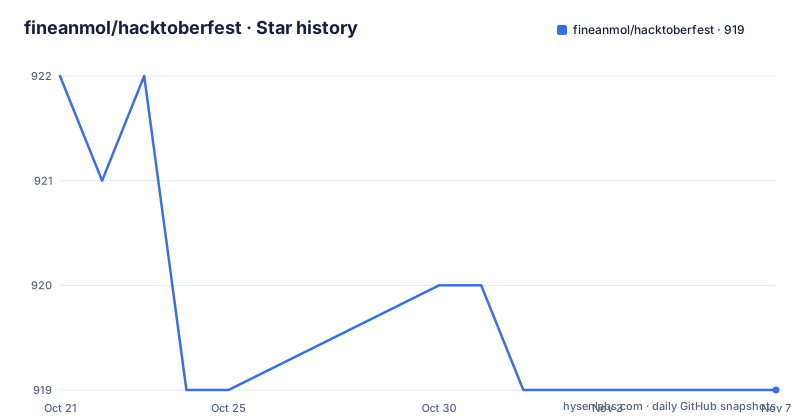
- fineanmol/hacktoberfest919 ★ · -3
| Repository | 2026-10-21 | 2026-11-07 |
|---|---|---|
| fineanmol/hacktoberfest | 922 | 919 |
-3 Stars in the last 17 days, measured from the daily GitHub snapshot. Compare with other projects
Editorial analysis
A repository whose purpose is to receive pull requests
This is not a library and there is nothing to install. The README opens by inviting you to contribute to complete your Hacktoberfest event, and the live site is published at fineanmol.github.io/hacktoberfest. The repository is described as open to all members of the GitHub community, with the explicit note that any member may contribute without being a collaborator. That single design decision is what makes it different from a normal project. There is no maintainer gatekeeping who has to approve you before you can start, no issue queue to understand and no build system to make pass. You fork, you add something small, you open a pull request, and the machinery of GitHub does the rest. Hacktoberfest itself is described as a month long celebration running from October 1 to 31, sponsored by DigitalOcean, GitHub and partners.
Three tasks, each one deliberately trivial
The README lists three ways to contribute. The first is to add your name to the CONTRIBUTING.md file using a fixed convention with a Name heading, a Place line, a Bio line and a GitHub line, all of them in Markdown. The second is to add a Your_Name.md file to the profiles directory, and the README shows an example skeleton with sections for Location, Academics, Interests, Development and Projects. The third is to create a hello_world_yourusername.xx script in the scripts directory, in any language you like, with the file name carrying your username. The example script shows the required header comments, one per line for the language, the environment, the author and the GitHub profile, followed by the print statement:
// LANGUAGE: Javascript
// ENV: Node.js
// AUTHOR: Anmol Agarwal
// GITHUB: https://github.com/fineanmol

console.log('Hello, World!');
The README says to add scripts to the folder for the specific language, and notes that the bonus value is discovering obscure languages, from Brainfuck to Groovy, and creative ways to print the same string.
The fork, branch, commit and push loop, spelled out
The Getting started section is a git tutorial as much as it is a contribution guide, and it is worth reading as a template for your own first contribution. You fork the repository from the button in the top right of the page, clone the fork to your machine, create a branch, make your changes, commit, push and open a pull request from the New Pull Request button. The commands the README gives are deliberately generic:
git clone https://github.com/fineanmol/hacktoberfest.gitgit checkout -b branch-namegit add .
git commit -m 'Commit message'
git push origin branch-nameA Git and GitHub quick reference table repeats the same operations in a single view, with clone, checkout, add, commit, push and a row for syncing a fork with git pull upstream main. The one piece of guidance worth keeping for later is that last one, because a fork that drifts from the upstream branch is the most common cause of a merge conflict for a beginner.
The mistakes section is the real documentation
A section titled Common Mistakes and How to Fix Them is more useful than the task list. It names three failures. Forgetting to create a new branch, fixed by running git checkout -b your-branch-name before making changes. A pull request not showing on a Hacktoberfest profile, which happens when the pull request is not merged, is not labelled hacktoberfest-accepted, or the repository is not participating in Hacktoberfest. And merge conflicts, fixed by running git pull upstream main to sync before pushing again. The label point matters because it describes the difference between a pull request that exists and a pull request that counts. The repository also carries a pull_request_template.md and a CODE_OF_CONDUCT.md at the root, so the contribution process has the same shape as a serious project even though the content is trivial.
What the repository layout shows about its real purpose
The top level directories tell the story. There is a profiles directory holding the submitted profile pages, a scripts directory holding the Hello World files organised by language, a contributors directory, and a hacktoberfest-react/ directory that holds the React site that is published as the live site. The single release tag, v1.0.0, is described as the Hacktoberfest 2026 React site and was published on 2026-06-06, and the last push was on 2026-10-19. The repository description on GitHub still reads as Hacktoberfest 2025 while the README title says 2026, which is a small sign of a project that is refreshed each October rather than continuously designed. The README also points at a related project, Annoying Button, and at other beginner friendly repositories such as First Contributions and the EddieHub Community.
What it teaches, and what it cannot teach
The pedagogical value is real but narrow. A first-time contributor who completes a task here has practised forking, branching, committing, pushing, opening a pull request, resolving a sync conflict and reading a pull request template. That loop is the part of open source that most people find frightening, and it is practised here without the risk of breaking anything. What the repository cannot teach is anything about reading someone else's code, understanding an architecture, handling review comments that require rework, or debugging a failing test, because there is no code here that does anything. It is also worth being honest about what a merged Hello World pull request demonstrates to a reader of your profile: it shows you can use GitHub, not that you can build software. Used as a warm up before a real contribution, it is helpful. Used as the whole of an open source portfolio, it says very little.
Licence, contributing rules and the annual refresh
The licence is GPL-3.0, which is worth a moment's thought for a repository whose contents are mostly names, bios and Hello World prints. Copyleft obligations attach when you distribute the work, and a repository like this is normally consumed by pulling a file from it rather than by shipping the project, so in practice the practical impact is small, but the choice is stated plainly in the LICENSE file and any fork inherits it. The README asks contributors to read CONTRIBUTING.md for the code of conduct and the pull request process, and points at the hacktoberfest.com event site as the official source. There is no release cadence to plan around and no versioning scheme to depend on, since the repository is re-skinned each October with a new site and a refreshed task list. That annual refresh is the whole lifecycle of the project.
Editorial conclusion
fineanmol/hacktoberfest fits a developer who has never opened a pull request and wants the mechanics practised on a repository that exists to receive them, or a teacher who wants a ready made exercise for a workshop. Skip it if you already know the fork, branch, commit and pull request loop, since the tasks add nothing beyond a name in a list and a Hello World print, and skip it if you need a real codebase to read. Before contributing, read pull_request_template.md and CODE_OF_CONDUCT.md, and remember the README states that the pull request must be merged or labelled hacktoberfest-accepted before it counts on a Hacktoberfest profile.
Frequently asked questions
What is fineanmol/hacktoberfest and who is it for?
It is a starter repository for people making their first open source contribution, and the README states it is open to all members of the GitHub community without needing to be a collaborator. It exists so a beginner can open a real pull request by adding a name, a profile page or a Hello World script.
How do I make my first contribution to fineanmol/hacktoberfest?
Fork the repository, clone it with git clone, create a branch with git checkout -b branch-name, make one of the three documented changes, commit with git add . and git commit, push with git push origin branch-name, and open a pull request from the New Pull Request button.
Why does my pull request not show up on my Hacktoberfest profile?
The README lists three causes: the pull request must be merged, it must be labelled hacktoberfest-accepted, or the repository must be participating in Hacktoberfest. It also explains that a merge conflict is fixed by running git pull upstream main before pushing again.
What can I contribute to fineanmol/hacktoberfest?
Three options: add your name to CONTRIBUTING.md using the given convention, add a Your_Name.md file to the profiles directory, or create a hello_world_yourusername.xx script in the scripts directory in any language, including the four header comments for language, environment, author and GitHub profile.
What licence is fineanmol/hacktoberfest under?
The repository is licensed under GPL-3.0, with the LICENSE file at the root. It also carries a CODE_OF_CONDUCT.md and a pull_request_template.md that contributors are asked to read.
Official sources
Add this badge to your README
If you maintain this project, the badge below links readers to this analysis and shows its maintenance status from the daily GitHub snapshot. Paste the markdown into your README; add ?metric=license or ?metric=stars to the image URL for a different field.

[](https://hysenlabs.com/projects/fineanmol-hacktoberfest)Star history chart for your README
[](https://hysenlabs.com/projects/fineanmol-hacktoberfest)Was this useful?