flare-game is the data half of Flare, and its mod layout is the reason it is worth reading
Fantasy action RPG using the FLARE engine
At a glance
- What is it?
- The art, maps, scripts and dialogue for Flare: Empyrean Campaign, kept in open INI style formats so anyone can modify it, and split into mods that the engine assembles at runtime. The engine lives in another repository, which is the first thing to understand before you install anything.
- Who is it for?
- Adopt flare-game if you want to play the campaign, contribute a translation, or fork a game built on the FLARE engine, since the data is in plain INI files and open formats that anyone can edit. Do not treat this repository as the engine itself, because the executable lives in flareteam/flare-engine and the game repository only supplies content.
- Can I use it commercially?
- Check first. The repository uses a licence we do not classify automatically, so read its LICENSE file before any commercial use.
- Is it still maintained?
- Yes. The repository last received commits 92 days ago.
- What is it written in?
- Mainly CMake, according to GitHub's language statistics.
Answers come from the project's GitHub data, last synced on November 7, 2026, and from our analysis. They are not legal advice.
Star history
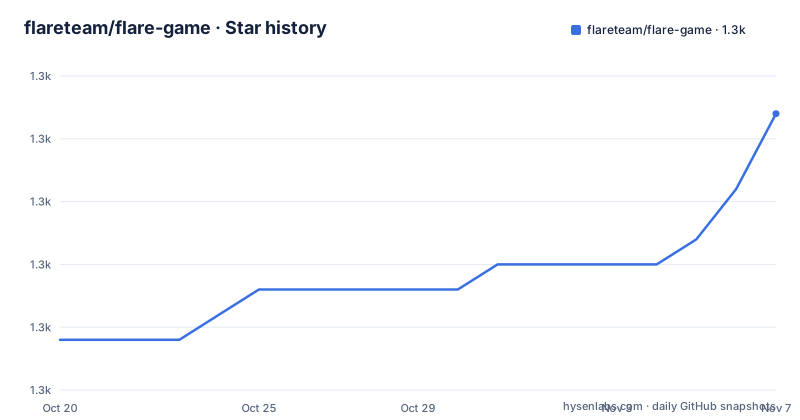
- flareteam/flare-game1,341 ★ · +9
| Repository | 2026-10-20 | 2026-11-07 |
|---|---|---|
| flareteam/flare-game | 1.3k | 1.3k |
9 Stars in the last 18 days, measured from the daily GitHub snapshot. Compare with other projects
Editorial analysis
This is the content repository, not the engine
Flare: Empyrean Campaign is a single-player 2D action RPG with fast paced action and a dark fantasy style, and this repository is its content. The engine is a separate project, the FLARE engine, Free/Libre Action Roleplaying Engine, hosted at flareteam/flare-engine.
The top level entries make the split obvious. There is a `mods/` directory holding the game content, `art_src/` with the raw source art, `tiled/` with the Tiled native map files, and `distribution/` with the packaging material. Alongside them are a `CMakeLists.txt`, a `CONTRIBUTING.md`, a `CREDITS.txt`, a `LICENSE.txt` and a `.tx/` directory, which is the configuration for Transifex and therefore the translation workflow.
The practical consequence is that there is nothing to build here in the usual sense. The CMake file exists for packaging, and the README explicitly frames the two package split: one package for the engine, which is a single engine reused by several games, and one package for the game data, which requires the engine. If you are packaging for an operating system repository, that is the shape the project wants.
The homepage is flarerpg.org, and binaries are published both on the GitHub releases page and as a mirror on SourceForge, with discussions on GitHub and an email contact for the maintainer.
INI files and open formats are the design commitment
The README states the core design decision plainly. FLARE uses simple file formats, INI style config files, for most of the game data, which allows anyone to easily modify game contents, and open formats are preferred, with png and ogg named. Maps are edited using Tiled.
That is an unusual choice for a 2D action RPG and it is the most consequential fact about the project. Most commercial or even indie RPG data lives in opaque binary formats, which means the community cannot contribute content, cannot fix a typo in a localisation file, and cannot build tools against the data format. Here, the data is text.
The consequence for contributors is that adding an item, a monster, a quest or a translation is a text edit, and the review of that edit is a diff rather than a binary comparison. The consequence for a tool author is that you can parse the game data.
The Tiled integration is the same idea applied to maps. The `tiled/` directory holds the Tiled native files used to export the maps, and `art_src/` holds the raw files such as Blender files used to generate the art. Both may be omitted at packaging time when distributing the game, since they are not used at runtime, which is a neat illustration of keeping the authoring material separate from the shipped material without losing either.
The flip side is that text data does not scale as cheaply, and a very large game would eventually want a database. For a project of this size, the trade has clearly been worth it.
Installing means copying three mod directories into the user folder
The easiest way to play is a bundled engine plus game build from the downloads page, and Flatpak users can find the game on Flathub as org.flarerpg.Flare.
The manual route is more instructive. You build the engine following the engine's own install document, run it once so that the config and user data directories are created, and then copy the mods into the user mod directory. The locations given are `%APPDATA%\flare\userdata\mods\` on Windows and `~/.local/share/flare/mods/` on Linux.
Three directories have to be copied.
flare-engine/mods/default
flare-game/mods/fantasycore
flare-game/mods/empyrean_campaign
The first comes from the engine repository and the other two from this one. The split between `fantasycore` and `empyrean_campaign` is the interesting part, because it separates the shared foundation from the campaign content. That is the same reasoning as the packaging split: the engine package holds the reusable parts, the game package holds the specific content, and a mod that is a separate directory can be enabled or disabled.
After copying, you launch Flare, open the Configuration menu, go to the Mods tab and enable the `fantasycore` and `empyrean_campaign` mods. The engine discovers what is on disk and the user chooses what to run, so the content is composable rather than baked in.
Save files live in `saves/empyrean/` inside the user data folder, so a campaign's progress is separated from the mod content, which means a content update does not touch your save.
Licensing is layered by asset type
The copyright and licence section splits the project into several layers, and the split matters if you redistribute anything.
Flare: Empyrean Campaign is copyright Clint Bellanger from 2010 to 2013, with contributors retaining copyright in their original contributions. The Flare engine is released under GPL version 3 or later. All of the art and data files for the campaign are released under CC-BY-SA 3.0, with later versions permitted.
The fonts are a separate list. The Liberation fonts version 2, the Bona Nova SC font, the Noto fonts and the Marck Script font are all under the SIL Open Font License, Version 1.1.
So the picture is: engine code under GPL, game content under a Creative Commons share-alike licence, and fonts under an open font licence. For a game distribution, the CC-BY-SA obligation on the art and data is the one to watch, since share-alike requires derivatives of those files to carry the same terms, and the explicit allowance of later versions means you can move to CC-BY-SA 4.0 if you need to.
The content also carries a content warning. The README states that the flare-game content contains depictions of violence, blood and mild gore, which is standard practice to state for an action RPG and worth knowing before a distribution decides whether to ship it.
This is not legal advice, and the point is simply that a fork or a redistribution has to satisfy several licences at once, and the repository tells you which applies to which part.
Translation coverage and the release history
The translation status table is one of the most informative things in the README, and it shows both the strength and the fragility of a volunteer driven translation effort.
Three languages are complete at 100 percent: Chinese, German and Russian. Several are close: Finnish at 90 percent, Portuguese from Brazil at 90 percent, French at 89 percent, Korean at 89 percent, Indonesian at 88 percent, Spanish at 88 percent, and Japanese at 59 percent. Others are barely started, with Dutch at 1 percent, Hindi at 1 percent, Galician at 3 percent, Greek at 4 percent and Bulgarian at 5 percent.
The pattern is that the languages with the most speakers and the strongest modding communities have the best coverage, which is what you would expect. The `.tx/` directory in the repository root and the Transifex convention behind it are what make that table possible, because the strings live in a translation platform rather than in the game data.
The release history shows a long gap. v1.14 was tagged in December 2022, with a release candidate in November of that year, and v1.15 came in May 2026. The last push to the repository was on 2026-08-08 and the project is not archived, so work continues between tags, and a three-and-a-half-year gap between two version numbers suggests the version is tied to the content release rather than to a continuous release cadence.
The README's version guidance follows from this. It asks you to use the latest version of the FLARE engine with the game data in the repository, and warns that an older engine could result in some game elements not working correctly, which is a version coupling between two repositories that have independent release schedules.
Editorial conclusion
Adopt flare-game if you want to play the campaign, contribute a translation, or fork a game built on the FLARE engine, since the data is in plain INI files and open formats that anyone can edit. Do not treat this repository as the engine itself, because the executable lives in flareteam/flare-engine and the game repository only supplies content. Verify first that you are using the latest FLARE engine with this game data, because the README warns that an older engine can break game elements, and that the two mod directories fantasycore and empyrean_campaign are both enabled in the Mods tab of the configuration menu.
Frequently asked questions
What is the difference between the flare-game and flare-engine repositories?
flare-game holds the content for Flare: Empyrean Campaign, including art, maps, scripts and dialogue, while the executable itself lives in flareteam/flare-engine. The recommended packaging splits them into a flare-engine package reused by several games and a flare-game package that depends on it.
How do I install the Flare mods manually?
Build the engine, run it once so the config and user data directories exist, then copy flare-engine/mods/default, flare-game/mods/fantasycore and flare-game/mods/empyrean_campaign into the user mod directory, which is ~/.local/share/flare/mods/ on Linux and %APPDATA%\flare\userdata\mods\ on Windows.
What file format does Flare use for game data?
Simple INI style config files for most of the game data, with open formats such as png and ogg preferred. Maps are edited using Tiled, and the tiled directory holds the Tiled native map files used to export them.
Which licence covers the game content and which covers the engine?
The Flare engine is under GPL version 3 or later, while the art and data files for the campaign are under CC-BY-SA 3.0 with later versions permitted. The bundled fonts are under the SIL Open Font License 1.1.
Where are Flare save files stored?
In saves/empyrean/ inside the user data folder, so campaign progress is kept separate from the mod content and a content update does not overwrite a save.
Official sources
Add this badge to your README
If you maintain this project, the badge below links readers to this analysis and shows its maintenance status from the daily GitHub snapshot. Paste the markdown into your README; add ?metric=license or ?metric=stars to the image URL for a different field.

[](https://hysenlabs.com/projects/flareteam-flare-game)Star history chart for your README
[](https://hysenlabs.com/projects/flareteam-flare-game)Was this useful?