ForecastBench Datasets: A Nightly Snapshot of AI Forecasting Questions
Forecastbench Datasets, updated nightly
At a glance
- What is it?
- Forecastbench-datasets is a JSON repository that ships the ForecastBench benchmark questions to LLM evaluators. It is a data feed, not a framework, and its value depends on how you handle its nightly updates and CC-BY-SA-4.0 terms.
- Who is it for?
- Adopt forecastbench-datasets if you are building or evaluating LLM forecasting systems and need a standardized, versioned set of questions tied to a peer-reviewed benchmark. Skip it if you require permissive licensing for commercial products, because CC-BY-SA-4.0 imposes share-alike obligations.
- Can I use it commercially?
- Yes, with credit. CC-BY-SA-4.0 allows commercial use as long as you credit the authors and indicate what you changed. It is written for creative content, so check how it applies to any code.
- Is it still maintained?
- Yes. The repository last received commits 4 days ago.
- What is it written in?
- Mainly JSON, according to GitHub's language statistics.
Answers come from the project's GitHub data, last synced on October 21, 2026, and from our analysis. They are not legal advice.
Star history
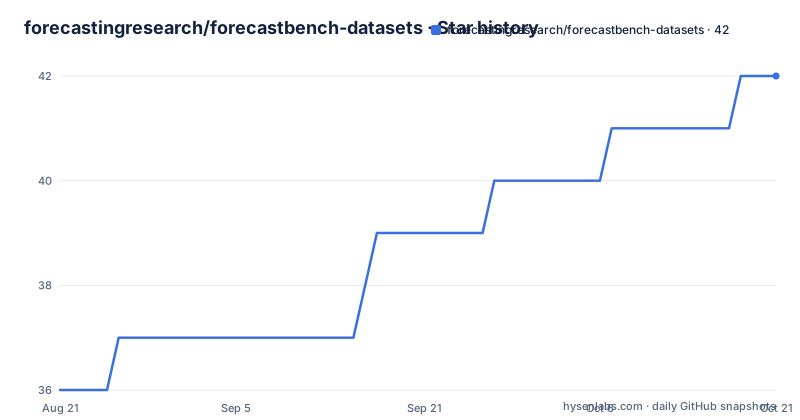
- forecastingresearch/forecastbench-datasets42 ★ · +6
| Repository | 2026-08-21 | 2026-10-21 |
|---|---|---|
| forecastingresearch/forecastbench-datasets | 36 | 42 |
6 Stars in the last 61 days, measured from the daily GitHub snapshot. Compare with other projects
Editorial analysis
What This Repository Actually Contains
The repository is called forecastbench-datasets, and its README says it contains the datasets produced by ForecastBench, a forecasting benchmark for LLMs. The primary language is listed as JSON, which suggests the data is stored in structured JSON files, though the README does not enumerate the files or their schema. The description says it is updated nightly, so the content changes frequently. This is not a code library. It is a data distribution point. If you want the code that generates or evaluates these datasets, the README points to a separate repository: forecastingresearch/forecastbench. That separation matters. You get the questions here, but the tooling lives elsewhere.
The Problem It Solves and Who It Serves
ForecastBench addresses a specific evaluation gap: how well can LLMs predict future events, as opposed to answering static questions? The dataset provides a structured set of forecasting questions that researchers can run against their models. The intended audience is clear from the citation and the ICLR poster link: academics and AI labs working on forecasting capabilities. If you are building a forecasting agent, you need a benchmark with known answers or resolvable outcomes. This repository gives you that, with the caveat that the questions are dynamic. The nightly updates mean the benchmark is always fresh, but that freshness introduces a versioning problem that a static benchmark would not have.
How the Data Flows: From Paper to Nightly JSON
The mechanism here is straightforward, but the implications are not. The datasets are produced by ForecastBench, which is described in the paper cited in the README, titled 'ForecastBench: A Dynamic Benchmark of AI Forecasting Capabilities.' The word dynamic is key. Unlike a fixed benchmark like MMLU, this one updates nightly. That means the JSON files in this repository are a moving target. If you pull the repository today and again in a week, you may get different questions. The README does not describe how the updates are generated, so the exact pipeline is opaque. What is clear is that the repository is a snapshot mechanism. You clone it or download it, and you get the current state of the benchmark questions.
Getting It Running: Commands and Configuration
The README does not include installation instructions, which is typical for a dataset repository. To use it, you would clone the repository with git clone https://github.com/forecastingresearch/forecastbench-datasets.git, or download the JSON files directly from the GitHub web interface. There are no config keys, no environment variables, and no build steps. The data is in JSON, so you can load it into your Python environment with json.load() or into any tool that reads JSON. The absence of a setup.py or package.json means you are on your own for parsing. The README also links to the main forecastbench repository for code, so if you need a loader or evaluation harness, that is where you would look. The dataset itself is passive.
A Real Limitation: The Nightly Update Problem
The most obvious failure mode is reproducibility. Because the datasets are updated nightly, you cannot assume that a result you got last month is comparable to a result you get today. The questions may have changed, the answer key may have shifted, or new questions may have been added. The README does not provide version tags or release notes. In fact, the repository metadata shows no recent releases and no release history. That is a significant gap for a benchmark. If you are running an evaluation, you need to pin a specific commit hash or a date-stamped copy of the repository. The README does not tell you how to do that, but git itself gives you the tools. Without that discipline, your evaluation is not reproducible.
License Implications: CC-BY-SA-4.0 in Practice
The datasets are licensed under CC-BY-SA-4.0, which is a share-alike license. That means if you use the data in your own work, you must attribute the source and license any derivative works under the same terms. For a research project that publishes its code and data openly, this is fine. For a commercial product that wants to keep its evaluation data proprietary, this is a problem. The license is not permissive like MIT or Apache-2.0. The README does not offer a separate commercial license, so you should assume the share-alike condition applies to anything you build directly on these datasets. This is not legal advice, but it is a clear constraint that any adopter must evaluate before committing.
Alternatives and How They Differ
The main alternative is to build your own forecasting evaluation set. That is what ForecastBench itself did, and you can see the result in this repository. The difference is that a custom set gives you full control over the questions, the update cadence, and the license. You can make it static, permissive, and tailored to your domain. The cost is the effort to design questions, resolve outcomes, and validate the benchmark. Another alternative is to use a static benchmark like MMLU or a question-answering dataset, but those do not test forecasting specifically. They test knowledge recall, not prediction. ForecastBench's dynamic nature is its differentiator, but it is also its weakness. If you need a stable baseline, a custom static set may be more appropriate.
Maintenance and Upgrade Cost
The repository is actively updated nightly, so maintenance is happening, but it is automated. The last push date is unknown, and there are no releases. That means you cannot rely on semantic versioning or changelogs. You have to track changes yourself, either by watching the commit history or by diffing the JSON files. The upgrade cost is low in terms of disk space, but high in terms of verification. Every time you pull a new version, you need to check whether the schema changed, whether the question IDs are stable, and whether your evaluation scripts still work. The README does not document a schema version, so you cannot assume backward compatibility. For a research team, this is manageable. For a production system, it is a warning sign.
Editorial conclusion
Adopt forecastbench-datasets if you are building or evaluating LLM forecasting systems and need a standardized, versioned set of questions tied to a peer-reviewed benchmark. Skip it if you require permissive licensing for commercial products, because CC-BY-SA-4.0 imposes share-alike obligations. Before relying on it, verify the exact commit or date you pull, check the repository's release history (currently none are listed), and confirm that the nightly updates do not break your evaluation pipeline. The dataset is a useful artifact, but it is not a maintained API with guarantees.
Frequently asked questions
What is a forecast bench, in the ForecastBench sense?
ForecastBench is a forecasting benchmark for large language models. This repository holds the datasets it produces, while the code that generates them lives separately at github.com/forecastingresearch/forecastbench and the project site is forecastbench.org.
What is forecast data in forecastbench-datasets?
It is the output records of a forecasting benchmark for LLMs, stored as JSON and published in two directories, datasets/ and leaderboards/. The README does not define a schema, field names or units, so the structure of a record has to be read from the files themselves.
How often do the forecastbench-datasets records change?
The repository description says the datasets are updated nightly, and the last commit is dated 30 September 2026. There are no tagged releases, so there is no version to pin to and a commit reference is the only stable identifier.
What licence and citation apply to the ForecastBench datasets?
The datasets are distributed under CC BY-SA 4.0, stated in the README front matter and held in full in the LICENSE file. The README also supplies a BibTeX entry keyed karger2025forecastbench for the ForecastBench paper presented at ICLR 2025, plus an arXiv link.
Official sources
Add this badge to your README
If you maintain this project, the badge below links readers to this analysis and shows its maintenance status from the daily GitHub snapshot. Paste the markdown into your README; add ?metric=license or ?metric=stars to the image URL for a different field.

[](https://hysenlabs.com/projects/forecastingresearch-forecastbench-datasets)Star history chart for your README
[](https://hysenlabs.com/projects/forecastingresearch-forecastbench-datasets)