FreeCodeCampChina/freecodecamp.cn: A Fork That Localizes the Full Stack Curriculum but Lags Behind
FCC China open source codebase and curriculum. Learn to code and help nonprofits.
At a glance
- What is it?
- This repository is the Chinese community fork of freeCodeCamp, bundling the original curriculum with a Chinese translation and a non-commercial license. It targets Chinese-speaking learners, but its maintenance status and licensing need scrutiny before adoption.
- Who is it for?
- Adopt this project if you are a Chinese-speaking learner who wants the classic freeCodeCamp curriculum in a localized interface and can accept the non-commercial translation license. Do not adopt it if you need the latest freeCodeCamp features, active maintenance, or a clear license status, since the repo shows no recent releases and the license is marked NOASSERTION.
- Can I use it commercially?
- Check first. The repository uses a licence we do not classify automatically, so read its LICENSE file before any commercial use.
- Is it still maintained?
- Probably not. The repository last received commits 40 months ago, on July 16, 2023.
- What is it written in?
- Mainly CSS, according to GitHub's language statistics.
Answers come from the project's GitHub data, last synced on November 15, 2026, and from our analysis. They are not legal advice.
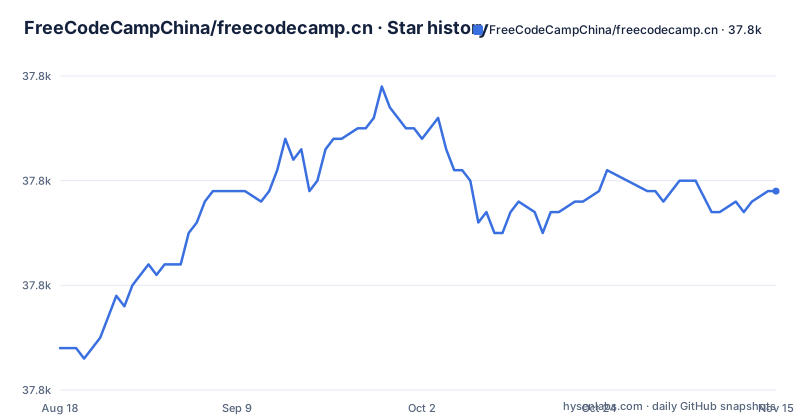
Star history
- FreeCodeCampChina/freecodecamp.cn37,789 ★ · +15
| Repository | 2026-08-18 | 2026-11-15 |
|---|---|---|
| FreeCodeCampChina/freecodecamp.cn | 37.8k | 37.8k |
15 Stars in the last 89 days, measured from the daily GitHub snapshot. Compare with other projects
Editorial analysis
What This Fork Actually Provides
The repository is the Chinese community fork of freeCodeCamp, aimed at Chinese-speaking learners who want to go through the original self-paced, browser-based full stack JavaScript curriculum. The README describes a four-certification path: Front End, Data Visualization, Back End, and Full Stack. The first three cover HTML, CSS, JavaScript, jQuery, Bootstrap, Sass, React, D3, Node.js, Express, MongoDB, and Git. The fourth certification is the nonprofit project track, where campers are paired with a partner, an agile project manager, and a nonprofit stakeholder to build and maintain real apps. The fork's value is that it localizes the interface and content into Chinese, as indicated by the Chinese sign-in link and the translation license. It is not a new curriculum; it is a translation and deployment of the freeCodeCamp platform with the README carrying a 2017 freeCodeCamp copyright notice.
How the Curriculum and Certification Path Are Structured
The certification structure is sequential. The Front End Certification starts with web basics and JavaScript, requiring 10 front-end projects and several JavaScript algorithms. The Data Visualization Certification builds on that with Sass, React, and D3, asking for 5 React apps and 5 D3 visualization apps. The Back End Certification introduces Node.js, Express, MongoDB, and Git, with 5 APIs and 5 full stack apps. The Full Stack Certification is the capstone: two projects from scratch and two existing projects to maintain or upgrade. Notably, the README states that solutions can be implemented in any programming language, as long as a live demo and source code are public. That flexibility is a genuine plus, because it decouples the certification from a specific stack, even though the curriculum itself teaches JavaScript. The path is long and project-heavy, which matches the original freeCodeCamp philosophy of learning by building.
Running the Project: What the README Shows
The README does not include installation instructions, setup commands, or configuration keys. It only points to the live site at freecodecamp.cn and to a CONTRIBUTING.md file for pull requests. The default branch is dev, which suggests that the main development happens on that branch, but there are no release tags or recent release notes in the metadata. The primary language listed is CSS, which is odd for a full stack platform, but it reflects the repository's file composition, likely dominated by stylesheets. To run this locally, you would need to clone the dev branch and infer the build process from the codebase, since the README gives no guidance. That is a real barrier for anyone who wants to self-host or contribute. The lack of setup documentation means you cannot get started from the README alone.
Licensing: A Mixed Bag with a Non-Commercial Catch
The license field in the metadata says NOASSERTION, which means the repository does not declare a single license in a machine-readable way. The README, however, lists three licenses: BSD-3-Clause for the computer software, CC-BY-SA-4.0 for the curriculum content, and CC-BY-NC-4.0 for the Chinese translation. The translation license explicitly says 'Do not use (it) for commercial/business purpose.' That is a significant constraint. If you plan to use this fork for a commercial coding bootcamp or paid training, the translation is off-limits, even though the underlying software is BSD-licensed. The curriculum is share-alike, so any derivative content must carry the same license. This layered licensing is not unusual for a fork, but it complicates reuse. You cannot assume that because the code is BSD, the Chinese text is free to use commercially.
Maintenance and Upgrade Cost: Signs of Stagnation
The repository has no GitHub releases and the last push was on 2023-07-16, which is a red flag for maintenance. The README carries a 2017 copyright notice and describes a curriculum built around jQuery, Bootstrap and a four-certification structure. The default branch is dev, and with the last push in July 2023 the project appears dormant. The maintenance cost is not just about keeping the site running; it is about updating the curriculum, fixing bugs, and aligning with upstream changes. For a learner, this means the material may be outdated, especially in fast-moving areas like JavaScript frameworks. For an organization, hosting this as a service would require ongoing work that the repository's history does not show.
Limitations and When This Is the Wrong Tool
The most obvious limitation is that the curriculum is dated. The README mentions jQuery and Bootstrap as core front-end skills, which reflects a 2017-era approach. This fork may teach you dated patterns. Another limitation is the lack of setup documentation, which makes it hard to run locally or deploy. The non-commercial translation license also rules out many legitimate uses, such as a company offering internal training. This is the wrong tool if you need an actively maintained learning platform, if you want to build a commercial course, or if you expect a modern curriculum. It is also not suitable as a base for a new project, because the codebase is tied to an old freeCodeCamp version and would require significant refactoring.
Alternatives: The Upstream and Other Localized Options
The direct alternative is the upstream freeCodeCamp repository, which is actively maintained and offers a modern curriculum with free certifications. Other alternatives include interactive platforms like The Odin Project, which takes a different approach by curating external resources rather than hosting a full curriculum. The Odin Project is not a fork and has no translation license issue, but it is not a direct drop-in replacement. The key difference is that this fork offers a localized, self-contained package, while upstream requires you to accept the current platform's direction.
Editorial conclusion
Adopt this project if you are a Chinese-speaking learner who wants the classic freeCodeCamp curriculum in a localized interface and can accept the non-commercial translation license. Do not adopt it if you need the latest freeCodeCamp features, active maintenance, or a clear license status, since the repo shows no recent releases and the license is marked NOASSERTION. Before using it, note that the last push was on 2023-07-16, verify the current state of the dev branch, and review the translation license to ensure your use case (personal study vs. commercial training) is allowed. The last push was in 2023, so treat it as a reference or archive, not a live service.
Frequently asked questions
Is freeCodeCamp totally free?
The project describes itself as a free open source community with a self-paced, browser-based full stack JavaScript curriculum, and the code is BSD-3-Clause, the curriculum CC-BY-SA-4.0 and the translation CC-BY-NC-4.0 (non-commercial). The README states no cost for any part of the path, including the nonprofit projects in the fourth certification.
Is a freeCodeCamp certification worth anything?
The repository states what each certification requires rather than what it is worth: 10 front-end projects, 5 React and 5 D3 apps, 5 APIs and 5 full stack apps, and for the fourth certification two projects built from scratch plus two existing ones maintained. It makes no claim about employer recognition or outcomes, and says nothing about how employers view the certificates.
Is freeCodeCamp enough to get a job?
The stated aim is to help campers build job-worthy portfolios of real apps used by real people while helping nonprofits, and the Front End certification requires 10 projects and a set of JavaScript algorithms. The README does not offer any evidence about employment outcomes, so treat that aim as the project's framing rather than a measured result.
Official sources
Add this badge to your README
If you maintain this project, the badge below links readers to this analysis and shows its maintenance status from the daily GitHub snapshot. Paste the markdown into your README; add ?metric=license or ?metric=stars to the image URL for a different field.

[](https://hysenlabs.com/projects/freecodecampchina-freecodecamp-cn)Star history chart for your README
[](https://hysenlabs.com/projects/freecodecampchina-freecodecamp-cn)Was this useful?