FSECDEV/Threat-Intelligence-Hackers-Forums: A README-Only Directory of Hacker Forums
A directory of hacker forums
At a glance
- What is it?
- This repository is a two-file, README-only list of clearnet and Tor addresses for hacking forums, refreshed with a timestamp. It is a pointer index, not a monitoring platform, and the README documents no tooling around it.
- Who is it for?
- Adopt this if you want a small, human-readable list of forum addresses to check yourself, and you accept that nothing here is verified or monitored. Do not adopt it if you need automated collection, deduplication, or any assurance that a listed address still resolves.
- Can I use it commercially?
- Not without permission. GitHub finds no licence file in the repository, and without a licence all rights are reserved by default: you may read the code but not reuse it. Check the README, or ask the authors, before using it.
- Is it still maintained?
- Yes. The repository last received commits 54 days ago.
- What is it written in?
- GitHub does not report a main language for this repository.
Answers come from the project's GitHub data, last synced on November 7, 2026, and from our analysis. They are not legal advice.
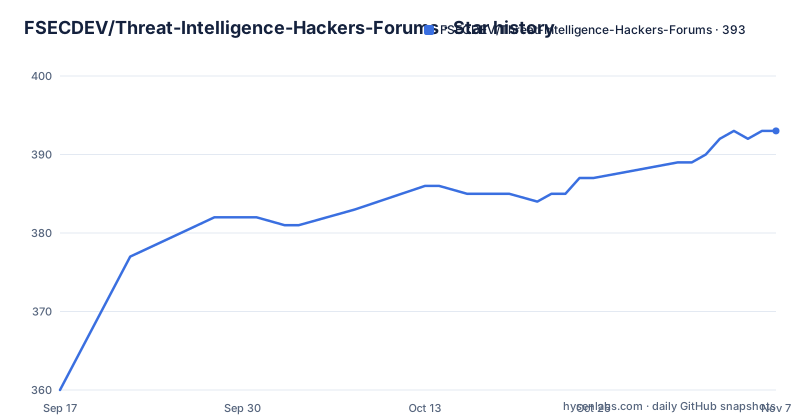
Star history
- FSECDEV/Threat-Intelligence-Hackers-Forums393 ★ · +33
| Repository | 2026-09-17 | 2026-11-07 |
|---|---|---|
| FSECDEV/Threat-Intelligence-Hackers-Forums | 360 | 393 |
33 Stars in the last 51 days, measured from the daily GitHub snapshot. Compare with other projects
Editorial analysis
What the Threat-Intelligence-Hackers-Forums repository actually contains
Strip away the name and what remains is small. The top level of the repository holds README.md and forums.png. There is no code directory, no configuration, no scraper, no schema, no test suite, and no packaging file. The README is a single Markdown table with three columns, CLEARNET, DARKNET and OTHER, and eleven rows, one per forum: Pwnforums, Spear, Breached, Raidforums, Sinister, XSS.MX, Darkforums, ZeroForums, Banished, t1eron3.vip and Breachforums. Below the table sits a line reading "Last Update: Tue Sep 15 03:22:32 CEST 2026".
That is the whole artefact. The description calls it "A directory of hacker forums", and the directory is literal: addresses and names, nothing more. Anyone expecting a threat intelligence feed, an enrichment pipeline or an API is looking at the wrong repository. What it solves is narrower and real enough: when an analyst needs a starting list of forum entry points, this gives one in a format that opens in any editor and diffs cleanly in Git. The audience is the person who already knows what to do with those addresses and only wants them collected in one place.
How the clearnet, darknet and other columns are organised
The table's structure carries the only design decision in the project. Each row is a forum, and the three columns describe how you reach it. The CLEARNET column holds ordinary web addresses such as https://pwnforums.st/ and https://spear.cx/. The DARKNET column holds Tor hidden service addresses ending in .onion, for example pwnfrm7rbf6kyerigxi677lcz5ifmoagdbqqknwdu2by27wfdst5qmqd.onion for Pwnforums. The OTHER column is mostly empty and holds a single Telegram link, https://t.me/RaidForumsHub, on the Raidforums row.
Two rows show that a forum can appear in more than one place. Raidforums lists two clearnet addresses (https://raidforums.as/ and https://raidforums.im/) plus a .onion address. Breached lists one clearnet address and three separate .onion addresses in the same cell, separated by a line break. The README gives no explanation of why a forum has multiple onion addresses, whether they are mirrors, v3 rotations, or something else. That silence is a limitation of the format: a table cell has room for strings, not for the provenance of those strings. There is also no column for status, last-seen date, or confidence. Every row looks equally current, which is a claim the data cannot support.
Reading the list for the first time
There is no install step because there is nothing to install. The repository contains no build system, no package manifest and no released artefacts, and the README gives no clone command or usage instructions. The directory is the table inside README.md, so a first real use is to open that file and read the rows directly.
The working copy contains README.md and forums.png, matching the top-level repository entries. Nothing in the repository checks that any address resolves, and nothing tells you when a row was last confirmed. The timestamp line at the bottom of the README is the only freshness signal, and it is a single date for the whole table rather than per row. If you want the addresses in another tool, you would have to copy them yourself; the README does not describe an export path, a script or a format beyond the table.
Where this directory breaks down as a source
The failure modes are structural, not incidental. A static table of forum addresses decays: forums move, rotate their onion services, and disappear, and the README offers no per-row date to tell you which entries are stale. The single "Last Update" line tells you when the file was touched, not when each address was last confirmed reachable. An update could consist of adding one row while the other ten sit unchanged for months, and the reader cannot tell the difference.
There is also no verification layer at all. No script, no CI configuration, no scheduled job appears in the repository, so nothing here tests whether a URL responds or whether an onion service is still published. The three Breached onion addresses in one cell are a good illustration: the format gives no way to record which of them is primary, which is a mirror, or whether any of them still work. Finally, the repository carries no licence file and no statement of where the addresses came from. For an analyst who needs to cite a source, or a team that needs to know the terms under which the data can be reused, both gaps matter more than the list itself.
How this differs from an open source threat intelligence feed
The comparison that matters is with an actual feed. Projects such as MISP or OpenCTI ingest indicators, normalise them, tag them with provenance and timestamps, and expose them through an API so that other tools can consume them. This repository does none of that. It is a document. The difference is not quality but kind: a feed is a pipeline with a schema, and this is a table with a date under it.
The practical consequence is what you can build on top. With a feed you can filter by confidence, correlate across sources, and automate ingestion. With this directory you can read it and copy an address into a browser or a Tor client. That is a legitimate workflow for a one-off look, and it is a poor foundation for anything that runs on a schedule. If your requirement is "give me a list I can read", the plain table wins on simplicity. If your requirement is "tell me when something changes", the table cannot answer, because change detection requires per-record state that the format does not carry.
Maintenance, licensing and what the repository does not say
The repository is not archived, and its last push was on 2026-09-15, the same date the README's "Last Update" line records. That is the only maintenance evidence available. The repository has no published GitHub releases, so there is no version to pin and no changelog to read. Upgrading, in this case, means fetching the latest README and comparing it against your copy, which is exactly what Git is good at and exactly as much process as the project supports.
The licence is not stated anywhere in the repository, and no licence file appears among the top-level entries. That is a real gap rather than a formality: without a licence, the terms for redistributing the list are unclear, and a team that wants to embed these addresses in an internal product has nothing to point at. This is not legal advice, and the resolution is a question for whoever maintains the repository, but the absence is worth noting before the list is reused outside personal reference.
Editorial conclusion
Adopt this if you want a small, human-readable list of forum addresses to check yourself, and you accept that nothing here is verified or monitored. Do not adopt it if you need automated collection, deduplication, or any assurance that a listed address still resolves. Before relying on it, confirm the licence and the maintainer's update policy, since the README states neither, and re-check each address against your own sources because the repository only records what its table says.
Frequently asked questions
What is threat intelligence in simple terms?
The repository does not define the term, and its own contents are a directory of forum names and addresses rather than analysed intelligence. What it provides is a reference list, and the interpretation of those forums is left to the reader.
Is there a dark web forum?
The README's DARKNET column lists .onion addresses for most rows, including Pwnforums, Spear, Breached, Raidforums, XSS.MX, Darkforums, ZeroForums, Banished, t1eron3.vip and Breachforums. Sinister is the one row with no darknet address in the table.
What do hackers hate the most?
The repository does not address this question; its README contains only a table of forum names, clearnet addresses, .onion addresses and one Telegram link, plus a last-update timestamp. Nothing in the repository discusses attacker preferences or motivations.
What is the hardest job in cybersecurity?
The repository does not cover careers or roles in cybersecurity. Its scope is a directory of hacker forums, and the README documents no other subject.
Official sources
Add this badge to your README
If you maintain this project, the badge below links readers to this analysis and shows its maintenance status from the daily GitHub snapshot. Paste the markdown into your README; add ?metric=license or ?metric=stars to the image URL for a different field.

[](https://hysenlabs.com/projects/fsecdev-threat-intelligence-hackers-forums)Star history chart for your README
[](https://hysenlabs.com/projects/fsecdev-threat-intelligence-hackers-forums)Was this useful?