gameworkerkim/vibe-investing: a Korean-language collection of LLM investing guides and lab pages, not a trading engine
AI-powered Vibe Investing for NASDAQ, S&P500, and crypto: LLM quant trading tools, multi-agent backtesting, and data-driven market columns (mNAV arbitrage, BTC-Nasdaq coupling, Alpha Arena).
At a glance
- What is it?
- gameworkerkim/vibe-investing is a mostly HTML repository of guides, columns and small web tools about using LLMs for investing and AI tooling. It points to separately deployed apps, has no releases, and leaves its license field unset on GitHub.
- Who is it for?
- Read this repository as a reading list and lab notebook by one author, useful if you read Korean and want his guides on LLM prompts, token savings and AI tooling. Do not expect a backtesting framework, a packaged trading bot or a stable release you can pin.
- Can I use it commercially?
- The repository metadata does not identify a licence. Check the project’s published terms and any component-specific licences before reuse.
- Is it still maintained?
- Yes. The repository last received commits 1 day ago.
- What is it written in?
- Mainly HTML, according to GitHub's language statistics.
Answers come from the project's GitHub data, last synced on November 25, 2026, and from our analysis. They are not legal advice.
Star history
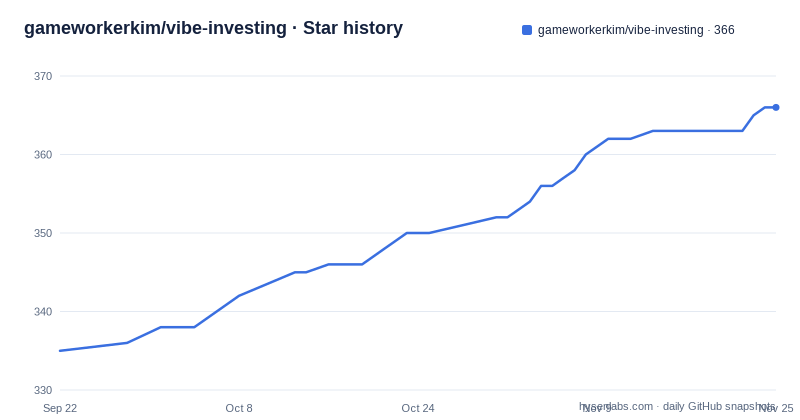
- gameworkerkim/vibe-investing366 ★ · +31
| Repository | 2026-09-22 | 2026-11-25 |
|---|---|---|
| gameworkerkim/vibe-investing | 335 | 366 |
31 Stars in the last 64 days, measured from the daily GitHub snapshot. Compare with other projects
Editorial analysis
The repository is a library of guides, with the README itself in Korean
The README is written mainly in Korean and opens with the author's stance: AI is a tool like Excel, LLMs are not all powerful, and the human who reads the model matters most. The topics it names are the US Nasdaq and S&P 500, crypto, a luxury sector, and crypto to stock correlation.
The folder list confirms the shape. Directories include 01.Trading Strategy, 02.Investment Idea Column, 03. Media-Column, TechDoc, TokenForge, VibeQuant, kiwoom_sdk, MyETF Project, toss-dashboard and a mNAV arbitrage folder, plus Markdown files such as Awesome Vibe Trading Bot.MD and Vibe Investing Risk Management.MD. An English version exists as Readme en.MD.
The consequence is that a visitor expecting one installable program will find a mix of columns, lists and several small projects. The author also says the README is unlikely to update weekly and changes on a random cycle, so do not expect a steady changelog.
Lab pages and the DART Monitor app deploy from different places
The README spends a whole block on a confusion it expects. The DART Monitor, a monitor for KOSDAQ DART disclosures, is a Vercel app at dart-monitor-pi.vercel.app. Its Vercel Git source is the root of github.com/gameworkerkim/cassandra-ai, with a package.json named dart-monitor. The monorepo folder called CASSANDRA AI/ inside this repository is only a copy and is not the Vercel root.
The Lab at vibequant.cc/lab/ is a different thing. It is the output of the Cloudflare Pages project vibequant-web uploading VibeQuant/pages/lab/, and its default tab is TokenForge. The stated deploy command is:
cd VibeQuant/pages && npx wrangler pages deploy . --project-name=vibequant-webIf you set TokenForge/ or CASSANDRA AI/ as the Pages root, the /lab/ page does not change. A path table sits in VibeQuant/pages-lab/SOURCE.md. Editing the wrong folder is the easy mistake here.
TokenForge turns Korean prompts into caveman English and only estimates the saving
TokenForge is a lab tool built on one claim: a Korean prompt sent to a coding agent such as Claude Code or ChatGPT costs more tokens than the same meaning in English. It uses DeepSeek to rewrite the requirements into what the README calls caveman-ultra English, with no articles, greetings, please or ROLE and TASK boilerplate. It then shows an estimated saving for Claude and for ChatGPT, with a stated margin of plus or minus 15 percent.
It shares the Worker DeepSeek key with the Play site at play.vibequant.cc but has no finance gate, so it is a coding prompt converter, not an investing tool. When no key or route is available, a mock rewrites the prompt and still shortens it. On the sample Korean prompt the README gives about 53 percent for Claude and about 45 percent for ChatGPT.
Those are estimates on a sample, and the mock is not the DeepSeek path. The README promises meaning is kept and paths, code and proper nouns are byte-perfect, which you should check on your own prompts.
The finance prompt guide names how LLM prompts fail
One long entry is a due diligence guide on public prompt libraries seen from a finance, quant and crypto angle. It argues that the decisive factor in LLM investment analysis is prompt quality, and that GitHub is full of unverified persona prompts of the form you are Warren Buffett, while structured prompts for real finance, quant and crypto work are few. It looks at prompts.chat, which it credits with more than 143,000 stars, and ternary-ai/prompts, which does agent based finance workflows.
The risks it dissects by layer are hallucination, sycophancy bias, herd risk and crypto data contamination. The closing line is blunt: the LLM is not an oracle, a prompt library is only the manual for the tool, and final judgment and the burden of verification stay with you.
That is a useful warning, and it also applies to the repository itself. Nothing here is investment advice, and no strategy in it is presented with a verified live track record.
Tool reviews repeat third-party figures that you have to check yourself
A number of entries summarise other projects, and their headline figures belong to those projects or to the author's reading of them. The Hy3 guide describes Tencent's Hunyuan Hy3 as a 295B mixture of experts model with 21B active and an Apache 2.0 license, and claims output prices of one twenty-fifth of Claude Sonnet and one fifty-first of GPT-5.5. The caveman and rtk guide claims 65 to 75 percent output savings for caveman and 60 to 90 percent compression for rtk. The Quivr guide cites more than 38,000 stars. The LLM Wiki entry compares DeepWiki, Google Code Wiki and OpenWiki, and the author says he tried all three.
Prices, star counts and savings change, so treat every figure as dated to the entry. The repository also hosts a report on a claimed leak of Claude system prompts. That is an unverified claim by the author, and you should not build on it.
The cost of skipping verification is acting on stale pricing.
Setup files are loose: unpinned Python packages and a two-provider key file
The root requirements.txt lists seven packages with no version pins: pandas, numpy, scipy, matplotlib, requests, tqdm and yfinance. Nothing fixes a version, so a fresh install today can differ from the author's, and a script that worked for him can break for you when a library changes its API.
The .env.example has four settings. CLAUDE_API_KEY and DEEPSEEK_API_KEY take provider keys, PORT is 3000, and DEFAULT_LLM is claude with the comment that it can be claude or deepseek. So any local server code in the repository expects one of those two providers and does not assume others.
Yfinance appearing in the requirements points at market data being pulled from a free source, which matters if you plan to rely on it for anything beyond study. The repository shows no run command at the top level, so each subproject, such as TokenForge or kiwoom_sdk, has to be read for its own instructions.
No releases, an unknown license field and a README that still says MIT
The repository has no GitHub releases, so nothing is tagged to pin. The last push was on 2026-11-02, and the repository is not archived, so it is being edited at present, but the author describes the update rhythm as random.
The license is the part to check before reuse. GitHub's license field is unknown, while the README starts with a badge linking to the MIT license page. A badge is not the same as a LICENSE file in the repository, and the top level folder list shows no LICENSE entry. If you intend to copy code into a product, ask the author or confirm in a subfolder before you do.
A second caution concerns the content. The author describes the repository as scattered, in the manner of a Don Quijote store in Japan, with gems in the mess. That honesty is fair warning that you will need to sift, and that older entries may not match newer ones.
Editorial conclusion
Read this repository as a reading list and lab notebook by one author, useful if you read Korean and want his guides on LLM prompts, token savings and AI tooling. Do not expect a backtesting framework, a packaged trading bot or a stable release you can pin. Before reusing any code, check the license, because GitHub shows none while the README carries an MIT badge.
Frequently asked questions
What is vibe investing in this repository?
It is the author's term for investing with AI as a tool, like Excel, covering Nasdaq, S&P 500 and crypto research, with guides, columns and small lab tools in the repository.
What does "vibe" stand for in vibe-investing?
The repository does not define vibe as an acronym. It uses Vibe Investing for AI assisted investing curation, strategies, columns and papers, with the human reading the model.
What is your vibe meaning for gameworkerkim/vibe-investing?
The README says AI is only a tool like Excel, that LLMs are not all powerful, and that human insight in reading the model matters most.
Official sources
Add this badge to your README
If you maintain this project, the badge below links readers to this analysis and shows its maintenance status from the daily GitHub snapshot. Paste the markdown into your README; add ?metric=license or ?metric=stars to the image URL for a different field.

[](https://hysenlabs.com/projects/gameworkerkim-vibe-investing)Star history chart for your README
[](https://hysenlabs.com/projects/gameworkerkim-vibe-investing)Was this useful?