GetStream/whatsApp-clone-compose: Android Messaging Reference App
📱 WhatsApp clone project demonstrates modern Android development built with Jetpack Compose and Stream Chat/Video SDK for Compose.
At a glance
- What is it?
- This Kotlin sample builds a WhatsApp-style Android interface with Jetpack Compose, Stream Chat, Stream Video, Hilt, AppStartup, and Kotlin Coroutines. It is most useful as a reference implementation, not as a ready-to-ship messaging product.
- Who is it for?
- Android developers studying Compose architecture or Stream SDK integration should inspect this repository, while teams seeking a deployable WhatsApp replacement should first verify backend provisioning, authentication, release artifacts, security controls, and the maintenance cost of the SDK versions used by the project. Based on the documented scope, this is a focused reference application rather than a complete commercial messaging system.
- Can I use it commercially?
- Yes. Apache-2.0 is a permissive licence: you can use, modify and sell software built on it, as long as you keep its copyright and licence notices.
- Is it still maintained?
- Yes. The repository last received commits 22 days ago.
- What is it written in?
- Mainly Kotlin, according to GitHub's language statistics.
Answers come from the project's GitHub data, last synced on November 6, 2026, and from our analysis. They are not legal advice.
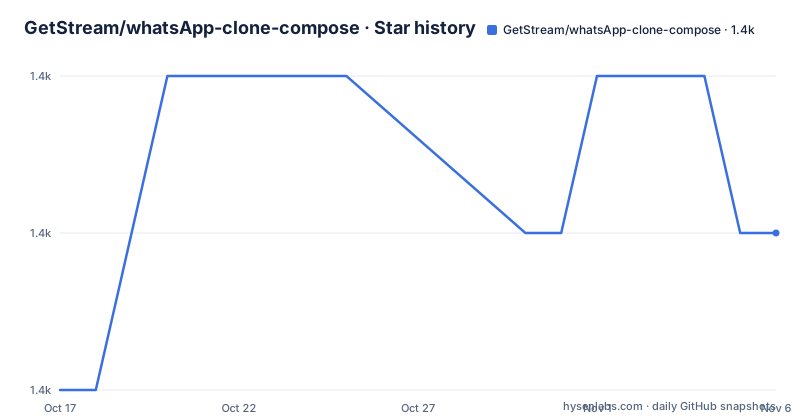
Star history
- GetStream/whatsApp-clone-compose1,387 ★ · +1
| Repository | 2026-10-17 | 2026-11-06 |
|---|---|---|
| GetStream/whatsApp-clone-compose | 1.4k | 1.4k |
1 Stars in the last 20 days, measured from the daily GitHub snapshot. Compare with other projects
Editorial analysis
What the WhatsApp Clone Compose Project Demonstrates
GetStream/whatsApp-clone-compose addresses a specific learning problem: how to assemble a real-time messaging and video calling application on Android using Jetpack Compose and Stream services. It is intended for Android developers who want to study UI implementation, application wiring, background work, and SDK integration in one project. The README explicitly identifies Compose UI construction, Android architecture components, Hilt, AppStartup, Kotlin Coroutines, chat events, and WebRTC-backed video calls as demonstration subjects.
The project imitates the broad interaction model associated with WhatsApp, but the repository description does not claim feature parity with WhatsApp. It is therefore misleading to treat the name as a promise of protocol compatibility, complete account management, or an independently operated messaging network. The documented technical foundation is Stream Chat SDK for Compose for messaging and Stream Video SDK for Compose for calls. Stream handles the relevant service layer, while the repository demonstrates the Android client around it.
That distinction matters when judging adoption. A developer can use the code to learn how chat state, navigation, dependency injection, startup work, and video calling fit into an Android application. A product team looking for a finished social network would still need to establish its own operational, identity, moderation, notification, and backend requirements. The README does not document those product-level concerns.
Compose UI, Hilt, AppStartup, and Coroutine Boundaries
The repository's stated learning goals imply a client-side application assembled from several Android technologies rather than a single-screen UI example. Jetpack Compose supplies the user interface, Hilt appears as the dependency injection mechanism, and AppStartup handles application initialization. Kotlin Coroutines provide the background-task model. These pieces suggest that startup, dependency construction, and asynchronous work are separate concerns, although the README does not document the class-by-class data flow.
The top-level layout reinforces that separation. Directories named `app/`, `core/`, `features/`, `previews/`, `build-logic/`, and `buildSrc/` indicate that build configuration, feature code, shared code, and preview support occupy distinct areas. Gradle Kotlin script files, a `benchmark/` directory, and `spotless/` are also present. Based on that layout, the project is configured as a multi-module-style Android build with project-specific formatting and benchmark locations. The README does not identify every module, so it would be wrong to assign functionality to all of them without inspecting their files.
The value here is architectural context. A small Compose sample can show a composable rendering correctly, while this repository also connects that UI to real-time SDKs and application infrastructure. The documentation does not claim that every architectural layer is explained in the README itself. For detailed coverage, it points readers to two linked blog posts about the overall architecture, layers, Compose themes, and video calling.
Stream Chat Events and Stream Video Calls
Messaging data flow is delegated substantially to Stream Chat SDK for Compose. According to the README, the SDK is used to implement messaging systems and real-time event handling. That means the sample is primarily a client integration study. The repository does not document its own message transport implementation, persistence rules, retry policy, synchronization strategy, or server-side event processing. Those details should not be inferred from the visual similarity to WhatsApp.
Calling is handled through Stream Video SDK for Compose. The README states that this SDK uses WebRTC underneath, so the example extends beyond text chat into real-time media integration. It also links dedicated video call, audio room, and livestream tutorials, but those links describe Stream's broader documentation rather than additional modules confirmed in this repository. The only confirmed call scope for this project is the integration of video calling through the Compose SDK.
This arrangement creates a clear dependency boundary. Developers learn how an Android Compose application can delegate chat transport, real-time event processing, and media calling to external SDKs. They do not get a self-contained protocol stack in this repository. The trade-off is practical for a reference app, because it avoids building a realtime communication service from scratch. It also limits independence, so evaluation must include the SDK's configuration, service dependencies, version compatibility, and licensing terms.
Downloading and Running the Android Sample
The README provides a release route but does not give command-line installation steps, Android Studio setup instructions, SDK configuration, or a documented run command. It directs users to the repository's Releases page to download the latest APK. It identifies API 21 as the minimum supported Android level through the project badge.
For a first real use, begin with the latest published APK from that Releases page. After installation, the expected result is the WhatsApp-style Android application described in the repository. The README does not enumerate its startup screens, test credentials, backend identifiers, navigation steps, or call setup procedure, so it does not support a more specific first-run walkthrough. It also does not say whether an APK can function without service configuration or what account is required.
Building from the default `main` branch appears possible from the repository layout because `gradlew` and `gradlew.bat` are included, but the README does not document the required build command or setup procedure. It would be speculative to supply one as an official tutorial step. Developers who need source-level inspection can review those wrapper files and the linked technical blog posts, but successful compilation, credentials, and device behavior are not confirmed by the README.
Where the Clone Falls Short of a Production Messenger
The largest limitation is scope. The repository presents itself as a demonstration of selected Android technologies and Stream SDK integrations, not as a complete messaging service. The README does not document user registration, account recovery, identity verification, block lists, message moderation, end-to-end encryption, push notification behavior, media retention, account deletion, abuse controls, or operational administration. Their absence from the documentation does not prove they are absent from the source, but it does mean they are not established adoption features.
A second limitation is service coupling. Chat and video depend on Stream SDKs and their service configuration. A team that needs direct control over its messaging infrastructure, data residency arrangement, transport implementation, or backend operations would have to assess that dependency carefully. The README provides links to Stream resources, but it does not state pricing, data handling terms, SDK support boundaries, or migration procedures. No conclusions about those commercial or operational matters should be made from the Apache-2.0 repository license alone.
The code is also less suitable as a generic messaging foundation than its branding may suggest. It demonstrates Compose and Stream integration within one application's structure. A team using another UI toolkit, another chat provider, a different media stack, or a different backend would need to replace substantial integration and architectural choices rather than merely renaming screens.
Comparing the Sample with an Independent Chat Stack
A real alternative is a production chat client backed by an independently selected backend and media stack. Its approach differs in ownership: rather than using Stream Chat SDK for Compose and Stream Video SDK for Compose as the documented foundation, such a system would require the team to choose, integrate, operate, and monitor its messaging, presence, notification, and calling infrastructure. The backend contract, SDK choice, and operational ownership become application decisions instead of dependencies already selected by this sample.
The Stream-backed sample offers a narrower path for developers learning Compose integration because the repository already connects its UI to Stream's chat and video capabilities. An independent stack offers greater control over contracts and infrastructure, but that comes with additional engineering and maintenance work. The alternative is therefore not interchangeable at the code level. It changes who supplies the communication services and which behavior the application team must build or manage.
For learning purposes, the sample also competes with smaller focused examples. The README links to separate repositories for a Twitch clone, a Slack clone, a drawing and chat game, a meeting room, and a Messenger clone. Those projects target different interface and communication patterns. Choosing among them depends on the exact feature being studied rather than on a generic claim that one clone is more advanced.
Maintenance, Releases, and Apache-2.0 Scope
The repository is not archived, and its last push was on 2026-07-08. That date is more recent than the latest listed release, 1.1.2, dated 2024-06-07. Earlier releases were published on 2024-03-15 and 2023-10-26. The repository activity and release history are separate signals: a later push may contain code or configuration changes without producing a new tagged APK.
The README does not provide an upgrade guide, dependency version matrix, migration policy, or support schedule. It also does not explain how updates to Stream Chat, Stream Video, Gradle, the Android toolchain, or Compose are managed. Engineers adopting any part of this project must account for that investigation rather than assuming that the latest repository push represents a supported production release.
The project uses the Apache-2.0 license. That identifies the repository's stated license, but it does not answer questions about external SDK terms, hosted service conditions, or the legal obligations attached to a particular distribution. No legal advice is offered here. Those dependencies and the exact files copied into a derived product require separate review before release.
Editorial conclusion
Android developers studying Compose architecture or Stream SDK integration should inspect this repository, while teams seeking a deployable WhatsApp replacement should first verify backend provisioning, authentication, release artifacts, security controls, and the maintenance cost of the SDK versions used by the project. Based on the documented scope, this is a focused reference application rather than a complete commercial messaging system.
Frequently asked questions
What does GetStream/whatsApp-clone-compose demonstrate?
It demonstrates an Android messaging application built with Jetpack Compose, Stream Chat SDK for Compose, Stream Video SDK for Compose, Hilt, AppStartup, and Kotlin Coroutines. The README specifically highlights Compose UI, architecture components, background tasks, real-time events, and WebRTC-backed video calls.
How can I download the GetStream/whatsApp-clone-compose APK?
The README directs users to the repository's Releases page to download the latest APK. It also displays an API 21 or later badge, but does not provide a command-line installation procedure.
Is GetStream/whatsApp-clone-compose a complete WhatsApp replacement?
The repository describes itself as a clone app demonstrating Jetpack Compose and Stream SDK integration, not as a full WhatsApp replacement. The README does not establish feature parity or document production account, moderation, encryption, and operational controls.
Which license does GetStream/whatsApp-clone-compose use?
The repository identifies Apache-2.0 as its license. The README does not explain the terms of the separately referenced Stream SDKs or hosted services.
Official sources
Add this badge to your README
If you maintain this project, the badge below links readers to this analysis and shows its maintenance status from the daily GitHub snapshot. Paste the markdown into your README; add ?metric=license or ?metric=stars to the image URL for a different field.

[](https://hysenlabs.com/projects/getstream-whatsapp-clone-compose)Star history chart for your README
[](https://hysenlabs.com/projects/getstream-whatsapp-clone-compose)Was this useful?