The Concise TypeScript Book: A Free, Open Source TypeScript Reference With a Paid Plus Edition
The Concise TypeScript Book: A Concise Guide to Effective Development in TypeScript. Free and Open Source.
At a glance
- What is it?
- The Concise TypeScript Book is a free, open source guide to TypeScript's type system and configuration, published as a website, a set of translated README files and an EPUB download. The free edition and the paid Plus Edition sit side by side, which is the first thing to understand before adopting it.
- Who is it for?
- Adopt the free book if you want a compact, open source reference for TypeScript's type system and compiler configuration, and you are comfortable reading it on the web or as an EPUB. Do not treat it as a replacement for the official TypeScript handbook if you need exhaustive, versioned coverage, and do not expect the free edition to contain the React and TypeScript 7 material that the README assigns to the Plus Edition.
- Can I use it commercially?
- Check first. The repository uses a licence we do not classify automatically, so read its LICENSE file before any commercial use.
- Is it still maintained?
- Yes. The repository last received commits 1 day ago.
- What is it written in?
- Mainly TypeScript, according to GitHub's language statistics.
Answers come from the project's GitHub data, last synced on November 7, 2026, and from our analysis. They are not legal advice.
Star history
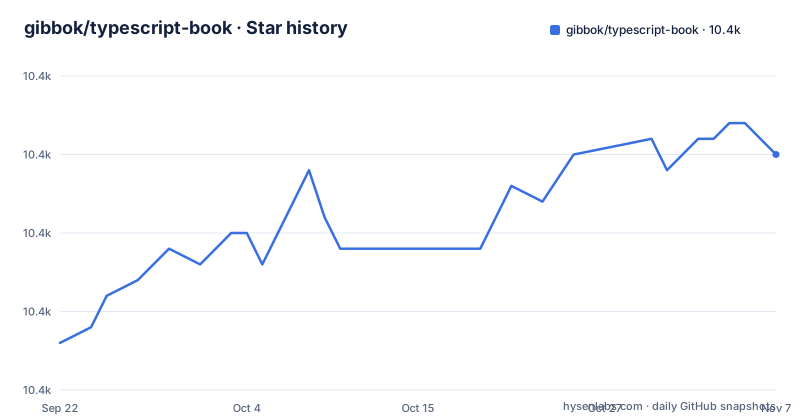
- gibbok/typescript-book10,365 ★ · +12
| Repository | 2026-09-22 | 2026-11-07 |
|---|---|---|
| gibbok/typescript-book | 10.4k | 10.4k |
12 Stars in the last 46 days, measured from the daily GitHub snapshot. Compare with other projects
Editorial analysis
What the free TypeScript book actually covers
The repository describes itself as a comprehensive and succinct overview of TypeScript's capabilities, covering the language from its type system to advanced features. The README frames it for two audiences at once: beginners and experienced developers. That is a broad claim, and the table of contents is where it becomes concrete. The listed chapters move from a TypeScript introduction (what it is, why use it, how it relates to JavaScript, code generation, downleveling) into getting started, then into the type system itself: structural typing, comparison rules, types as sets, type declarations versus type assertions, ambient declarations, excess property checking, weak types, freshness checking and type inference.
That ordering matters. This is not a tutorial that walks you through building an application. It is a reference organized around language concepts, closer to a handbook than a course. If you want to understand why a particular assignment compiles or fails, the chapter list is aimed at you. If you want to build a first project step by step, the book gives you installation and configuration chapters, but the emphasis sits on the type system.
The README also states the book is completely free and open source, and that the author keeps it freely available and regularly updates it with improvements and new examples. The repository was last pushed on 2026-10-30, and it is not archived, so the free edition is being maintained as of that date.
How the repository is organized: website, translations, downloads and tools
The top-level layout tells you how the book is produced and distributed. There is a website/ directory, a translations/ directory, a downloads/ directory and a tools/ directory, alongside README.md and eighteen translated README files (Arabic, Bulgarian, Czech, German, Spanish, French, Indonesian, Italian, Japanese, Korean, Polish, Portuguese (Brazil), Russian, Swedish, Thai, Turkish, Vietnamese and Chinese). There is also an AGENTS.md file and a .agents/ directory at the root, plus .github/ and .vscode/.
The website directory is what backs the online version at gibbok.github.io/typescript-book. The downloads directory holds the EPUB build, which the README links to directly. The translations are separate README files rather than a translation framework, which means the translated content lives in files named with locale suffixes such as README-ja_JP.md and README-zh_CN.md.
One practical consequence: the English README.md is the canonical index. The translated READMEs mirror it for their languages, and the README lists them as translations of the book. If you read in a language other than English, you are reading a translated copy of the same table of contents, not a separate book.
Installing nothing: reading the book online or as an EPUB
There is no package to install. The book is documentation, so the setup is choosing a reading surface. The README gives two: the online version and the EPUB download.
The online version is the homepage listed in the repository metadata:
https://gibbok.github.io/typescript-bookOpen that URL and you get the rendered book. No build step, no clone.
If you prefer an e-reader, the README points at the downloads directory for the EPUB:
https://github.com/gibbok/typescript-book/tree/main/downloadsThat directory contains the EPUB file referenced by the README. Download it and open it in any EPUB reader.
If you want the source instead, clone the repository and read the Markdown directly. The root README.md carries the table of contents, and the translated files sit next to it with locale suffixes. Source does not show how the website or EPUB is built; the tools/ directory is at the repository root.
A first real use: pick a chapter that maps to a problem you already have, such as excess property checking or type inference, read it, then test the behaviour in a scratch TypeScript file. The book's value is in the explanations, not in runnable examples shipped as a project.
The free edition versus the Plus Edition
This is the part of the README that deserves the most attention, because it defines the boundary of what you get for free. The README promotes a separate product, The Concise TypeScript Book Plus Edition: React and Real-World Patterns for TypeScript 7. The Plus Edition is described as including three things the free book does not: coverage updated for TypeScript 7, practical guidance for TypeScript with React (typing components, props, hooks, events, children, refs and common React patterns), and TypeScript recipes for real-world projects.
The README states the Plus Edition is available in English and Italian on Amazon worldwide, and links to a dedicated page. It also states that purchasing it supports the continued development and maintenance of the free and open-source book.
So the split is explicit: the free book covers the language and its type system, and the paid book covers React integration and TypeScript 7 specifics. If your work is React-heavy, or you are specifically tracking TypeScript 7 changes, the free edition as described will not cover that ground. That is not a flaw in the free book. It is a scope decision stated plainly in the README, and it is better to know it before you start reading and wonder where the React chapter is.
The README also asks readers to support the project through a pay-what-you-want contribution with a suggested amount of $5, or through Buy Me a Coffee and PayPal links.
Where the book is the wrong tool
The book is a conceptual reference, and the README does not present it as anything else. If you need exhaustive, versioned coverage of every compiler flag and every language change, the official TypeScript documentation is the source of record, and a community book is a companion to it, not a substitute. The README does not claim otherwise.
A second limitation is the React and TypeScript 7 gap described above. If those are your immediate needs, the free edition is the wrong purchase, because there is no purchase. The material you want is in the Plus Edition.
A third limitation is practical: if you want to fork the book, translate it into a new language, or regenerate the artifacts, check the tools/ and translations/ directories and the repository layout for how the pipeline works.
Finally, a book about a fast-moving language ages. The README says the author regularly updates the free book, and the last push was on 2026-10-30, so the free edition is current as of that date. But if you need guarantees about which TypeScript version a given chapter reflects, check the book itself, since the README describes it as covering the latest version of the language.
Alternatives and how they differ
The most direct alternative is the official TypeScript documentation. The difference is authority and scope: the official docs are maintained by the TypeScript team and track the compiler release by release, while The Concise TypeScript Book is a single author's condensed overview, distributed as a website and an EPUB with community translations. If you need the definitive answer on a compiler flag, go to the official docs. If you want a shorter, opinionated pass over the type system that you can read end to end, the book is built for that.
A second alternative is the Plus Edition of this same book. The difference is content, not approach: same author, same style, but with React patterns and TypeScript 7 coverage added, and sold on Amazon in English and Italian. If the free book's chapter list matches your needs, the Plus Edition is redundant. If you need React typing guidance, it is the version that has it.
A third alternative is any other TypeScript book, and the README's own framing is useful here: it positions this one as concise. That is the trade-off. A concise book covers less ground per topic than a long one. The README leans into that with the word succinct. Whether that is a feature or a gap depends entirely on how much depth you need on any single concept.
Licence, maintenance and upgrade cost
The repository metadata reports the licence as NOASSERTION, which means the licence could not be classified automatically from the repository. The repository does contain a LICENSE.MD file at the top level, so a licence text exists, but the repository metadata does not classify it. If you intend to reuse, translate or redistribute the content, read LICENSE.MD directly rather than assuming. The README calls the book free and open source, and those two words do not by themselves tell you what redistribution is permitted.
On maintenance: the repository is not archived, and the last push was on 2026-10-30. The README states the author regularly updates the book with improvements and new examples. The most recent GitHub releases are typescript-7-book-v1-4 (2026-10-14), typescript-7-book-v1-3 (2026-10-13) and typescript-7-book-v1-2 (2026-10-11), and updates also arrive as commits to main.
The upgrade cost is close to zero for readers. There is nothing to install and nothing to migrate. You re-read the online version or download a newer EPUB. For anyone forking or translating, the cost is different: keeping a fork in sync means understanding the repository structure yourself. The eighteen translated README files also imply an ongoing translation upkeep burden.
Editorial conclusion
Adopt the free book if you want a compact, open source reference for TypeScript's type system and compiler configuration, and you are comfortable reading it on the web or as an EPUB. Do not treat it as a replacement for the official TypeScript handbook if you need exhaustive, versioned coverage, and do not expect the free edition to contain the React and TypeScript 7 material that the README assigns to the Plus Edition. Before relying on it, check the table of contents in the repository to confirm the chapter you need is present, and check the downloads directory for the EPUB.
Frequently asked questions
What is a TypeScript book?
In this case, it is a free and open source book that the README describes as a comprehensive and succinct overview of TypeScript's capabilities, covering the type system and advanced features. It is published as an online version and as an EPUB download.
Is The Concise TypeScript Book worth it in 2026?
The README states the book is completely free and open source and that the author regularly updates it with improvements and new examples. The repository was last pushed on 2026-10-30 and is not archived, so the free edition is current as of that date.
What is the best way to learn TypeScript with The Concise TypeScript Book?
The README says the book suits both beginners and experienced developers, and its chapter list starts with a TypeScript introduction and getting started material before moving into the type system. Reading those early chapters first follows the order the book itself uses.
Can I learn TypeScript in a week with The Concise TypeScript Book?
The README describes the book as concise and succinct, and it is free to read online or as an EPUB, so the pace is up to you.
Official sources
Add this badge to your README
If you maintain this project, the badge below links readers to this analysis and shows its maintenance status from the daily GitHub snapshot. Paste the markdown into your README; add ?metric=license or ?metric=stars to the image URL for a different field.

[](https://hysenlabs.com/projects/gibbok-typescript-book)Star history chart for your README
[](https://hysenlabs.com/projects/gibbok-typescript-book)Was this useful?