github/india is a link directory, and its staleness is the main defect
GitHub resources and information for the developer community in India
At a glance
- What is it?
- github/india is a GitHub-maintained community page collecting open source projects, grants, student programmes and events for developers in India. It has no software, no releases and a licence that permits reuse of the content.
- Who is it for?
- Treat github/india as a pointer list rather than a dependency: it is useful for finding Indian projects and programmes, and it is not a source of structured data you can rely on, since the project catalogue lives on an external site and several entries are dated. Read the CC0 licence before republishing, since it makes the text reusable in a way most community pages are not.
- Can I use it commercially?
- Yes. CC0-1.0 is a permissive licence: you can use, modify and sell software built on it, as long as you keep its copyright and licence notices.
- Is it still maintained?
- Yes. The repository last received commits 32 days ago.
- What is it written in?
- Mainly Ruby, according to GitHub's language statistics.
Answers come from the project's GitHub data, last synced on November 7, 2026, and from our analysis. They are not legal advice.
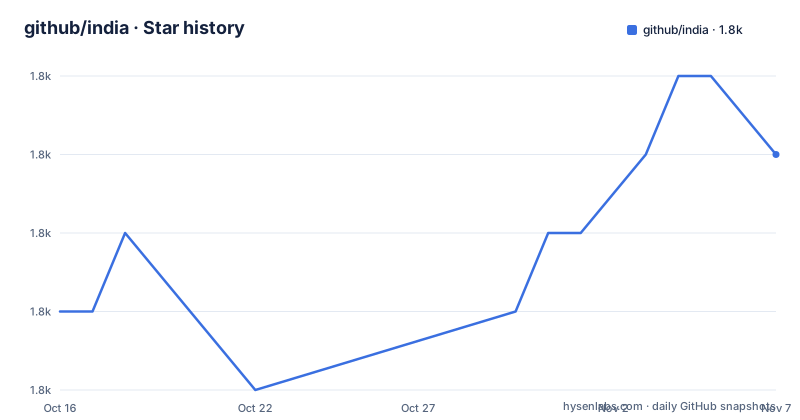
Star history
- github/india1,828 ★ · +2
| Repository | 2026-10-16 | 2026-11-07 |
|---|---|---|
| github/india | 1.8k | 1.8k |
2 Stars in the last 22 days, measured from the daily GitHub snapshot. Compare with other projects
Editorial analysis
A community page with directory-shaped folders
github/india collects resources and information for the developer community in India, and the repository layout mirrors that purpose literally. The top-level tree contains directories named Open Source/, Startups/, Students/ and Events/, alongside README.md, CODEOWNERS, CODE_OF_CONDUCT.md, CONTRIBUTING.md, a script/ directory, a website/ directory and assets/ with the project artwork.
That structure is the most useful fact in the repository. It is not a Ruby gem despite the primary language being reported as Ruby, and it is not a generator or a data package. Ruby is what the script/ directory appears to hold, presumably for whatever drives the website/ content, but nothing in the README describes it and no usage is documented.
The README is the actual artefact, and it is a table of contents followed by linked sections. The consequence for an engineer is simple: there is nothing here to install, nothing to configure and no API. If you came looking for a library, you have the wrong repository.
Projects and maintainers live on another website
The open source section opens with the observation that the ecosystem in India is thriving, with contributors and maintainers and projects built there, and then immediately hands off. Projects and maintainers from India are collated on the githubindia.com website, not in this repository.
The README asks readers who know of additional projects or maintainers to send a contribution, pointing at CONTRIBUTING.md, and the contributing section is truncated in the visible text where it explains which parts of the repository accept contributions. That phrasing is itself informative: not everything in the repo is editable by outsiders.
So the useful output of the open source section is a single link plus a grants reference. If you are looking for the catalogue, this repository is a signpost to it, and the signpost is worth having only if you know to follow it.
The grants section is the only dated, specific claim
GitHub Grants for Open Source is the one section with numbers attached. The program was announced at GitHub Satellite India 2021, and it provides monetary grants to contributors and maintainers from a total fund of INR 1 crore. Recipients are covered in an announcement blog post on github.blog dated 2021-09-12.
That is a concrete programme with a defined size and a published outcome, which makes it more useful than the rest of the page. The README describes it in the past tense as something that was announced, with no indication of whether the fund is still open or whether a further round exists.
The Resources subsection that follows points contributors and maintainers to the Open Source Guide for advice on starting a project, building communities and maintainer best practices. That is a general resource rather than an India-specific one, and it is the only link in the README that is not tied to a programme or event.
Events and programmes are links to GitHub's own programmes
The developer, student and startup sections all point at GitHub programmes rather than at anything built in this repository.
For developers, there is a GitHub India Virtual Meetup group on Meetup, described as for developers in India by developers in India, and a link to the GitHub Stars profiles filtered by country, plus nomination links for both GitHub Stars and The ReadME Project. The ReadME section highlights three named profiles from India: Shikha Mishra, Liyas Thomas and Karthik Iyer.
For students, the Campus Program page for schools, the Student Developer Pack for free access to developer tools, and a Campus Experts directory filtered for India.
For startups, GitHub for Startups, which the README describes as helping startups go from idea to IPO with free access to GitHub Enterprise, with details at startups.github.com.
The events section is the one place where the content has visibly aged. It covers GitHub Universe 2022, held virtually or live at the Yerba Buena Center for the Arts in San Francisco on November 9 and 10, two days. It lists a 2022 conference event with no replacement shown, which is the clearest signal of how the page is maintained.
Maintenance, licence, and what to do with the page
The repository is not archived and the last push was on 2026-10-06, so somebody is still editing it. What that editing looks like is limited: there are no GitHub releases, and the visible changes are content links rather than anything structural.
The licence is CC0-1.0, which is the notable practical detail. CC0 is a public domain dedication rather than a permissive licence with attribution requirements, so the text of the page can be reused without crediting the source. That is unusual for a company-run community page and it makes the content straightforward to quote or republish, subject to any third-party links it contains.
For use, the sensible reading is that this repository is a bookmark file. It is worth scanning once for the grants programme and the programmes, and it is not worth building anything on top of it, because the substantive catalogue sits on an external site that this repository does not mirror, and the events section is out of date.
If you want to contribute, the README routes you to GitHub Discussions on the repository itself, asks you to respect CODE_OF_CONDUCT.md, points to CODEOWNERS for who reviews what, and has a Twitter account linked as the broadcast channel.
Editorial conclusion
Treat github/india as a pointer list rather than a dependency: it is useful for finding Indian projects and programmes, and it is not a source of structured data you can rely on, since the project catalogue lives on an external site and several entries are dated. Read the CC0 licence before republishing, since it makes the text reusable in a way most community pages are not. If you are looking for a maintained index of Indian open source work, the githubindia.com site referenced from the README is the place the project itself points to, and anything you build on it should verify each link rather than trusting the listing.
Frequently asked questions
What is the github/india repository for?
It collects resources and information for the developer community in India: links to projects and maintainers collated on githubindia.com, the GitHub Grants for Open Source programme, meetups, student programmes, GitHub for Startups and events.
What licence does github/india use and can I reuse its content?
The repository is licensed CC0-1.0, a public domain dedication rather than an attribution-based licence, so the text can be reused without crediting, subject to the third-party links it points at.
Where can I find the list of Indian open source projects and maintainers?
The README states that projects and maintainers from India are collated on the githubindia.com website rather than in this repository, and asks readers to contribute additional names through CONTRIBUTING.md.
Official sources
Add this badge to your README
If you maintain this project, the badge below links readers to this analysis and shows its maintenance status from the daily GitHub snapshot. Paste the markdown into your README; add ?metric=license or ?metric=stars to the image URL for a different field.

[](https://hysenlabs.com/projects/github-india)Star history chart for your README
[](https://hysenlabs.com/projects/github-india)Was this useful?