Google Research on GitHub: A Monorepo of Experiments, Not a Product
Google Research
At a glance
- What is it?
- Google Research's public GitHub repository bundles hundreds of research code snapshots under Apache 2.0. It is a discovery archive, not a stable library, and its value depends on how you browse it.
- Who is it for?
- Adopt this repository if you want to inspect or build on specific research code from Google, and you are comfortable with experimental quality and no release cadence. Do not adopt it as a dependency for production systems; it is a collection of snapshots, not a maintained SDK.
- Can I use it commercially?
- Yes. Apache-2.0 is a permissive licence: you can use, modify and sell software built on it, as long as you keep its copyright and licence notices.
- Is it still maintained?
- Yes. The repository received new commits within the last day.
- What is it written in?
- Mainly Jupyter Notebook, according to GitHub's language statistics.
Answers come from the project's GitHub data, last synced on November 14, 2026, and from our analysis. They are not legal advice.
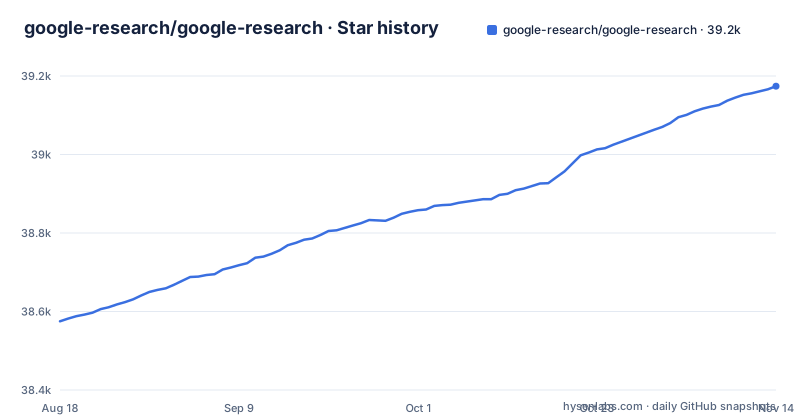
Star history
- google-research/google-research39,174 ★ · +599
| Repository | 2026-08-18 | 2026-11-14 |
|---|---|---|
| google-research/google-research | 38.6k | 39.2k |
599 Stars in the last 88 days, measured from the daily GitHub snapshot. Compare with other projects
Editorial analysis
What This Repository Actually Is
This is not a single project. It is a monorepo that aggregates code released by Google Research. The README states that all datasets inside are under CC BY 4.0 and all source files are under Apache 2.0. The primary language is Jupyter Notebook, which tells you the code is often exploratory. The repository has no GitHub releases, and its last push was on 2026-10-30. That means you are looking at a living archive of research outputs, not a versioned product. If you need a stable API, this is the wrong place.
The Core Problem It Solves: Discoverability of Research Code
Google Research publishes papers and often releases code. Without a central place, you would have to track each project individually. This repository solves that by putting hundreds of research code snapshots in one location. For an engineer, the value is the ability to search across many experiments and find a starting point for a technique you want to reproduce. The README explicitly recommends downloading only the subdirectory of interest, because the full repo is large. That is the key use case: targeted retrieval, not full integration.
How the Repository Is Structured
The structure is a flat collection of subdirectories, each typically representing a separate research project. The README gives no index or overview of what each folder contains. You are expected to know what you are looking for, or to browse the GitHub interface. The data flow is simple: you clone the repo or download a folder, then run the code in that folder. The documentation does not describe any shared build system, common dependencies, or interoperability between subdirectories. Each subdirectory likely has its own README, but the top-level README does not summarize them. This means the repository is more like a file cabinet than a coherent codebase.
Getting It Running: Commands and Practical Steps
The README gives one explicit command for cloning: git clone [email protected]:google-research/google-research.git --depth=1. The depth flag creates a shallow clone without history, which is sensible for a large repository. For most use, the README suggests using the GitHub editor by changing the URL from github.com to github.dev, then right-clicking the folder of interest and selecting download. That avoids cloning the entire repo. There are no other setup instructions in the top-level README. You will need to read the individual subdirectory's README to learn dependencies and execution steps. The license is Apache 2.0 for code, which permits commercial use with attribution, but you must verify each file's headers because the top-level statement is a blanket claim.
A Genuine Limitation: No Maintenance Guarantees
The repository has no release process and no stated maintenance policy. The README was updated in 2023, but individual subdirectories may be stale. Research code is often a proof of concept, not production-grade. The Jupyter Notebook primary language reinforces that. You cannot rely on bug fixes or security patches. If you build on a subdirectory, you are on your own. The README also includes a disclaimer: 'This is not an official Google product.' That is a clear warning about support. For a production system, this repository is the wrong tool unless you are prepared to fork and maintain the code yourself.
Alternative Approaches and How They Differ
A real alternative is to go directly to the specific project's own repository. The monorepo here is a snapshot, while a dedicated repo often has active development and a clear versioning scheme. Another alternative is to use the original paper's supplementary material or a third-party reimplementation. The difference is that this monorepo comes with no support. A dedicated repo might be more maintained but could diverge from the paper. You have to decide which fidelity you need. For a quick experiment, the monorepo is fine. For a long-term dependency, a dedicated repo or a fork with a commit history is better.
Licensing and Maintenance Cost
The licensing is clear at the top level: source under Apache 2.0, datasets under CC BY 4.0. Apache 2.0 allows commercial use, modification, and distribution, with conditions on attribution and patent protection. CC BY 4.0 for datasets requires attribution and allows sharing and adaptation. The maintenance cost is high because you must track the specific subdirectory you use. You will need to periodically check the subdirectory for updates manually. The shallow clone command reduces initial download cost, but it also removes history, so you cannot see how the code evolved. That is a trade-off: you save bandwidth but lose context. The repository's size is a real cost, and the README's advice to download only a subdirectory is the only mitigation.
Editorial conclusion
Adopt this repository if you want to inspect or build on specific research code from Google, and you are comfortable with experimental quality and no release cadence. Do not adopt it as a dependency for production systems; it is a collection of snapshots, not a maintained SDK. Before using any subdirectory, verify its own README, license headers, and recent commit history, because the top-level README only gives you the license and the clone command. Check whether the specific code you need has a separate project page or a more maintained fork, and confirm the dataset license applies to your use case.
Frequently asked questions
what is google research
The repository is a public dump of code released by Google Research, with source files under Apache 2.0 and datasets under CC BY 4.0 International. It carries a disclaimer that it is not an official Google product, a note that the file was updated in 2023, and a homepage at research.google.
is google research ai
The top level is a flat alphabetical list of research project folders, from short names such as aqt, alx and TimesX to full paper titles with spaces replaced by underscores, alongside a root __init__.py. Nothing groups those folders or states which of them are current, and no GitHub releases exist for the repository.
what is google research colab
Nothing in the README mentions Colab. The closest documented route to running a single project is to open it in the GitHub web editor by changing github.com to github.dev and downloading that folder, or to clone the whole repository shallowly with git clone [email protected]:google-research/google-research.git --depth=1.
How do I get into Google Research?
The README documents no hiring, internship, or onboarding route. The only way in it describes is a pull request, which requires cloning the repository, and it recommends a shallow clone without history to keep the download manageable.
google research vs deepmind
The README contains no comparison and never mentions DeepMind. What it does state is that it holds code released by Google Research, that it is not an official Google product, and that its default branch is master rather than main.
Official sources
Add this badge to your README
If you maintain this project, the badge below links readers to this analysis and shows its maintenance status from the daily GitHub snapshot. Paste the markdown into your README; add ?metric=license or ?metric=stars to the image URL for a different field.

[](https://hysenlabs.com/projects/google-research-google-research)Star history chart for your README
[](https://hysenlabs.com/projects/google-research-google-research)Was this useful?