Google HTTP Client Library for Java: Web Requests and Data Models
Google HTTP Client Library for Java
At a glance
- What is it?
- Google HTTP Client Library for Java is a Java library for HTTP communication with pluggable transports and JSON or XML models. It suits Java and Android applications that need a shared request layer across different networking stacks.
- Who is it for?
- Adopt this library when a Java or Android application needs HTTP access with interchangeable low-level transports and JSON or XML serialization. Do not choose it as a complete API client or OAuth layer by itself, and verify the setup instructions, transport module, serialization choice, and beta annotations before integrating it.
- Can I use it commercially?
- Yes. Apache-2.0 is a permissive licence: you can use, modify and sell software built on it, as long as you keep its copyright and licence notices.
- Is it still maintained?
- Yes. The repository last received commits 1 day ago.
- What is it written in?
- Mainly Java, according to GitHub's language statistics.
Answers come from the project's GitHub data, last synced on October 23, 2026, and from our analysis. They are not legal advice.
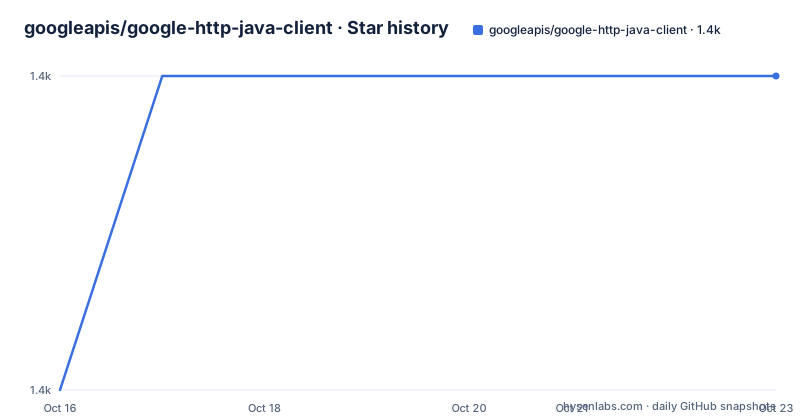
Star history
- googleapis/google-http-java-client1,445 ★ · +1
| Repository | 2026-10-16 | 2026-10-23 |
|---|---|---|
| googleapis/google-http-java-client | 1.4k | 1.4k |
1 Stars in the last 7 days, measured from the daily GitHub snapshot. Compare with other projects
Editorial analysis
What Google HTTP Client Library for Java Solves
Google HTTP Client Library for Java addresses the part of application development that sits between application logic and an HTTP endpoint. Code written against this library can issue requests to web resources without committing the surrounding application to one low-level networking implementation. The README identifies java.net.HttpURLConnection, Apache HTTP Client, and URL Fetch on Google App Engine as possible transports. That separation matters when the same request code needs to run in different Java environments, including an Android application and a server-side application.
The target audience is Java developers who need more than a thin convenience method for a single HTTP operation. It can also fit Android projects, because the README lists Android 4.4 Kit Kat and Google App Engine among supported environments. The library itself is not described as a service-specific API client. Its related projects provide separate layers for OAuth authorization and Google APIs, so this repository should be evaluated as an HTTP foundation rather than as a replacement for those higher-level libraries.
The scope includes both sending HTTP requests and representing response or request content. JSON and XML data models are part of the library, and the repository layout includes separate modules for Gson, Jackson2, XML, Apache HTTP Client v2, Apache HTTP Client v5, App Engine, Android, and protobuf. This modular layout gives callers separate choices instead of requiring every application to load every integration.
Transport Abstraction and Data Flow
The central design choice is a pluggable HTTP transport abstraction. Application code can use a low-level library such as java.net.HttpURLConnection, Apache HTTP Client, or URL Fetch on Google App Engine, while the higher-level library handles the common request and response model. The README does not provide the class names or a complete data-flow example, so the exact API surface should be checked in the linked Developer's Guide and JavaDoc. The architectural fact is nevertheless clear from the documented feature list: the transport is replaceable.
Content handling follows a second axis of replaceability. The library supplies efficient JSON and XML data models for parsing and serializing HTTP response and request content. Those models are fully pluggable, with support for Jackson and Android's GSON libraries for JSON. This means an application can choose a data binding implementation that fits its runtime or existing dependency set, rather than treating one JSON parser as inseparable from HTTP transport.
The repository structure reinforces that separation. The top-level `google-http-client` module represents the core library, while `google-http-client-gson`, `google-http-client-jackson2`, and `google-http-client-xml` represent serialization integrations. The `google-http-client-apache-v2`, `google-http-client-apache-v5`, and `google-http-client-appengine` directories correspond to transport or environment integrations. Based on the repository layout, this is a multi-module Java project with optional integrations rather than a single all-purpose artifact.
Installation and First Java HTTP Use
The README links to the project's Setup Instructions at `https://googleapis.github.io/google-http-java-client/setup.html`, but it does not include Maven or Gradle dependency declarations. It would therefore be inaccurate to invent an artifact version, dependency block, or command here. The documented starting point for installation is the linked setup page. The README also links to JavaDoc, which can show the current class and method names needed to write a first request.
A first real use should begin by selecting the core module and only adding the transport and serialization modules required by the application. The repository's module names show the available integration areas, but they do not by themselves define dependency coordinates. The setup documentation should be consulted before copying configuration into a build file.
For a first example, the application needs to identify its HTTP endpoint, select a supported transport for the Java environment, and choose either the JSON or XML model. The README gives no endpoint, executable sample instruction, or complete code listing that can be copied as a verified first-use script. The `samples/` directory contains `dailymotion-simple-cmdline-sample`, `install-without-bom`, `snapshot`, and `snippets`, but the README does not document how to run any of them. Those directories are useful places to inspect for repository examples, not evidence that a particular command will work.
Compatibility, Modules, and Integration Boundaries
The documented environment baseline is Java 8 or higher, Android 4.4 Kit Kat, and Google App Engine. This gives the library a broad compatibility target, but it does not mean every integration module works in every environment. Apache HTTP Client v2 and Apache HTTP Client v5 are separate repository modules, and App Engine has its own module. The caller must choose an integration that matches the runtime and dependency constraints.
The JSON choices also differ. The README names Jackson and Android's GSON as supported pluggable options, while the repository contains both `google-http-client-gson` and `google-http-client-jackson2`. It also contains `google-http-client-protobuf`, although the README's feature list does not describe protobuf support in detail. That difference is worth noting during evaluation. The presence of a module indicates a repository area for that integration, not a guarantee that its API or compatibility requirements are identical to the core modules.
For Java libraries published to downstream users, beta annotations are a direct constraint. The README says that features marked `@Beta` at class or method level may be modified or removed in any major release, and it advises against using beta features when the consuming code is itself a library placed on the `CLASSPATH` of users outside its control. This is a different upgrade risk from an application that can update its own source code.
Maintenance, Release Policy, and Upgrade Cost
The repository is not archived, and its last push was on 2026-10-09. The release history lists `v2.2.0` dated 2026-07-20, `v2.1.1` dated 2026-06-29, and `v2.1.0` dated 2026-01-23. These dates indicate recent repository activity and recent 2.x releases. They do not establish compatibility for every module or prove that an application will upgrade without source changes.
The README's deprecation policy provides a concrete upgrade rule. Deprecated non-beta features are scheduled for removal eighteen months after the release in which they were first deprecated. The README warns that unaddressed usages may break and that compilation errors are not guaranteed. Applications using deprecated APIs therefore need to track release notes and inspect deprecation annotations, rather than relying on the build to identify every problem.
The project is licensed under `Apache-2.0`, as stated in the repository metadata. That license identifies the project's licensing terms, but this article does not provide legal interpretation. The actual obligations for distribution, notices, and modified files should be checked against the repository's `LICENSE` file.
Limits and Alternatives
The main limitation is scope. Google HTTP Client Library for Java provides an HTTP layer, pluggable transports, and JSON or XML models. It does not itself provide the OAuth 2.0 or OAuth 1.0a authorization implementation or the complete surface for Google APIs. The README names Google OAuth Client Library for Java and Google APIs Client Library for Java as related projects. A project whose primary requirement is authentication or a ready-made Google API surface may need one of those layers in addition to, or instead of, this library.
Another limitation is integration discipline. A transport abstraction does not remove the need to choose a compatible low-level library. Similarly, adding Jackson or GSON means selecting a serialization path and managing the resulting dependency. The library can keep request code more portable, but it cannot make environment-specific HTTP behavior disappear.
Compared with using java.net.HttpURLConnection directly, this project adds reusable models and alternate transport integrations. Compared with a service-specific API client, it leaves more application-level work to the caller, but also avoids tying the HTTP foundation to one API ecosystem. That difference is architectural, not a claim that one approach is always better.
Editorial conclusion
Adopt this library when a Java or Android application needs HTTP access with interchangeable low-level transports and JSON or XML serialization. Do not choose it as a complete API client or OAuth layer by itself, and verify the setup instructions, transport module, serialization choice, and beta annotations before integrating it. The repository's last push was on 2026-10-09, so its maintenance status is current rather than abandoned.
Frequently asked questions
Which Java versions does Google HTTP Client Library for Java support?
The README lists Java 8 or higher, Android 4.4 Kit Kat, and Google App Engine as supported environments.
Can Google HTTP Client Library for Java use Apache HTTP Client?
Yes. The README describes a pluggable transport abstraction that supports low-level libraries such as java.net.HttpURLConnection, Apache HTTP Client, and URL Fetch on Google App Engine.
Does Google HTTP Client Library for Java handle JSON and XML?
Yes. It provides pluggable JSON and XML data models for parsing and serializing request and response content, with documented support for Jackson and Android's GSON libraries for JSON.
Official sources
Add this badge to your README
If you maintain this project, the badge below links readers to this analysis and shows its maintenance status from the daily GitHub snapshot. Paste the markdown into your README; add ?metric=license or ?metric=stars to the image URL for a different field.

[](https://hysenlabs.com/projects/googleapis-google-http-java-client)Star history chart for your README
[](https://hysenlabs.com/projects/googleapis-google-http-java-client)Was this useful?