HaoZhang95/Python24: A Structured Python and Machine Learning Study Path
仓库主要为了学习Python和机器学习基础,每一章的具体知识点可以在下面的目录中详细查看课程大纲,具体的讲义文档,提供在线阅读和下载,大部分的章节讲义使用了Gitbook进行整章的阅读,同样的,在学习的过程中,我在代码中都每行进行了注释,基本上不用看文档也能理解,方便进行阅读和理解,**望大家多多支持,喜欢本仓库的话,记得Star哦,希望能够帮助大家。**
At a glance
- What is it?
- HaoZhang95/Python24 organizes Python fundamentals, web development, concurrency, databases, automation, and data structures into chapter-based study material. It is best suited to learners who want guided examples, but its outdated dependencies and inconsistent catalog limit its use as a production template.
- Who is it for?
- HaoZhang95/Python24 suits self-directed learners who want a broad, example-led path through Python and early web development. It is a poor foundation for a current production application because its dependency set is substantially older than the current Python ecosystem, and it does not document a reproducible environment.
- Can I use it commercially?
- Yes. MIT is a permissive licence: you can use, modify and sell software built on it, as long as you keep its copyright and licence notices.
- Is it still maintained?
- Activity is slowing. The repository last received commits 6 months ago.
- What is it written in?
- Mainly Python, according to GitHub's language statistics.
Answers come from the project's GitHub data, last synced on November 7, 2026, and from our analysis. They are not legal advice.
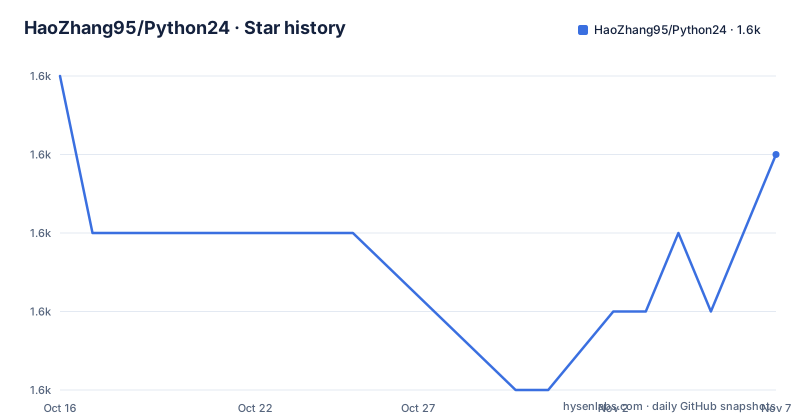
Star history
- HaoZhang95/Python241,555 ★ · -1
| Repository | 2026-10-16 | 2026-11-07 |
|---|---|---|
| HaoZhang95/Python24 | 1.6k | 1.6k |
-1 Stars in the last 22 days, measured from the daily GitHub snapshot. Compare with other projects
Editorial analysis
Python24’s chapter map and intended learners
HaoZhang95/Python24 addresses learners who want a guided route through Python and introductory machine learning rather than a single reusable library. Its sequence starts with `00Python`, Linux, network programming, multitasking, web servers, regular expressions, advanced Python, and MySQL. It then covers HTML, CSS, JavaScript, jQuery, Django, Flask, Redis, Git, several application projects, crawling, operations automation, deployment, and data structures. The repository description also identifies machine learning as a goal, although the visible catalog ends with `27数据挖掘`, which is marked incomplete.
Each topic has its own directory and `README.md`, giving learners a course-like structure rather than an unstructured collection of snippets. The README says most chapter lectures were prepared for GitBook, while a published site provides online reading. It also states that the code contains comments on many lines, reducing the need to switch repeatedly between notes and implementation. That format is useful for students who are still learning syntax and program structure.
The intended audience is narrower than the directory may initially suggest. This is study material assembled from an older Chinese programming course, not a current Python package, framework, or deployment product. It offers no component with an API intended for downstream developers. Learners looking for one production-ready web application should select a smaller, maintained framework project instead. The repository is more relevant as a map of foundational subjects and examples for reading.
How the Python24 repository stores and presents lessons
The repository is organized as a course catalog. Directories such as `14Django`, `15Flask`, `17Git`, `21爬虫入门`, and `26数据结构` map closely to the numbered learning path. Their individual `README.md` files are the entry points for chapter material, while additional files under those directories are expected to hold demonstrations and lecture documents. Based on the top-level layout, lesson content and sample projects are combined in the same Git repository rather than distributed as independently versioned packages.
The README directs readers to an online lecture site and also publishes two Baidu Netdisk download locations. It labels one course set as authoritative and warns that the first set has a disordered structure and incomplete lectures. This warning matters because the repository contains overlapping or inconsistent signs of progress. One statement says the content was updated through chapter 30, while the visible numbered catalog currently shows sections only through `27数据挖掘`, and that final entry remains unchecked.
The mechanism is therefore document and example based. There is no documented plugin loader, training pipeline, model registry, command dispatcher, or unified application entry point. The learner selects a chapter, opens its content, and studies the accompanying code. That simplicity is useful for guided reading, but it means there is no project-wide API contract or command that connects all topics into one executable system.
Starting with Python24 without a documented installer
The README does not provide installation commands, a supported Python version, operating-system requirements, or a setup procedure for external services. It directs readers to the online lecture site and provides downloadable lecture archives instead. Accordingly, there is no documented command here that can safely be presented as the repository’s official installation process.
The repository does contain a `requirements.txt`, and that file pins packages including Django, Scrapy, Celery, Redis clients, database connectors, testing libraries, and code-quality tools. Its dependency list provides useful evidence about the technologies used in the lessons, but it does not establish that every package can be installed together on a current machine. Some entries are platform-specific, including `pywin32==224` and `pypiwin32==223`, which are tied by name to Windows-oriented environments. The README does not explain whether that requirement file must be installed for every chapter or only for selected projects.
A first useful use begins by identifying the exact chapter needed, reading that directory’s `README.md`, and checking which external services or platform assumptions its code expects. The repository itself gives no setup checklist for MySQL, Redis, browser drivers, deployment hosts, or Baidu Netdisk downloads. Treating the top-level requirements file as a guaranteed one-command environment would therefore go beyond the documentation.
Dependency age limits Python24’s framework examples
The strongest technical warning is `requirements.txt`. It records versions such as `Django==2.1.7`, `Scrapy==1.6.0`, `celery==4.3.0`, `redis==3.2.1`, and `requests==2.21.0`. Those pins reveal the software generation for which the course was assembled. They also make modern installation less predictable because the repository provides no documented Python version or platform matrix for selecting a compatible interpreter.
This is not merely a cosmetic issue. Django, Scrapy, Celery, Redis clients, and Python packaging behavior have changed across releases. A tutorial copied from an older version can teach APIs, configuration keys, or deployment assumptions that differ from current documentation. The README does not claim that the repository is a production framework distribution, so these limitations do not contradict its stated learning purpose. They do, however, make version verification necessary before treating an example as current guidance.
The pinned file also mixes application dependencies with utilities such as `flake8==3.7.5`, `pylint==2.2.2`, `isort==4.3.4`, and `yapf==0.26.0`. A learner targeting only `00Python` may have no need for Django, database drivers, crawling packages, or Windows utilities. Conversely, a chapter project may require services not represented as installable packages, such as a database or Redis server. The repository does not explain these boundaries. Its dependency file should be read as evidence of the course stack, not as a complete environment specification.
Python24 compared with focused framework documentation
A real alternative is to use the official documentation and examples for one framework or library at a time. Python24 follows a breadth-first course structure: after Python fundamentals, it introduces Linux, networking, concurrency, databases, web development, crawling, deployment, and other subjects. Focused framework documentation instead organizes content around one current API surface and usually documents its supported Python versions and installation path. The practical difference is scope and maintenance: Python24 offers a connected study path but leaves the learner to resolve version and environment boundaries.
Another alternative is an older-version-specific tutorial bundle that pins its interpreter and dependencies together. That approach would have greater internal consistency than this repository’s broad catalog, although the README does not name such a bundle. Python24’s advantage is breadth within its selected syllabus. Its cost is that each project may target different library generations, while the repository gives no chapter-level compatibility matrix.
For Django and Flask work, learners should therefore decide whether they want historical course examples or current application development. The repository can serve the first purpose. For the second, current framework documentation should supply the installation instructions, supported versions, security guidance, and deployment model that Python24 does not document.
Maintenance, release status, and MIT reuse
The repository is not archived, and its last push was on 2026-05-06. It has no GitHub releases, so there is no tagged package upgrade path documented through releases. The README separately reports that its content had recently reached chapter 30 on 2026-03-05, but that statement conflicts with the visible catalog ending at an unchecked `27数据挖掘` entry. This makes the chapter count and completion state difficult to reconcile from the repository alone.
The MIT license permits reuse and modification under that license’s conditions, including preservation of the copyright and license notices. That does not remove responsibility for checking third-party packages, downloaded lecture materials, trademarks, or other included content. The repository itself includes a note that the content is for study and asks for removal of infringing content if necessary. No legal conclusion about external Baidu Netdisk files can be drawn from the repository metadata.
Upgrade cost is therefore primarily an interpretation cost. There is no release migration guide, no documented Python upgrade procedure, and no evidence that the pinned dependencies are synchronized with a current environment. A learner can retain the MIT-licensed repository code for study, but current project work requires checking every selected dependency and service separately.
Editorial conclusion
HaoZhang95/Python24 suits self-directed learners who want a broad, example-led path through Python and early web development. It is a poor foundation for a current production application because its dependency set is substantially older than the current Python ecosystem, and it does not document a reproducible environment. Before adoption, first compare `requirements.txt` with the Python version and operating system you intend to use, then confirm that the relevant chapter has runnable code for that environment. For current production work, choose a maintained framework tutorial and use this repository only as historical study material.
Frequently asked questions
What is HaoZhang95/Python24 used for?
It is a chapter-based learning repository covering Python fundamentals, web development, databases, automation, and introductory machine learning. The README says the code is heavily commented to support study without constantly consulting the lectures.
Does HaoZhang95/Python24 provide installation instructions?
The README does not provide installation commands or a supported Python version. It links to online lectures and downloadable archives, while the repository includes a pinned `requirements.txt` without documenting a setup process for it.
Can HaoZhang95/Python24 be used as a current Django or Flask project base?
The repository is educational and pins older framework versions, including `Django==2.1.7`; it does not document compatibility with a current Python environment. Its project directories are better treated as study examples unless their dependencies and APIs are independently checked.
Official sources
Add this badge to your README
If you maintain this project, the badge below links readers to this analysis and shows its maintenance status from the daily GitHub snapshot. Paste the markdown into your README; add ?metric=license or ?metric=stars to the image URL for a different field.

[](https://hysenlabs.com/projects/haozhang95-python24)Star history chart for your README
[](https://hysenlabs.com/projects/haozhang95-python24)Was this useful?