ICS Advisory Project: CISA ICS Advisories as CSV for OT/ICS Vulnerability Analysis
The ICS Advisory Project is an open-source project to provide CISA ICS Advisories data in Comma Separated Value (CSV) format to support vulnerability analysis for the ICS/OT community. This is a community effort: please contribute to improve, expand, and maintain this data source.
At a glance
- What is it?
- The ICS Advisory Project repackages CISA ICS Advisories into CSV files to support vulnerability analysis for OT/ICS asset owners. It adds vendor location, product distribution, and critical infrastructure sector data that CVEs do not provide.
- Who is it for?
- Adopt this project if you are a smaller OT/ICS asset owner or a researcher who needs a filterable, CSV-based view of CISA ICS Advisories, especially to assess supply chain risks by vendor location or critical infrastructure sector. Do not use it as a replacement for the original CISA advisories; always cross-check with the official HTML pages.
- Can I use it commercially?
- Check first. The repository uses a licence we do not classify automatically, so read its LICENSE file before any commercial use.
- Is it still maintained?
- Yes. The repository last received commits 6 days ago.
- What is it written in?
- GitHub does not report a main language for this repository.
Answers come from the project's GitHub data, last synced on October 20, 2026, and from our analysis. They are not legal advice.
Star history
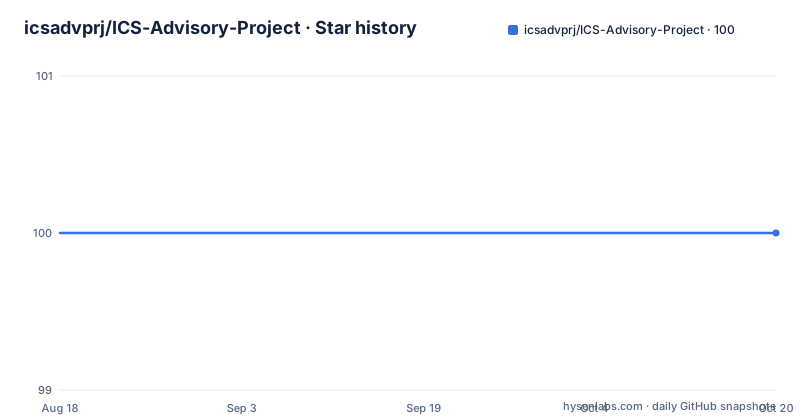
- icsadvprj/ICS-Advisory-Project100 ★ · +0
| Repository | 2026-08-18 | 2026-10-20 |
|---|---|---|
| icsadvprj/ICS-Advisory-Project | 100 | 100 |
0 Stars in the last 63 days, measured from the daily GitHub snapshot. Compare with other projects
Editorial analysis
Why CSV Instead of HTML for ICS Advisories
CISA publishes ICS advisories as HTML pages. That format is readable but hard to query, filter, or combine with other datasets. The ICS Advisory Project converts that data into CSV files so that analysts can load it into spreadsheets, databases, or scripts. The README states the goal is to provide 'clean and usable' CISA ICS Advisories data. This matters because vulnerability analysis in OT/ICS environments often involves checking a specific vendor or product against a list of advisories. Doing that by hand across dozens of HTML pages is slow and error prone. A CSV file lets you sort, filter, and join with other data. The project also notes that the data is not a replacement for the original advisories. That is a clear boundary: the CSV is a convenience layer, not an authoritative source.
The Extra Data That CVEs Do Not Carry
The project's value proposition goes beyond reformatting. The README explains that CISA ICS Advisories include insight not found in a CVE: vendor headquarters locations, product distributions, and critical infrastructure sectors for each vendor product. This is supply chain information. A CVE tells you a vulnerability exists in a product. It does not tell you where the vendor is based or which critical infrastructure sectors are affected. The ICS Advisory Project preserves that context in the CSV. That makes it useful for researchers who want to assess, for example, whether a vulnerability in a vendor based in a particular region could affect a specific sector like energy or water. The project explicitly positions this as a way to understand potential supply chain risks. Without that extra data, you would have to cross-reference multiple sources manually.
How the Data Is Structured and What You Get
The repository layout is not fully described in the provided material, but the core deliverable is a set of CSV files derived from CISA ICS Advisories. The README mentions a companion dashboard at icsadvisoryproject.com that lets smaller asset owners 'quickly filter the view of vulnerabilities affecting vendors/products within their environment.' That dashboard is built on the same data. The CSV format is the primary interface. You can download the files and use them with any tool that reads CSV, including Python's pandas, Excel, or a SQL database. The data fields likely include advisory ID, vendor, product, and the additional attributes mentioned earlier, though the exact schema is not documented in the README. If you need a precise field list, you must inspect the repository files directly. The project also links to Efi Kaufman's Splunk Add-On for CISA ICS Advisories, which suggests the data can be integrated into Splunk for monitoring workflows.
Getting Started: Commands and Configuration
The README does not provide installation commands or a setup guide. There is no package manager install, no requirements.txt mentioned, and no CLI tool described. To use the project, you clone the repository or download the CSV files directly. A typical start would be: git clone https://github.com/icsadvprj/ICS-Advisory-Project.git. Then you open the CSV files in your preferred analysis tool. If you want the dashboard, you visit the linked site. There are no configuration keys to set because this is a data repository, not a software application. That simplicity is a strength: you do not need to build anything. But it also means you must handle data updates yourself. There is no mention of an API or automated update mechanism in the README. You would need to pull the repository periodically to get new advisories.
A Genuine Limitation: It Is a Snapshot, Not a Live Feed
The biggest limitation is that this project is a curated dataset, not an official feed. CISA updates its advisories continuously. The CSV files here depend on community maintenance. The README calls it a 'community effort' and asks for contributions to 'improve, expand, and maintain this data source.' That means there could be delays between a CISA advisory release and its appearance in the CSV. For time-sensitive vulnerability management, that lag is a risk. The project itself says it is 'by no means a replacement' for the original advisories. If your organization needs immediate notification of new advisories, you should rely on CISA's official channels. The CSV is better suited for periodic analysis, such as quarterly supply chain reviews, rather than real-time alerting. Also, the data is offered 'as-is' with no warranty, so you cannot hold the project liable for inaccuracies.
Licence and Maintenance Cost
The project uses the Open Database License (ODbL) v1.0 for the database itself, and the Database Contents License (DbCL) v1.0 for individual contents. The README states this explicitly. That means you can use, share, and modify the data, but if you distribute a derived database, you must keep it under the same license and attribute the source. That is a real obligation. If you build a product that embeds this data, you need to comply with share-alike terms. The maintenance cost is on you: there is no stated release cadence, no versioning scheme, and no automated update pipeline. You must monitor the repository for changes. The project is not archived, but the last push date is unknown from the material, so you should check the commit history before depending on it. The license update is recent, but that does not guarantee ongoing maintenance.
Alternative Approach: The Splunk Add-On and Official CISA Pages
The README links to a Splunk Add-On by Efi Kaufman (github.com/efi-k/ICS_CERT_TA). That is a different approach: instead of a static CSV dataset, it integrates CISA ICS advisory data directly into Splunk, likely via a technical add-on that pulls data on a schedule. That is better for organizations that already run Splunk and need automated ingestion. The CSV project requires manual or scripted fetching. The official CISA ICS Advisory pages remain the authoritative source, but they are HTML and not designed for bulk analysis. The choice depends on your workflow. If you want a quick, portable dataset for a one-off analysis, the CSV project is simpler. If you need continuous monitoring inside a SIEM, the Splunk add-on is more fitting. The README also points to a dashboard, which is another way to filter the data without writing code.
Editorial conclusion
Adopt this project if you are a smaller OT/ICS asset owner or a researcher who needs a filterable, CSV-based view of CISA ICS Advisories, especially to assess supply chain risks by vendor location or critical infrastructure sector. Do not use it as a replacement for the original CISA advisories; always cross-check with the official HTML pages. Before relying on it, verify the data freshness and completeness against the CISA source, and confirm your intended use is compatible with the ODbL v1.0 license, which requires attribution and share-alike for the database as a whole. If you need a direct, real-time feed from CISA, the Splunk add-on linked in the README may offer a different integration path, but for a standalone dataset, this CSV repository is a concrete starting point.
Frequently asked questions
What does ICS stand for in cybersecurity, in this project's terms?
The README expands CISA as the Critical Infrastructure Security Agency and repeatedly pairs ICS with OT, referring to the OT/ICS community and OT/ICS environments. It does not spell out the letters ICS themselves, and the repository is named the ICS Advisory Project.
What are cybersecurity advisories, and what does this project add to them?
The project's premise is that CISA ICS Advisories carry information a CVE does not. The additions named are Vendor headquarters locations, Product distributions, and Critical Infrastructure sectors for each vendor product, which help with supply chain risk analysis.
Is Cisa still a thing, according to this project?
The project treats CISA as the source of record rather than something superseded. It directs readers to CISA's official ICS-CERT Advisories for vulnerabilities and states it is by no means a replacement for the original advisories.
What is ICS targeting, and does this project cover it?
The repository does not discuss ICS targeting. Its stated scope is providing CISA ICS Advisories data in CSV format to help organizations look for vulnerabilities specific to the Vendors and Products used in OT/ICS environments.
Official sources
Add this badge to your README
If you maintain this project, the badge below links readers to this analysis and shows its maintenance status from the daily GitHub snapshot. Paste the markdown into your README; add ?metric=license or ?metric=stars to the image URL for a different field.

[](https://hysenlabs.com/projects/icsadvprj-ics-advisory-project)Star history chart for your README
[](https://hysenlabs.com/projects/icsadvprj-ics-advisory-project)