AIWriteX: A CrewAI Pipeline for Chinese Self-Media Publishing, and Where It Stops Being the Right Tool
AIWriteX is a fully automated AI tool for WeChat official accounts: aggregates trending topics and public sentiment across the web, analyzes trends, picks viral topics, collects source articles, and generates and publishes formatted posts with one click. Includes AI-generated illustrations, de-AI-detection polishing (to beat the Zhuque AI-text detector), support for Xiaohongshu/Baijiahao/Toutiao and other platforms, multi-account rewriting, expert tracks, short-video scripts, phone remote control, and novel serialization - built for making 100k+ viral posts.
At a glance
- What is it?
- AIWriteX chains topic discovery, article collection, multi-agent drafting, de-AI-flavored rewriting, image generation and one-click publishing to WeChat, Xiaohongshu, Baijiahao, Toutiao and Fanqie. It is aimed at operators running Chinese content accounts at volume, and its own README admits the anti-detector feature is not stable.
- Who is it for?
- AIWriteX may suit operators who want an integrated Chinese-language content workflow and are prepared to configure model providers and publication accounts. Confirm the requirements for your chosen platform and release before enabling automatic publishing.
- Can I use it commercially?
- Yes. Apache-2.0 is a permissive licence: you can use, modify and sell software built on it, as long as you keep its copyright and licence notices.
- Is it still maintained?
- Yes. The repository last received commits 5 days ago.
- What is it written in?
- Mainly Python, according to GitHub's language statistics.
Answers come from the project's GitHub data, last synced on November 22, 2026, and from our analysis. They are not legal advice.
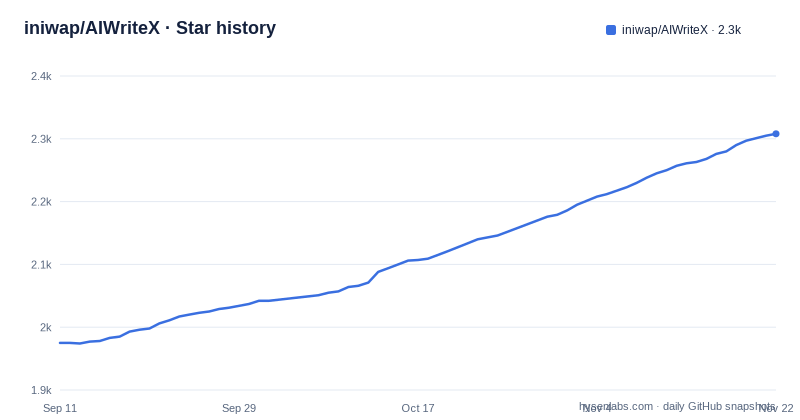
Star history
- iniwap/AIWriteX2,308 ★ · +333
| Repository | 2026-09-11 | 2026-11-22 |
|---|---|---|
| iniwap/AIWriteX | 2k | 2.3k |
333 Stars in the last 72 days, measured from the daily GitHub snapshot. Compare with other projects
Editorial analysis
The problem AIWriteX is built around: Chinese self-media production volume
Running a WeChat public account as a business means producing a publishable article on a schedule, with a headline that matches whatever is trending that morning, images that do not look recycled, and formatting that survives the platform's editor. The repository describes a pipeline that covers that whole chain in one program: hot-topic aggregation across Weibo, Douyin and Xiaohongshu, article collection from other public accounts, topic selection, drafting, de-AI-flavored rewriting, image generation, layout, and publishing. The tool targets content operators, including people managing accounts across platforms; its README also describes a novel-writing workflow. The README is explicit that the project now targets Xiaohongshu, Baijiahao, Toutiao, Fanqie Novel and Weibo alongside WeChat, so the unit of work is a piece of content that gets reshaped per platform rather than a single article for a single site. That framing explains most of the design choices, including the ones I think are weak.
The CrewAI role split and what actually flows between the stages
The core mechanism named in the README is a CrewAI crew with four roles: researcher, writer, reviewer, designer. The README describes the sequence as research feeding writing, writing feeding review, and review feeding layout and image generation. Upstream of the crew sits what the project calls AIForge, a search and collection layer: the README says it performs multi-strategy search and borrows from competitor articles, and the current README badge lists aiforge-engine 0.0.20 or later. Downstream sits the publishing layer, with per-platform support listed separately for WeChat, Xiaohongshu, Baijiahao and Toutiao (text plus images, drafts, scheduled publishing, long-image mode) and for Fanqie Novel (chapter publishing, automatic volume creation). The de-AI-flavor stage is described as sitting between generation and layout, and the README names four techniques: extracting a reference article's vocabulary and injecting it into the output, breaking up list and paragraph regularity, injecting subjective and rhetorical phrasing, and scoring each attempt to feed back into later runs. The interface layer is a PyWebView desktop shell with GrapesJS for layout, Monaco for editing and FastAPI behind it. None of this is unusual individually. What is unusual is that all of it ships as one installable program rather than a set of scripts an operator assembles.
Installing it: two modes, two config files, and the keys that matter
The README splits installation into a software mode, described as a one-click install for non-developers, and a development mode for people who want to modify it. The development path requires Python 3.10 or later, and the badges list minimum versions, not exact pins. The inspected pyproject.toml specifies Python >=3.10,<3.13 and CrewAI >=0.102.0,<1.0.0; requirements.txt includes additional dependencies and may specify different minimums or exact versions. Check these files for the release you install. Configuration lives in two files, config.yaml and aiforge.toml, and the README recommends editing them through the GUI rather than by hand. From the documented table, the keys you cannot skip are api.api_key, since a model provider credential is required, and wechat.appid, wechat.appsecret and wechat.author, which the README marks as mandatory for automatic publishing. To switch providers you change api.api_type, for example to OpenRouter, and then set api.OpenRouter.model_index to pick the model inside that provider. The wechat.credentials block contains call_sendall, sendall and tag_id, and the README states these apply only to certified accounts. The platforms key sets sampling weights for hot-topic selection across platforms. Confirm the exact nesting of the credentials block from the repository's own sample file rather than from the documentation table.
The anti-detector claim is the weakest part, and the README says so
The project markets a de-AI-flavor engine and names Zhuque as a detector it tries to defeat. Read the fine print and the authors themselves write that as detectors like Zhuque keep evolving, getting a full AI-generated long article past detection will become harder, and they recommend AI-assisted rather than AI-generated writing, with a human substantially rewriting and supplementing the draft. They describe their own measured result as good but not stable. That is an unusually candid admission and it should shape how you evaluate the feature. Treat the de-AI-flavor stage as a rewriting pass that changes vocabulary, sentence rhythm and rhetorical stance, not as a compliance control. Any workflow that depends on a specific detector returning a specific verdict is built on something the maintainers describe as unstable. The same section also mentions automatic handling of AIGC labeling and anti-template interaction rules, which is a platform-compliance concern rather than a detection-evasion one, and that part is more defensible: disclosure requirements depend on the platform and applicable rules, so confirm them independently rather than assuming the automation guarantees compliance.
Where the pipeline breaks: scraping, platform limits and the certification wall
Several constraints are visible in the documentation. First, the WeChat group-send options (call_sendall, sendall, tag_id) are marked as applying only to certified accounts, so an unverified personal subscription account cannot use that path and is limited to what the draft and article APIs allow. Second, the article collection feature downloads other public accounts' articles and stores images and text locally; the README frames this as building a private material library, and the content-mining feature explicitly offers to take several collected articles, deduplicate and restructure them into a new draft. Whether that is acceptable depends on your jurisdiction and on how much of the source survives, and the project does not offer guidance on it. Third, the hot-topic radar claims it can surface topics with zero current heat that it predicts will spike within twelve hours, using what the README calls local algorithms plus model verification; a prediction of that kind is inherently probabilistic and the README provides no accuracy figures, so treat it as a candidate generator rather than a forecast. Fourth, the multi-platform support is uneven: Fanqie Novel is listed for text and chapter structure only, while WeChat, Baijiahao and Toutiao get the full treatment including long-image mode. If your main platform is not on the richer list, you are getting less than the feature table suggests.
How it differs from wiring a general agent framework to a CMS yourself
The obvious alternative is to assemble the same pipeline from a general multi-agent framework plus a publishing client. If you build on CrewAI directly, you get the same role abstraction but you write the researcher's search tool, the writer's prompt, the reviewer's criteria and the platform-specific publisher yourself. AIWriteX's value is that those pieces are already coupled: the topic radar output feeds the crew input, the crew output feeds the de-AI-flavor pass, that feeds layout, and layout feeds the publish call, with a content library and an image library persisting between runs. The cost of that coupling is that you inherit the project's choices. If you want a different reviewer policy, or you want to publish to a platform the project does not list, you are modifying its code rather than swapping a module. A narrower alternative for teams whose only need is drafting is to use a chat model with a saved prompt and publish manually; that removes the Python 3.10 requirement, the config files and the certification constraint entirely, at the cost of doing the topic discovery and the layout by hand. The honest comparison is between an integrated pipeline you configure and a loose set of tools you operate.
Maintenance, release cadence and what Apache-2.0 does and does not cover
The release history shows a steady cadence: V2.4.8 in July 2026, V2.4.9 in early August, V2.5.0 in mid-August, as recorded when this article was reviewed; check the repository for current activity. Each release names a theme (templates, image generation, the scenario library), which suggests feature work is ongoing rather than maintenance-only. For an operator, that cadence cuts both ways: new capability arrives regularly, and so does the chance that a config key or a template format shifts under you. The dependency list is also long. README badges show minimums, while pyproject.toml and requirements.txt contain the actual constraints for the inspected source and do not always match those badges. Budget time for dependency upgrades, not just for the tool's own releases. On licensing: the repository is Apache-2.0, which permits commercial use and modification and requires that you preserve notices and state changes; it also includes an explicit patent grant and a termination clause. The README separately points to a commercial stable version on the project's website, so the open repository and the paid offering are distinct, and the Apache-2.0 terms apply to what is in the repository. I am not a lawyer and this is not legal advice; if you are shipping this inside a product, read the LICENSE file and the NOTICE requirements yourself, and check whether the commercial version has separate terms.
Editorial conclusion
AIWriteX may suit operators who want an integrated Chinese-language content workflow and are prepared to configure model providers and publication accounts. Confirm the requirements for your chosen platform and release before enabling automatic publishing. Review facts, originality, source rights and platform disclosure rules before publication; the project's detector-related features do not guarantee a particular result.
Frequently asked questions
What is AIWriteX?
AIWriteX is a content creation and publishing tool whose Chinese README describes topic discovery, drafting with multiple agents, formatting, image generation and publishing to several platforms. It also describes a novel-writing workflow and a separate commercial offering. Check the release and platform documentation for current capabilities.
Does AIWriteX publish to WeChat automatically, and what does that require?
Yes. The configuration requires an application identifier, an application secret and an author name for each WeChat account, and multiple accounts are supported. A further group of fields named for the broadcast call and a tag identifier controls mass sending, which the documentation notes applies only to a certified account.
How does AIWriteX handle AI text detection?
It ships a module that extracts the vocabulary of a reference article and injects it, flattens lists, varies paragraph length, removes connective words and injects subjective colour and rhetorical questions. The project's own assessment is that the effect is good but not stable and that the detector it targets keeps improving, and it recommends using the tool for assistance with human rewriting rather than for generating finished posts.
What does AIWriteX need to install?
The inspected pyproject.toml specifies Python >=3.10 and <3.13 and declares CrewAI >=0.102.0,<1.0.0. The separate requirements.txt lists additional packages, including crewai==0.102.0, aiforge-engine>=0.0.20 and platform-specific Windows bindings. Check both files for the specific version you install; README badges are not an exact lockfile.
Which platforms can AIWriteX publish to besides WeChat?
Xiaohongshu, Baijiahao, Toutiao, Fanqie Novel and Weibo, with a per-platform capability table. Fanqie supports novel publishing with automatic volume creation, while Weibo is the narrowest, listed with only image-and-text posts, automatic publishing and TXT or Markdown output. Several platforms support long-image mode, and draft boxes are supported on all of them except Weibo.
Official sources
Add this badge to your README
If you maintain this project, the badge below links readers to this analysis and shows its maintenance status from the daily GitHub snapshot. Paste the markdown into your README; add ?metric=license or ?metric=stars to the image URL for a different field.

[](https://hysenlabs.com/projects/iniwap-aiwritex)Star history chart for your README
[](https://hysenlabs.com/projects/iniwap-aiwritex)Was this useful?