Lab.Architecture: A Personal Knowledge Base for Enterprise Architecture, Not a Product
A repository that serves as my lab for exploring Architecture concepts, patterns, ideas
At a glance
- What is it?
- Lab.Architecture is a personal repository for collecting architecture ideas, templates, and resources. It is not a tool or framework, but a raw workspace with a clear to-do list and a few links.
- Who is it for?
- Adopt Lab.Architecture if you are an individual architect looking for a lightweight, unstructured place to store drafts, lists, and links, and you are comfortable with a repository that has no releases, no license, and no code. Do not adopt it if you need a structured reference, a maintained tool, or a collaborative resource.
- Can I use it commercially?
- Not without permission. GitHub finds no licence file in the repository, and without a licence all rights are reserved by default: you may read the code but not reuse it. Check the README, or ask the authors, before using it.
- Is it still maintained?
- Yes. The repository last received commits 58 days ago.
- What is it written in?
- GitHub does not report a main language for this repository.
Answers come from the project's GitHub data, last synced on October 4, 2026, and from our analysis. They are not legal advice.
Star history
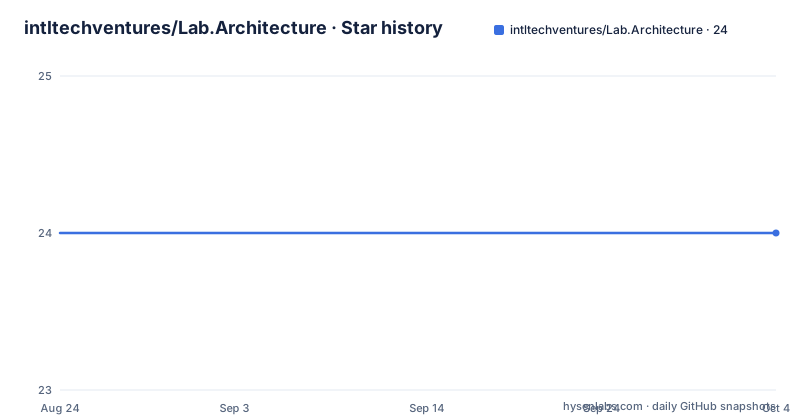
- intltechventures/Lab.Architecture24 ★ · +0
| Repository | 2026-08-24 | 2026-10-04 |
|---|---|---|
| intltechventures/Lab.Architecture | 24 | 24 |
0 Stars in the last 41 days, measured from the daily GitHub snapshot. Compare with other projects
Editorial analysis
What This Repository Actually Is
Lab.Architecture is not a software project. It is a personal knowledge management tool, as the README states. The owner uses it to store bits and pieces, works-in-progress, early drafts, lists, ideas, links, suggestions, guidelines, and templates related to architecture. There is no code, no documentation framework, and no build system. The primary language is unknown, and the license is unknown. This is a raw workspace, not a polished deliverable. If you came looking for a reusable architecture framework, you will be disappointed. If you are curious how one architect organizes their thinking, this gives you a glimpse, though a sparse one.
The To-Do List as the Core Content
The most substantive part of the repository is the TO-DO list. It reveals the owner's intentions. They plan to add Sparx Enterprise Architect sample .eap files to exemplify documenting architectures. They want to add best practices for organizing information in Sparx Enterprise Architect. They also intend to add exemplars for Architecture Principles, Policies, Standards, Specifications, Patterns, and NFRs. There is a plan to refactor the Ontology numbering scheme and to elaborate on Architecture Assessment Checklists. The list also includes creating a set of NFR list exemplars, a base set of EA Principles, Policies, Standards, and an exemplar of an EA Mission and Vision Statement. This list is the repository's roadmap. It shows a focus on practical artifacts, not theory.
The Thin Resource Section
The README includes a section called Interesting Resources with a single link: http://www.liteea.com/wordpress/. That is the only resource listed. There is also a link to an EA-related book from The Open Group, specifically Managing Digital. And there is a general educational resource: a YouTube video titled 'Why Enterprise Architecture' by Gerben Wierda and T36. That is the entirety of the external material. For a repository that claims to be a knowledge management tool, the resource list is remarkably thin. It may be that the owner keeps most resources elsewhere, but based on the README alone, there is little to draw from.
How You Would Use It, If You Forked It
There are no installation steps, no commands, and no configuration files. To use this repository, you would fork it and start editing the README or adding files. The README gives no structure beyond the to-do list and links. You would have to impose your own organization. The owner's mention of an Ontology numbering scheme suggests they have a system in mind, but it is not documented. If you fork this, you are essentially starting from a blank slate with a few pointers. That might be useful as a template for your own knowledge base, but it is not a turnkey solution.
A Genuine Limitation: No License and No Maintenance Signal
The repository has no license. That means you have no legal permission to reuse any content beyond what copyright law allows, which for a personal repository is likely very little. The last push date is unknown, and there are no recent releases. The README's to-do list reads like a plan, but there is no evidence of progress. The repository could be abandoned. This is a real limitation. If you are considering adopting any content from it, you should contact the owner or look for a license. Without one, you cannot legally copy or redistribute anything.
The Alternative: A Structured EA Reference or a Fresh Start
If you need a comprehensive enterprise architecture reference, Lab.Architecture is not it. A better alternative is to consult The Open Group's publications, such as the book linked in the README, Managing Digital. That book provides a structured approach to digital transformation and enterprise architecture. Alternatively, you could start your own repository with a clear license and a defined structure, using the to-do list as inspiration. The difference is that a structured reference gives you curated, consistent content, while Lab.Architecture is a raw collection of intentions. If you want to learn EA, watch the linked video and read the book. If you want to build your own knowledge base, fork this repository and replace the to-do list with your own.
Maintenance and Upgrade Cost
The maintenance cost of this repository is essentially zero, because there is nothing to maintain. There is no code to update, no dependencies to track, and no documentation to keep current. The only cost is the owner's time to add content, which based on the to-do list, they have not spent yet. For a user who forks it, the cost is also low, but you inherit a lack of structure. You would need to create your own folder layout, naming conventions, and numbering schemes. The license issue is a one-time cost: you must either get permission or strip the content. In short, the maintenance burden is minimal, but so is the value.
Editorial conclusion
Adopt Lab.Architecture if you are an individual architect looking for a lightweight, unstructured place to store drafts, lists, and links, and you are comfortable with a repository that has no releases, no license, and no code. Do not adopt it if you need a structured reference, a maintained tool, or a collaborative resource. Before using it, verify the license and check the last push date, as the repository appears dormant and may not reflect current best practices.
Frequently asked questions
What are the four types of laboratories?
This repository does not cover laboratory types. It is a personal knowledge management folder for architecture, holding bits and pieces, works in progress, early drafts, lists, ideas, links, suggestions, guidelines and templates.
What is an architect lab?
The author calls the repository a lab for exploring architecture concepts, patterns and ideas. Concretely it is 58 topic folders at the root, from C4/ and CloudComputing/ to Ontologies/ and ParallelComputing/, plus two markdown files.
What are the different types of architectures?
The to-do list names the artifact types the author wants exemplars for: principles, policies, standards, specifications, patterns and NFRs. Root folders already exist for NFRs, Ontologies, Diagrams and C4, but none of the exemplars is in place yet.
How much would it cost to build a lab?
No cost information appears in the repository. There is no build system, no package manifest and no release, so nothing here is packaged for installation and no version has ever been published.
Official sources
Add this badge to your README
If you maintain this project, the badge below links readers to this analysis and shows its maintenance status from the daily GitHub snapshot. Paste the markdown into your README; add ?metric=license or ?metric=stars to the image URL for a different field.

[](https://hysenlabs.com/projects/intltechventures-lab-architecture)Star history chart for your README
[](https://hysenlabs.com/projects/intltechventures-lab-architecture)