Istio: Sidecar and Ambient Mesh in One Control Plane
Connect, secure, control, and observe services.
At a glance
- What is it?
- Istio is a CNCF service mesh that layers Envoy sidecars or the Rust-based ztunnel onto Kubernetes workloads. This review covers its architecture, install path, and where its complexity becomes a real cost.
- Who is it for?
- Adopt Istio if you run Kubernetes and need uniform traffic management, mTLS, and telemetry across many services without rewriting application code. Skip it if your cluster is small, your team has no dedicated platform engineers, or you only need simple ingress.
- Can I use it commercially?
- Yes. Apache-2.0 is a permissive licence: you can use, modify and sell software built on it, as long as you keep its copyright and licence notices.
- Is it still maintained?
- Yes. The repository received new commits within the last day.
- What is it written in?
- Mainly Go, according to GitHub's language statistics.
Answers come from the project's GitHub data, last synced on November 15, 2026, and from our analysis. They are not legal advice.
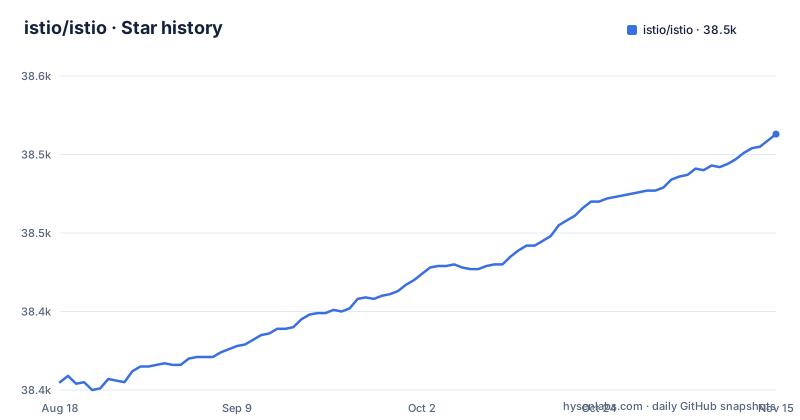
Star history
- istio/istio38,513 ★ · +158
| Repository | 2026-08-18 | 2026-11-15 |
|---|---|---|
| istio/istio | 38.4k | 38.5k |
158 Stars in the last 89 days, measured from the daily GitHub snapshot. Compare with other projects
Editorial analysis
What Istio Actually Solves
Istio addresses the operational problem of cross-cutting concerns in distributed applications: load balancing, service-to-service authentication, and monitoring. The README states it layers transparently onto existing applications, so you do not change service code. The target user is a platform team running Kubernetes who wants a uniform way to manage traffic flow, enforce policies, and aggregate telemetry. It is aimed at several services working together rather than a single service. The control plane abstracts the underlying cluster, which means you configure Istio resources rather than touching each deployment.
Two Data Planes, One Control Plane
Istio's architecture splits into three components. Envoy sidecar proxies handle ingress and egress traffic per microservice, providing layer-7 routing, circuit breakers, and policy enforcement. Ztunnel is a lightweight Rust proxy used in Ambient mesh mode, giving secure connectivity and observability without sidecars. Istiod is the control plane, handling service discovery, configuration, and certificate management. The README explicitly notes that the service mesh is not an overlay network; it works over the existing cluster network.
Getting It Running: What the README Shows
The README does not include install commands, but it points to istio.io for usage and to the istioctl directory in this repository. The istioctl/ directory holds the code for the istioctl command line utility, and the main repository hosts Istio's core components, install artifacts, and sample programs. For exact install steps, follow the official docs on istio.io.
The Trade-Off of Sidecar vs Ambient
The README presents both Envoy sidecars and Ztunnel as valid data plane options. Sidecars give you the richest feature set, including layer-7 routing and circuit breakers, but they add a proxy per pod, which increases resource usage and operational complexity. Ambient mode with ztunnel is lighter, but the README only promises secure connectivity and observability, not the full routing feature set. This is a genuine trade-off: choose sidecars for advanced traffic management, choose Ambient for lower overhead and simpler operations. The documentation does not claim parity, so you must verify which features work in Ambient before committing.
A Real Limitation: Not a Library
The README contains a clear warning: only istio/api and istio/client-go expose stable interfaces intended for direct usage as libraries. The main istio/istio repository, including pilot and security code, is not meant for external consumption as a Go module. If you plan to extend Istio programmatically, you must use the API definitions and generated clients, not the internal packages. This is a boundary that many adopters overlook. It also means that upgrading Istio may break your code if you depend on internal packages, so your integration should only use the stable client libraries.
Maintenance and Upgrade Cost
The release cadence is visible in the repository history: 1.32.0-beta.0 (2026-10-22), 1.32.0-rc.0 (2026-10-28) and 1.32.0-rc.1 (2026-10-30) were published within nine days, showing an active project. Upgrades are not trivial. You must update the control plane (Istiod) and the data plane (Envoy sidecars or ztunnel) in coordination. The README does not detail the upgrade process, but the steady stream of pre-releases suggests that you need to track which version you run and plan upgrades. The license is Apache-2.0, which gives you freedom to modify and redistribute, but you must retain copyright notices. There is no vendor lock-in from a licensing perspective, but operational lock-in comes from the APIs and configuration you adopt.
Alternatives and How They Differ
The most direct alternative is Linkerd, another CNCF service mesh. Linkerd focuses on simplicity and low resource usage, while Istio provides more advanced traffic management and policy features. Another alternative is to use Kubernetes-native features like NetworkPolicies for security and Ingress controllers for traffic, but those do not provide service-to-service mTLS or telemetry across all workloads. Istio's control plane abstraction over Kubernetes is what sets it apart, but it also adds a component you must operate.
Editorial conclusion
Adopt Istio if you run Kubernetes and need uniform traffic management, mTLS, and telemetry across many services without rewriting application code. Skip it if your cluster is small, your team has no dedicated platform engineers, or you only need simple ingress. Before adoption, verify which data plane mode fits your workloads: sidecar injection for mature features, or Ambient with ztunnel for lower resource overhead. Check the current release notes for your target version and the upgrade path from your existing version, because major version upgrades require coordinated control plane and proxy updates.
Frequently asked questions
What is Istio used for?
It is a service mesh that layers onto existing distributed applications to give load balancing, service-to-service authentication and monitoring with few or no service code changes. Each service gets an Envoy sidecar that handles traffic to other services and to external ones.
What is an Istio mesh?
It is the set of sidecar proxies forming a secure microservice mesh, providing discovery, layer-7 routing, circuit breakers, policy enforcement and telemetry. The project is explicit that it is not an overlay network but a way to change how services talk over the network the platform already provides.
What does Istio do in Kubernetes?
The control plane provides an abstraction layer over the underlying cluster management platform, handling service discovery, configuration and certificate management. Code in the pilot/ directory populates an abstract service model and translates routing rules into proxy specific configuration.
how to install istio
The README gives no install command and sends you to istio.io instead. The repository holds the pieces a deployment uses, with operator/, manifests/, cni/ and bin/ at the top level and istioctl/ holding the command line utility's code.
how does istio work
Envoy sidecars carry the traffic, ztunnel covers workloads that have no sidecar in Ambient mode, and istiod sits above both as the control plane for discovery, configuration and certificates. Configuration you write is translated by the control plane into proxy specific config rather than read directly by the proxy.
Official sources
Add this badge to your README
If you maintain this project, the badge below links readers to this analysis and shows its maintenance status from the daily GitHub snapshot. Paste the markdown into your README; add ?metric=license or ?metric=stars to the image URL for a different field.

[](https://hysenlabs.com/projects/istio-istio)Star history chart for your README
[](https://hysenlabs.com/projects/istio-istio)Was this useful?