Jac: A Single-Language Bet Against the Twelve-Notation Stack
The Jac Programming Language the only language you need to build anything (full stack app, device driver, video game, website, whatever). One self-contained binary; One language; Codegens to Python bytecode, JavaScript, and native machine code.
At a glance
- What is it?
- Jac compiles one Python-like syntax to Python bytecode, JavaScript, and native code, with persistence, APIs, and AI calls as language features. It is a bold consolidation play, but its real-world cost is still unproven.
- Who is it for?
- Adopt Jac if you are a small team or an AI-assisted developer building a greenfield full-stack app and you want one source of truth for models, endpoints, and UI, and you are willing to trust the compiler to generate the glue. Do not adopt it if you need mature tooling, a large ecosystem of libraries, or if your project must integrate deeply with existing Python or JavaScript codebases.
- Can I use it commercially?
- Yes. MIT is a permissive licence: you can use, modify and sell software built on it, as long as you keep its copyright and licence notices.
- Is it still maintained?
- Yes. The repository last received commits 2 days ago.
- What is it written in?
- Mainly Jac, according to GitHub's language statistics.
Answers come from the project's GitHub data, last synced on November 14, 2026, and from our analysis. They are not legal advice.
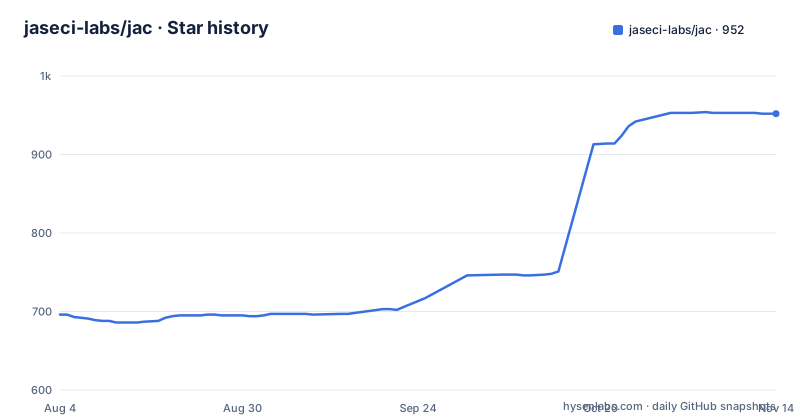
Star history
- jaseci-labs/jac952 ★ · +256
| Repository | 2026-08-04 | 2026-11-14 |
|---|---|---|
| jaseci-labs/jac | 696 | 952 |
256 Stars in the last 102 days, measured from the daily GitHub snapshot. Compare with other projects
Editorial analysis
The Problem: Twelve Notations and a grep-Based Type Checker
Jac starts from a specific pain: a modern full-stack repo forces a maintainer to read TypeScript, Python, SQL, shell, JSX, CSS, JSON, TOML, YAML, Dockerfile, HCL, and dotenv. Each architectural boundary is also a change of language, type system, and package manager. The README makes a sharp point: no compiler can see across those boundaries. Rename a field and the frontend type checker checks the frontend, the backend checks the backend, but nothing checks the wire format, the ORM mapping, or the prompt template between them. The whole-program type checker of the modern stack is grep. That is where bugs pool, and it is why teams staff a specialist per boundary. Jac's answer is to collapse those boundaries into one language and one compiler. The intended user is a developer or an AI pair who wants to build an entire application, from database schema to browser UI, in a single codebase with a single type checker.
How the Compiler Owns the Data Model, Wire, and Browser
The core mechanism is that the compiler generates what frameworks usually provide. The README gives a concrete example: a user record in a conventional stack needs a SQL table, a Python ORM class, a Pydantic schema, and a TypeScript interface, four copies in three type systems. In Jac, the record is one node declaration, and the compiler owns its representation in the store, on the wire, and in the browser. This is the synechic property: the codebase is contiguous, not fragmented. The topokinetic property refers to the compiler's ability to move code to different targets, compiling the same source to Python bytecode, JavaScript, and native machine code. The jac_site example shows this in action: pages and components compile to JavaScript, endpoints compile to Python and serve over RPC, and an arcade game compiles through LLVM to WebAssembly, borrow-checked with zero reference counting. The compiler also generates API endpoints, route tables, ORM models, validation, serializers, and migrations, which the README claims cuts code volume by about five times compared to a conventional full-stack setup.
Getting Started: One Binary, Two Commands
Installation is a single curl pipe to a shell script, which the README claims requires no Python, pip, Node, or C toolchain. The command is: curl -fsSL https://raw.githubusercontent.com/jaseci-labs/jaseci/main/scripts/install.sh | bash. After that, you clone the official jac_site repository and run two commands: jac install, which pulls npm dependencies on first run, and jac run, which builds the frontend and wasm and serves on localhost:8000. The README notes that prebuilt binaries ship for macOS and Linux, and Windows users must use WSL because a native PowerShell installer is coming soon. This is a real constraint for a language that claims to replace the whole toolchain: on Windows, you still need a Linux layer. The tutorial link points to building an AI day planner, and the playground is at playground.jaseci.org, which suggests a low-friction way to try the language without installing anything.
AI as a Typed Function Call, Not a Framework
Jac treats an LLM call as a language feature rather than a library call. The README states that the compiler builds the prompt from your function signature and enforces the return type as the output schema. This is a meaningful design choice: instead of writing a prompt template and hoping the model returns valid JSON, you declare a function with a return type, and the compiler generates the prompt and validates the output against that type. This could reduce a whole class of bugs where prompt output drifts from the expected schema. But it also means the language is tightly coupled to a particular way of doing AI, and if your use case requires fine-grained control over prompts or multi-step reasoning, you may fight the abstraction. The documentation does not describe how to override the generated prompt or handle model failures, so that remains an open question.
Persistence and Deployment as Built-Ins, with Trade-offs
The README claims that objects just persist, with no database, ORM, or migrations. That is a strong claim. It likely relies on the compiler generating storage code behind the scenes, but the exact storage engine, consistency model, and query capabilities are not described. Similarly, jac scale deploy builds images and provisions a Kubernetes cluster with no Dockerfile or YAML, spooling out multipod deployments with spliced microservices. This is ambitious, but it also means you are entrusting the compiler with operational decisions you might want to control, such as network policies, resource limits, and service discovery. If your deployment target is not Kubernetes, or if you need custom infrastructure, this feature may not help. The README does not mention any escape hatch for writing custom Dockerfiles or Helm charts, so you may be locked into the compiler's deployment model.
Limitations and Wrong-Tool Cases
The most obvious limitation is platform support: Windows requires WSL, which contradicts the one-binary promise for a large share of developers. The README also says the native PowerShell installer is coming soon, so it is a known gap. Another limitation is ecosystem compatibility. Jac claims access to the entire PyPI, npm, and C ecosystems without wrappers, but that claim is not substantiated with examples. If you need to call a Python library that relies on CPython internals, or a Node package that uses native addons, the compilation path may not handle it. The README does not list any known incompatibilities, which is a red flag for a tool that promises universal interop. Also, the language is young: the latest release is v0.34.17, and the dev build is pushed daily, which suggests rapid change. For a production system, that churn is a risk. The wrong tool cases are clear: a team with a large existing Python or JavaScript codebase, a project that needs fine-grained control over infrastructure, or a developer on Windows who refuses WSL.
Alternatives: What You Give Up by Not Using Jac
The obvious alternative is a conventional stack like TypeScript on the frontend, Python on the backend, and SQL for persistence, held together by frameworks such as React, FastAPI, and SQLAlchemy. That approach gives you mature tooling, a huge ecosystem, and a clear boundary between layers, but it also gives you the four-copy problem the README describes. Another alternative is a meta-framework like Next.js or Nuxt, which unifies frontend and backend in one language (JavaScript or TypeScript) but still leaves the database and API schema as separate concerns. A third alternative is a low-code platform, but that sacrifices programming expressiveness. The real difference in approach is that Jac moves the integration burden from the developer to the compiler. In a conventional stack, you write the glue and the type checker cannot see across boundaries. In Jac, the compiler generates the glue and type checks the whole program. The trade-off is that you lose control over the generated code, and you depend on the compiler's choices being correct.
Maintenance, Upgrade Cost, and License
The project is MIT licensed, which is permissive and allows commercial use without copyleft obligations. That is a positive for adoption. Maintenance cost is hard to assess from the README alone. The repository shows a dev build pushed on the same day as the last release, and releases v0.34.16 and v0.34.17 came two days apart. That cadence suggests active development, but also means the language is not stable. The README does not mention a migration guide or a compatibility policy for language changes. If you build on Jac, you may need to track compiler updates frequently to avoid breaking changes. The documentation site is linked. The README says upgrading and IDE setup are covered in the installation guide, but the details are not here. Before adopting, you should verify the upgrade path from one minor version to the next and check whether the community has produced any real-world projects beyond jac_site.
Editorial conclusion
Adopt Jac if you are a small team or an AI-assisted developer building a greenfield full-stack app and you want one source of truth for models, endpoints, and UI, and you are willing to trust the compiler to generate the glue. Do not adopt it if you need mature tooling, a large ecosystem of libraries, or if your project must integrate deeply with existing Python or JavaScript codebases. Before committing, verify that the current compiler output for your specific use cases (especially the LLVM path and the deployment spooler) matches your performance and deployment requirements, and check the state of the IDE support and Windows installer, which are still incomplete.
Frequently asked questions
What is the Jac programming language?
Jac is a Python-like language distributed as one self-contained binary that compiles to Python bytecode, JavaScript and native machine code, with the PyPI, npm and C ecosystems reachable without wrappers or interop layers. Its design is described as resting on two named properties, synechic and topokinetic.
How do I install the Jac binary?
One command, curl -fsSL https://raw.githubusercontent.com/jaseci-labs/jaseci/main/scripts/install.sh | bash, run through bash with no Python, pip, Node or C toolchain needed. Note that the script is fetched from the jaseci repository rather than from the jac repository you are reading.
Does Jac ship prebuilt binaries for Windows?
Not natively. Prebuilt binaries are provided for macOS and Linux, and on Windows the project directs you to WSL while stating that a native PowerShell installer is coming soon. Versions, upgrading and IDE setup are covered by a separate installation guide.
Does Jac really write five times less code than a normal full-stack app?
The README states roughly five times less code than a modern full-stack setup, with the difference attributed to glue the compiler generates: API endpoints, route tables, ORM models, validation, serializers and migrations. No reference project, line count or benchmark is given alongside the figure.
Where are synechic and topokinetic defined for Jac?
The README says both properties are described in what it calls the ninja book, linked as a Zenodo record, and defined further below in the document itself. The text available here ends earlier, inside a section on maintaining one record in four notations, so those definitions are not written in what a reader can check here.
Official sources
Add this badge to your README
If you maintain this project, the badge below links readers to this analysis and shows its maintenance status from the daily GitHub snapshot. Paste the markdown into your README; add ?metric=license or ?metric=stars to the image URL for a different field.

[](https://hysenlabs.com/projects/jaseci-labs-jac)Star history chart for your README
[](https://hysenlabs.com/projects/jaseci-labs-jac)Was this useful?