Suede Creator Skills: A Supervision Pack for Unsupervised Coding Agents
Open-source Agent Skills for Claude Code and Codex: ship-DAG orchestration, A-F code review, AI evals, CI gates, design, copy, SEO/AEO/GEO, Instagram growth, app shipping, creator rights, and consumer recovery.
At a glance
- What is it?
- JasonColapietro/suede-creator-skills bundles 69 open-source Agent Skills for Claude Code and Codex, adding outcome-bound orchestration, A-F code review, and marketing workflows. The core judgment: it is a serious supervision layer, but its most advanced workflow only runs on Claude Code with macOS sandbox-exec.
- Who is it for?
- Adopt this pack if you run Claude Code or Codex and want a structured, auditable supervision layer for shipping code, reviews, and marketing content. Skip it if you need a deployment tool, a binary-free guarantee for Codex workflows, or a solution that works identically across every agent.
- Can I use it commercially?
- Yes. MIT is a permissive licence: you can use, modify and sell software built on it, as long as you keep its copyright and licence notices.
- Is it still maintained?
- Yes. The repository received new commits within the last day.
- What is it written in?
- Mainly JavaScript, according to GitHub's language statistics.
Answers come from the project's GitHub data, last synced on October 22, 2026, and from our analysis. They are not legal advice.
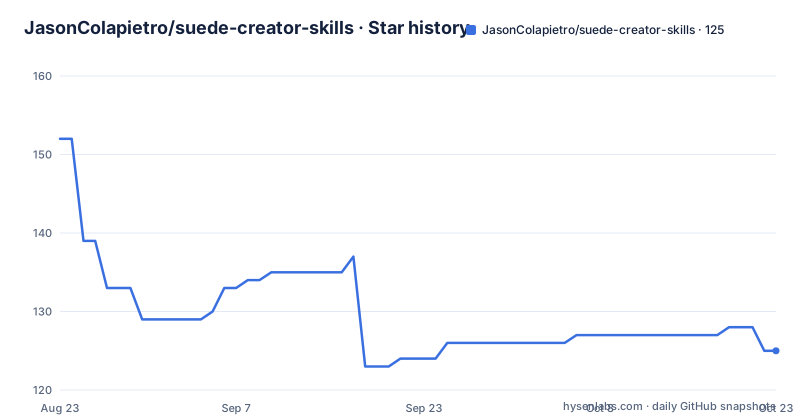
Star history
- JasonColapietro/suede-creator-skills125 ★ · -27
| Repository | 2026-08-23 | 2026-10-22 |
|---|---|---|
| JasonColapietro/suede-creator-skills | 152 | 125 |
-27 Stars in the last 60 days, measured from the daily GitHub snapshot. Compare with other projects
Editorial analysis
The problem: enthusiasm instead of engineering
The README opens with a blunt diagnosis: your coding agent is fast, capable, and completely unsupervised. It will happily ship the bug, skip the test, publish the slop, and tell you everything went great. That is the specific problem this project attacks. The author, Jason Colapietro, positions the pack as the supervision layer that sits between an agent's raw output and a production decision. The intended user is a developer who already runs Claude Code or Codex, has seen the agent produce plausible but wrong work, and wants a repeatable structure to catch it. This is not a tool for people new to agents. It assumes you know what a skill folder is, how to install a plugin, and why a ship grade matters. The value proposition is not more automation. It is restraint, review, and evidence before a change goes out.
What the pack actually contains
The repository holds 69 agent skills as of v0.10.0, up from 67 in v0.9.2. Every skill is a plain text file at skills/<name>/SKILL.md. That design choice matters: you can read any skill before you trust it. The README is explicit that there are no binaries, no telemetry, and no accounts. The skills split into lanes. The orchestration lane includes suede-graph-flo-xr, which runs a Suede Thought Graph shipping search: generate competing plans, score and prune them, adversarially refute and improve survivors, aggregate compatible lanes, then build, review, and gate only the selected plan. It is capped at 55, 110, or 200 calls depending on light, standard, or deep mode. It is production-read only and never deploys. A second orchestration skill, suede-agent-teams, wires complex changes into coordinated agent lanes with WIP collision detection, RFC mode, feature-flag strategy, rollback trees, and a handoff checklist. A third, suede-ship-copy, is a copy-only DAG for a single high-stakes piece of writing, with blind research lenses and a claim audit. The code review lane, suede-code, runs findings passes against TypeScript, React, Next.js, OWASP, and database checklists, then returns a grade card scoring seven lanes: Correctness, Security and permissions, Data and state, Domain truth, UX and release behavior, Tests and verification, and Deploy readiness. The weakest lane determines the overall A-F ship grade. That is a concrete, testable output, not a vague recommendation.
Install routes: plugins, CLI, clone, and MCP
Installation is the part where the README gives the most detail, and it is also where the complexity lives. For Claude Code, you add a marketplace and install the pack: /plugin marketplace add JasonColapietro/suede-creator-skills, then /plugin install suede-skills@suede. That installs every skill. Three focused subsets exist: suede-marketing@suede for 42 marketing and growth skills, suede-agent-workflows@suede for orchestration and evals, and suede-code@suede for review and grading. For Codex, the commands differ: codex plugin marketplace add JasonColapietro/suede-creator-skills --ref main, then codex plugin add suede-skills@suede-codex. The Codex plugin loads every skill and registers three read-only MCP discovery profiles. You must restart Codex after installing. For any agent, including Cursor, Copilot, and Windsurf, you can use the skills CLI: npx skills add JasonColapietro/suede-creator-skills. There is also a clone route: git clone and then bash install.sh, which copies every skill into ~/.claude/skills/ and prints the installed count. Finally, there is a dependency-free stdio MCP server: node mcp/suede-skills-mcp.mjs --profile all. It exposes 9 tools, 7 resources, and 5 prompts over JSON-RPC. The tools include list_suede_skills, search_suede_skills, suede_code_grade, and suede_visibility_grade. The README warns that single-skill installs from GitHub require restarting Codex, and that Claude.ai may use admin-managed flows instead of filesystem copy.
The hardened workflow has a narrow platform window
The most interesting limitation is not a bug. It is a platform constraint. The suede-graph-flo-xr JavaScript workflow is hardened, and it requires three things beyond the skill folder: the repository's agents/suede-graph-flo-xr-*.md profiles installed in ~/.claude/agents, macOS sandbox-exec, and the Claude Code agent. The README is explicit that the suede-skills and suede-agent-workflows Claude plugins, plus install.sh, install those profiles. A skill-folder-only install or a generic skills-CLI install does not. Codex can use the skill's orchestration contract, but it cannot execute this Claude Workflow runner. That is a real boundary. If you are on Linux or Windows, or if you use Codex as your primary agent, the flagship orchestration skill is unavailable to you. The README also notes that the caller must pass the namespace explicitly on every launch: suede-skills for the full plugin, suede-agent-workflows for the focused plugin, and an empty string for clone or manual user-agent installs. That is a small operational detail, but it is the kind of thing that breaks silently if you forget it. This is the wrong tool if you want a single orchestration workflow that runs everywhere.
What the A-F grade actually checks
The suede-code skill is the most concrete deliverable in the pack. It runs a findings pass against specific checklists: TypeScript, React, Next.js, OWASP, and database. Then it returns a grade card with seven lanes. The lanes are Correctness, Security and permissions, Data and state, Domain truth, UX and release behavior, Tests and verification, and Deploy readiness. The weakest lane determines the overall ship grade. That design has a clear point of view: a change is only as shippable as its worst dimension. A change with perfect tests but a security hole gets a failing grade. The README gives a sample prompt: Use suede-code to review my staged diff and give it an A-F ship grade. That is a simple, testable interaction. The grade is not a score out of 100, which is honest. An A-F scale forces a categorical decision, and tying it to the weakest lane prevents a team from averaging away a critical failure. The limitation is that the skill is only as good as its checklists. If your stack includes something outside TypeScript, React, Next.js, OWASP, and databases, the findings pass will miss it. The README does not claim coverage beyond those areas.
Orchestration philosophy: refute before you build
The orchestration skills share a common mechanism: adversarial review. In suede-graph-flo-xr, the agent generates competing plans, scores and prunes them, then adversarially refutes and improves the survivors. Only after that does it aggregate compatible lanes and build. In suede-ship-copy, the same pattern appears: five blind research lenses, a claim audit that closes the set of assertable facts, disjoint section writers, adversarial refutation, a deslop pass, and a publish-readiness gate. The phrase deslop pass is worth pausing on. It is a direct acknowledgement that agents produce slop, and that the skill exists to remove it. This is a different philosophy from most agent tooling, which focuses on giving the agent more tools or more memory. Here the focus is on making the agent argue with itself before producing output. The cost is compute. The light, standard, and deep modes cap at 55, 110, and 200 calls respectively. That is a real budget, and it means the deep mode is expensive. The README does not say how long those calls take, so you should expect a nontrivial wait for a deep orchestration run. For a small change, that overhead may not be worth it.
Alternatives: what else does this space
The obvious alternative is to write your own SKILL.md files. The format is plain text and the repository is MIT licensed, so you can copy the structure and adapt it. The difference is that this pack bundles 69 skills with a consistent orchestration philosophy and a pre-built grade card. Writing your own means you control every checklist, but you also lose the adversarial review patterns that the author has encoded. Another alternative is to use the underlying agent's built-in review features, such as Claude Code's own review commands or Codex's built-in safety features. Those are narrower: they check code, but they do not run a multi-lane grade card or a ship DAG with disjoint lanes and refutation. A third alternative is a CI-based review tool that runs after every commit, such as a linter or a security scanner. That approach catches deterministic issues but cannot reason about domain truth or UX release behavior, which the suede-code grade card explicitly includes. The real difference is that this pack treats review as an agent-side, pre-commit activity with an explicit evidence handoff, rather than a post-commit gate. If you want that, this pack is the only one in the material that offers it as a coherent set.
Maintenance and license: what you are signing up for
The repository is MIT licensed, which means you can use, copy, and modify the skills freely, subject to the license terms. The README notes that adapted components carry their upstream notices beside the source, so you should check those notices if you redistribute modified skills. The project is actively maintained: the last push was 2026-08-04, and v0.10.0 shipped the same day with 69 skills, up from 67 in v0.9.2 two days earlier. That release cadence is fast, which has two implications. First, you get fixes and new skills quickly. Second, you need to track updates, because the install routes differ: the plugin marketplace and the skills CLI pull from the repository, but a manual clone will not auto-update. The README says to restart Codex after installing or updating, and the same likely applies to Claude Code. The maintenance cost is not code, it is process. You must decide which install route matches your agent, re-run it when you want new skills, and verify that the skill folders you use are current. The MCP server is a separate component, and it is dependency-free, so you do not need a package manager for it. The biggest maintenance risk is the platform-specific workflow: if you switch from Claude Code to Codex, you lose suede-graph-flo-xr execution, and you need to re-read the orchestration contract to see what remains.
Editorial conclusion
Adopt this pack if you run Claude Code or Codex and want a structured, auditable supervision layer for shipping code, reviews, and marketing content. Skip it if you need a deployment tool, a binary-free guarantee for Codex workflows, or a solution that works identically across every agent. Before adopting, verify that the skills you intend to use match your agent: the hardened suede-graph-flo-xr workflow requires Claude Code, macOS sandbox-exec, and the agent profiles that only the plugin or install.sh provide. Read the SKILL.md files first, especially the ones that invoke code execution, and confirm the upstream notices for any adapted components. The pack is MIT licensed, so the license cost is low, but the operational cost is real: you must match the right install route to the right agent or you will silently lose workflow capabilities.
Frequently asked questions
What is suede-creator-skills?
An MIT licensed pack of open source agent skills for Claude Code, Codex and Hermes, covering SEO audits, AI search visibility, conversion copy, code review, AI evals, orchestration and app shipping. The skills are folders of instructions you can read before installing, and the pack ships no binaries, no telemetry and no accounts.
How do I install suede-creator-skills in Claude Code?
Add the plugin marketplace with /plugin marketplace add JasonColapietro/suede-creator-skills, then install with /plugin install suede-skills@suede for everything, or one of three focused subsets: suede-marketing for 42 marketing and growth skills, suede-agent-workflows, or suede-code for review, grade and ship-gate.
Why does the suede graph workflow not run after I installed the skills?
The hardened graph workflow needs the skill's bundled agent profiles in the Claude agents directory as well as the skill folder, and on macOS it needs sandbox-exec. Only the two Claude Code plugin installs and the install script put those profiles in place, so a folder copy or the generic skills CLI leaves the workflow without them.
Does the suede-creator-skills MCP server need any dependencies?
No. It is a dependency-free stdio server started with node and a profile argument, exposing nine tools, seven resources and five prompts over JSON-RPC. With the full profile the tools cover skill discovery, an install options lookup, and four that act: the SEO audit copy, a visibility grade, a code grade and a QA checklist.
Can I use suede-creator-skills with Codex?
Yes, by adding the Codex-native marketplace with a ref and installing the suede-skills plugin, which loads every skill and registers three read-only MCP discovery profiles. Codex must be restarted after installing or updating, and the graph workflow's orchestration contract is usable there but its runner does not execute on Codex.
What does the suede-creator-skills repository validate before shipping?
The validate script runs a strict skill-pack validator and a trigger-routing validator, then runs four builders in check mode so stale committed artifacts fail the suite. Further test groups cover the MCP protocol, triggers, the Hermes tap, ship workflow cost, score resilience, plan path safety and the contribution ledger, on Node 22 or newer.
Official sources
Add this badge to your README
If you maintain this project, the badge below links readers to this analysis and shows its maintenance status from the daily GitHub snapshot. Paste the markdown into your README; add ?metric=license or ?metric=stars to the image URL for a different field.

[](https://hysenlabs.com/projects/jasoncolapietro-suede-creator-skills)Star history chart for your README
[](https://hysenlabs.com/projects/jasoncolapietro-suede-creator-skills)