moreThanFAANGM: A Curated Company List for Job Seekers Who Want More Than FAANG
This repository contains opportunities for you to apply to more than 400 product base companies(NOT JUST FAANGM) & good start-ups.
At a glance
- What is it?
- moreThanFAANGM is a community-maintained repository listing over 480 product companies and startups with links to their careers pages. It is a directory, not a job board, and its value depends on how current those links are.
- Who is it for?
- Adopt moreThanFAANGM if you are a job seeker who wants a broad, alphabetically organised starting point for company research and you are willing to verify every careers link yourself. Do not rely on it as a live job feed or expect it to surface new postings.
- Can I use it commercially?
- Yes. MIT is a permissive licence: you can use, modify and sell software built on it, as long as you keep its copyright and licence notices.
- Is it still maintained?
- Yes. The repository last received commits 97 days ago.
- What is it written in?
- GitHub does not report a main language for this repository.
Answers come from the project's GitHub data, last synced on November 15, 2026, and from our analysis. They are not legal advice.
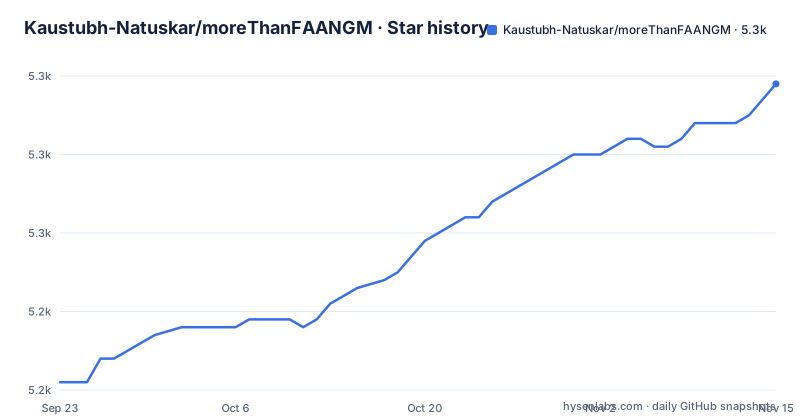
Star history
- Kaustubh-Natuskar/moreThanFAANGM5,269 ★ · +38
| Repository | 2026-09-23 | 2026-11-15 |
|---|---|---|
| Kaustubh-Natuskar/moreThanFAANGM | 5.2k | 5.3k |
38 Stars in the last 53 days, measured from the daily GitHub snapshot. Compare with other projects
Editorial analysis
What moreThanFAANGM Actually Is
The repository is a single README that lists companies alphabetically, each with a hyperlink to that company's careers page. The README's own count table states 482 companies, and the description says the list covers "more than 400 product base companies(NOT JUST FAANGM) & good start-ups." That framing is the point: the author is arguing that the well-known FAANGM set is too narrow a target for job seekers, and that product companies and startups deserve equal attention.
The intended audience is people applying for software engineering and adjacent roles, particularly in India, judging by the large number of Indian employers and the India-specific careers URLs. There is no application tracking, no filtering, and no database. It is a reading list.
How the List Is Organised and Maintained
The README opens with a table of letter anchors from A to Z plus a 0-9 section, so readers can jump to a letter rather than scroll the whole file. Each letter is an h2 heading, and companies sit inside ordered lists with anchor links. The README explicitly warns contributors: "PLEASE DON'T CHANGE THE NUMBERING. KEEP EVERYTHING STARTING WITH 1."
A separate GUIDELINES.MD at the repository root is the contribution rulebook. The repository also carries a _config.yml, which is consistent with the GitHub Pages homepage at kaustubh-natuskar.github.io/moreThanFAANGM. The last push was on 2026-08-10, so the list is not abandoned, but it is also not a continuously updated feed. Every change is a manual pull request against a Markdown file.
Installing and Using moreThanFAANGM
There is nothing to install. The project is a Markdown file and a static site, so the two ways to use it are to read it on GitHub or open the Pages homepage. If you want to work with the file directly, clone the repository:
git clone https://github.com/Kaustubh-Natuskar/moreThanFAANGM.gitAfter cloning, you have README.md, GUIDELINES.MD, LICENSE.txt and _config.yml. The README is the list itself. To contribute, follow the process in GUIDELINES.MD, then open a pull request adding a company in the correct alphabetical section without renumbering existing entries. The README's warning about numbering is the main rule it states directly: keep every list starting at 1.
Where the Directory Breaks Down
The central limitation is staleness. A careers URL that worked when a contributor added it can 404 or redirect to a generic homepage months later, and the repository has no published releases, so there is no changelog to tell you when a given entry was last touched.
The README's own count table is another weak point. It says 482, but the count is maintained by hand, and the file even carries an HTML comment reminding contributors to change the count after adding companies. Hand-maintained totals drift. Treat 482 as approximate.
Finally, this is the wrong tool if you want open roles. It links to careers landing pages, not to specific postings, and it has no location, seniority, salary or remote filters. If you need a live feed, a directory like this will waste your time.
How It Compares to a Job Board
A conventional job board such as a company's own ATS or an aggregator indexes individual postings and expires them when the role closes. moreThanFAANGM does the opposite: it indexes employers and never expires them. That difference matters. A job board answers "what is open right now" and goes stale in weeks. This repository answers "which companies exist and where do I apply" and goes stale in years.
The trade-off is maintenance cost. A job board pays for crawling and de-duplication. This project pays with contributor attention, which is cheaper but less reliable. The upside is breadth: 482 employers in one file is a broader sweep than most niche job boards, and it includes semiconductor, fintech, edtech and ecommerce names that a general tech job board may bury. The downside is that you do the filtering, every time.
Licence and Upgrade Cost
The repository is MIT licensed, with LICENSE.txt at the root. MIT is permissive: you can copy, modify and redistribute the list, including commercially, provided the copyright notice and permission notice are retained. Note that the licence covers the repository's contents, not the third-party careers pages it links to; those sites have their own terms.
Upgrade cost is low. There is no package to update and no API to version. Pulling the latest changes is a git pull, and any merge conflict will almost certainly be in README.md around the alphabetical lists. If you fork the list and add your own companies, expect to resolve conflicts whenever upstream adds entries in the same letter section.
Frequently Asked Questions
The questions below cover the most common points of confusion about what this repository is and is not.
Editorial conclusion
Adopt moreThanFAANGM if you are a job seeker who wants a broad, alphabetically organised starting point for company research and you are willing to verify every careers link yourself. Do not rely on it as a live job feed or expect it to surface new postings. Before using it, check the README's total count against the actual entries, confirm the GUIDELINES.MD contribution rules if you plan to submit a company, and treat the MIT licence as covering the list's structure rather than the third-party careers pages it links to.
Frequently asked questions
What is moreThanFAANGM?
It is a GitHub repository containing a list of more than 400 product companies and startups, each linked to its careers page. The README states it covers "more than 400 product base companies(NOT JUST FAANGM) & good start-ups."
Does moreThanFAANGM list actual job openings?
No. The README links each company to its careers page, not to individual postings. You still have to check each company's site for open roles.
How many companies are in moreThanFAANGM?
The README's count table states 482 companies. The count is maintained by hand, and the file includes a comment reminding contributors to update it after adding entries, so treat the number as approximate.
Which companies are considered FAANG+?
The repository does not define FAANG+ or list its members. Its stated purpose is to go beyond that set, listing product companies and startups instead.
Which companies are considered FAANGs in India?
The README does not define a FAANG set for India. It includes many Indian employers with India-specific careers links, but it does not group or label them as FAANG equivalents.
How do I contribute a company to moreThanFAANGM?
Follow the rules in GUIDELINES.MD at the repository root, then open a pull request. The README warns contributors not to change the existing numbering and to keep every list starting at 1.
Official sources
Add this badge to your README
If you maintain this project, the badge below links readers to this analysis and shows its maintenance status from the daily GitHub snapshot. Paste the markdown into your README; add ?metric=license or ?metric=stars to the image URL for a different field.

[](https://hysenlabs.com/projects/kaustubh-natuskar-morethanfaangm)Star history chart for your README
[](https://hysenlabs.com/projects/kaustubh-natuskar-morethanfaangm)Was this useful?