Nodal: A Stateless, PostgreSQL-Bound API Framework for Node.js
GitHub describes it as API Services Made Easy With Node.js. The repository metadata lists JavaScript as its primary language. The metadata lists the MIT license. This article stays within the project description and details documented in the GitHub repository README.
At a glance
- What is it?
- Nodal is an opinionated Node.js framework for building CRUD-focused API services, with built-in PostgreSQL integration and a strict stateless design. This review covers its mechanics, setup, limitations, and whether it fits your stack.
- Who is it for?
- Adopt Nodal if you need a quick, opinionated CRUD API server tied to PostgreSQL and you accept its stateless, non-streaming constraints. Skip it if you require WebSockets, long-polling, or in-memory state across requests.
- Can I use it commercially?
- Yes. MIT is a permissive licence: you can use, modify and sell software built on it, as long as you keep its copyright and licence notices.
- Is it still maintained?
- Probably not. The repository last received commits 45 months ago, on January 16, 2023.
- What is it written in?
- Mainly JavaScript, according to GitHub's language statistics.
Answers come from the project's GitHub data, last synced on October 24, 2026, and from our analysis. They are not legal advice.
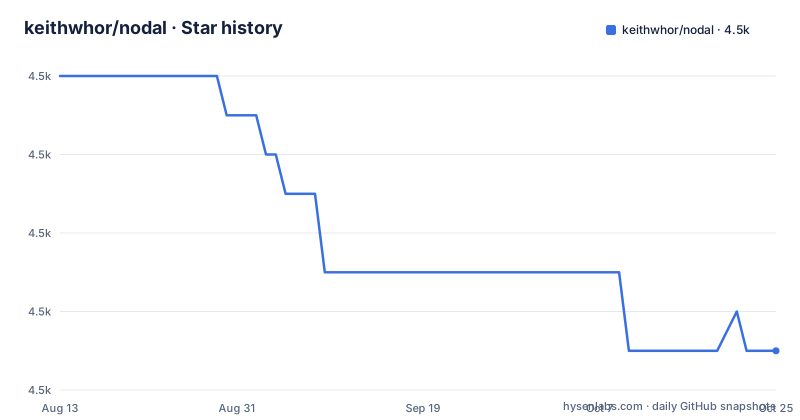
Star history
- keithwhor/nodal4,475 ★ · -7
| Repository | 2026-08-13 | 2026-10-24 |
|---|---|---|
| keithwhor/nodal | 4.5k | 4.5k |
-7 Stars in the last 72 days, measured from the daily GitHub snapshot. Compare with other projects
Editorial analysis
What Nodal Actually Solves
Nodal targets a specific niche: building API services that are essentially data manipulation layers. The README describes it as a web server and opinionated framework for Create Read Update Destroy (CRUD) APIs for web, mobile, or IoT apps. It is not a general-purpose web framework. It is for teams that want to expose a database to clients without hand-rolling routes, controllers, migrations, and authentication. The framework makes decisions for you, which reduces the number of choices you need to make. This is useful for prototyping mobile or IoT backends quickly, as the blog posts linked in the README suggest. The target user is a developer who wants a structured, explicit way to build a data-centric API and is willing to follow Nodal's conventions.
The Stateless Dogma and Its Consequences
The most distinctive feature of Nodal is its insistence on statelessness. The README is explicit: Nodal servers are stateless and distributed, and you should not rely on in-process memory to serve multiple requests. It even uses process clustering in development to discourage this practice. This has direct consequences. You cannot use socket connections for realtime features; the README says there should be a separate server for that. You also should not use Nodal for streaming or long-poll requests. The HTTP request and response objects are intentionally obfuscated. This is a hard constraint, not a suggestion. If your application needs WebSockets or server-sent events, Nodal is the wrong tool. The framework pushes you to use PostgreSQL for any state, including unstructured data via the JSON field type. This is a coherent design, but it means you must design your system around statelessness from the start.
How Nodal Works: Controllers, Models, and Query Composer
The core mechanism is a combination of controllers, models, and a query composer. The README shows a BlogPostsController with methods like index, show, create, and update. Each method calls a static method on a model, such as BlogPost.query() or BlogPost.find(), and then responds with the result. The query builder supports chaining, as in BlogPost.query().join('user').join('comments').where(this.params.query).end(callback). This is similar to other ORMs, but it is built into the framework. The framework also includes migrations and a query composer, which handle database schema changes and query generation. The pattern is consistent: you define models, then controllers that operate on them, and the framework handles routing and response formatting. The response format is JSON API, which is built-in. This means you get a standard way to structure responses without extra configuration. The framework also includes pre-built User and OAuth AccessToken models and controllers, which saves time for authentication.
Getting Started: Commands and Configuration
Installation is straightforward. You install the CLI globally with npm install nodal -g, then run nodal new to create a project. The README instructs you to enter the project directory and run nodal s to start the server. For database setup, you need PostgreSQL. After installing Postgres, you run createuser postgres -s to create a superuser with no password, which is the default configuration. Then you run nodal db:create to create the database, nodal db:prepare to prepare for migrations, nodal db:migrate to run pending migrations, and nodal db:rollback to roll back one migration at a time by default. These commands are specific and concrete. The configuration expects a postgres user with no password, which is a development default. For production, you would need to change that, but the README does not explain how. The CLI is the main interface, and it seems designed to get you from zero to a running API quickly.
Limitations and Potential Failure Modes
The most obvious limitation is the statelessness requirement. If you ignore it, you will run into problems because the framework actively discourages in-process state by clustering in development. This can be confusing for developers coming from Express, where you can store data in memory. Another limitation is the reliance on PostgreSQL. The README says to connect Nodal to a PostgreSQL database for unstructured data, but it does not mention support for other databases. If your team uses MySQL or MongoDB, Nodal may not work out of the box. The framework is also opinionated, which means you have to follow its conventions. If you need to customize the HTTP layer, you cannot because the request and response objects are obfuscated. This is a deliberate trade-off, but it can be a blocker for certain use cases. Finally, the README targets Node 6.x, which is old. This suggests the project may not have kept up with Node.js versions, which could be a maintenance concern.
Alternatives: Express and Sails.js
The most common alternative is Express, which is a minimal web framework. Express does not impose a stateless design or a specific database. You can use any database, any ORM, and you have full control over the HTTP layer. The difference is that Express gives you nothing out of the box; you have to build the CRUD endpoints, migrations, and authentication yourself. Nodal provides all of that, but at the cost of flexibility. Another alternative is Sails.js, which is a full-featured MVC framework for Node.js. Sails includes an ORM (Waterline) that supports multiple databases, and it has built-in support for WebSockets via Socket.io. This is a direct contrast to Nodal's statelessness. If you need realtime features, Sails is a better choice. The trade-off is that Sails is heavier and less opinionated about statelessness, so you have to make more decisions about architecture.
Maintenance and License
The repository is licensed under MIT, which is permissive and allows commercial use. However, the maintenance status is uncertain. The metadata shows no recent releases and the last push is unknown. The README asks for contributors and says the project is under active development, but that statement may be outdated. The target Node 6.x version is a red flag, as that version is end-of-life. If you adopt Nodal, you may need to fork it or maintain it yourself. The documentation is sparse; the README points to a website and blog posts, but the actual API documentation is not in the repository. This increases the learning curve. The upgrade path is unclear because there are no release notes to track changes. You should check the repository's commit history and issues before committing to this framework.
Editorial conclusion
Adopt Nodal if you need a quick, opinionated CRUD API server tied to PostgreSQL and you accept its stateless, non-streaming constraints. Skip it if you require WebSockets, long-polling, or in-memory state across requests. Before committing, verify the current state of the project: the README targets Node 6.x, which is outdated, and the last push and release info are unclear, so check the repository's recent commits and open issues to confirm active maintenance. If you need realtime features or more flexibility, look elsewhere.
Frequently asked questions
What is Nodal used for?
It is a web server and opinionated framework for data manipulation-centric CRUD API services in Node.js, aimed at web, mobile or IoT applications. The stated goal is a stateless, distributed service that does not hold memory between requests.
Can Nodal handle realtime features or socket connections?
Not by design. Nodal is not meant for streaming or long poll requests, socket connections cannot be relied on, and the API server should never keep a stateful, prolonged connection with a client. Realtime belongs in a separate server that can interface with the Nodal API server and receive events from it.
Which database does Nodal use?
PostgreSQL, with migrations, a Query Composer used as the ORM and PostgreSQL integration packaged in. The setup steps create a postgres superuser with no password, which is the configuration Nodal expects, and the manifest depends on the pg driver at 4.5.x.
How do I create and migrate a database with Nodal?
Run nodal db:create to create the database, nodal db:prepare to prepare it for migrations, nodal db:migrate to run everything pending, and nodal db:rollback to reverse them. Rollback goes one migration at a time by default rather than undoing a whole series at once.
Is the Nodal repository current?
Treat it as a snapshot: the manifest version is 0.16.1, there are no GitHub releases, and the last push to master was on 2023-01-16. The install steps still name Node 6.x, and the pg driver sits in the 4.x line, so a newer runtime is not something the repository covers.
Official sources
Add this badge to your README
If you maintain this project, the badge below links readers to this analysis and shows its maintenance status from the daily GitHub snapshot. Paste the markdown into your README; add ?metric=license or ?metric=stars to the image URL for a different field.

[](https://hysenlabs.com/projects/keithwhor-nodal)Star history chart for your README
[](https://hysenlabs.com/projects/keithwhor-nodal)Was this useful?