Kitware/VTK: what the Visualization Toolkit actually gives you
Mirror of Visualization Toolkit repository
At a glance
- What is it?
- VTK is a C++ library for image processing, 3D graphics, volume rendering and visualization, built up since 1994. Here is what it solves, how the project says to build it, and where it stops being the right tool.
- Who is it for?
- Adopt VTK when you need volume rendering, surface reconstruction, decimation or implicit modeling inside a C++ application and you are willing to manage a CMake build against a large vendored dependency tree. Do not adopt it if you only need to put a chart on a web page: the Web/, Wrapping/ and Examples/JavaScript/ directories exist, but the core value is in the C++ algorithms.
- Can I use it commercially?
- Check first. The repository uses a licence we do not classify automatically, so read its LICENSE file before any commercial use.
- Is it still maintained?
- Yes. The repository received new commits within the last day.
- What is it written in?
- Mainly C++, according to GitHub's language statistics.
Answers come from the project's GitHub data, last synced on November 14, 2026, and from our analysis. They are not legal advice.
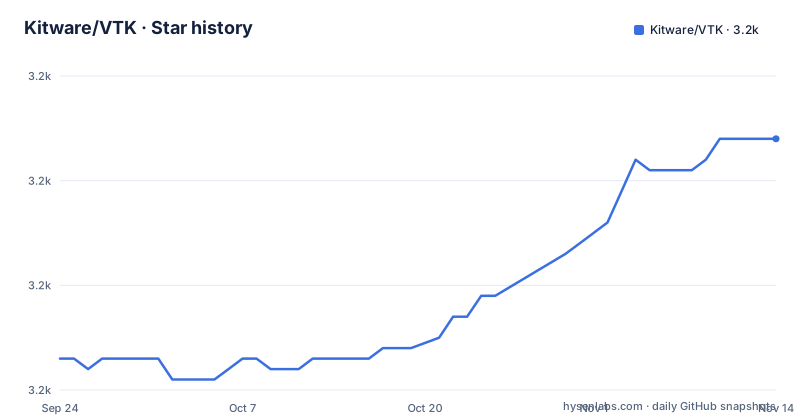
Star history
- Kitware/VTK3,234 ★ · +21
| Repository | 2026-09-24 | 2026-11-14 |
|---|---|---|
| Kitware/VTK | 3.2k | 3.2k |
21 Stars in the last 51 days, measured from the daily GitHub snapshot. Compare with other projects
Editorial analysis
The problem VTK solves, and who it is written for
VTK is not a viewer application. It is a library you link against when you need image processing, 3D graphics, volume rendering or visualization inside your own program. The README lists the algorithms it ships: surface reconstruction, implicit modeling and decimation, plus rendering techniques such as hardware-accelerated volume rendering and LOD control. Those are the tasks that are expensive to write yourself and easy to get subtly wrong.
The stated audience is broad. The README says VTK is used by academicians for teaching and research, by government research institutions such as Los Alamos National Lab in the US and CINECA in Italy, and by commercial firms that use VTK to build or extend products. The project traces its origin to the textbook "The Visualization Toolkit, an Object-Oriented Approach to 3D Graphics", originally published by Prentice Hall and now published by Kitware, Inc. That history matters for how you read the API: the design is object-oriented and pipeline-based, and it has been accumulating since the initial release in 1994.
If your problem is "I have voxel data or a mesh and I need to filter, reconstruct or render it", VTK is aimed at you. If your problem is "I need a dashboard", it is not.
How the toolkit is organized: modules, pipelines and the repository layout
The top level of the repository is a map of the library's concerns. Common/, Filters/, Imaging/, Rendering/, IO/, Interaction/, Parallel/, Charts/, Geovis/, Infovis/, Domains/, Views/ and Web/ are separate directories, and CMakeLists.txt at the root drives the whole build. ThirdParty/ holds vendored dependencies, and Wrapping/ is where the language bindings live, which is why the same algorithms are reachable from more than one language rather than only from C++.
Documentation sits in Documentation/, and the build guide the README points to is Documentation/docs/build_instructions/build.md. Examples/ is split by domain rather than by API: Examples/Medical/, Examples/ImageProcessing/, Examples/IO/, Examples/Charts/, Examples/Modelling/, Examples/ParallelProcessing/, Examples/JavaScript/, Examples/Android/, Examples/iOS/ and Examples/Emscripten/ are all present. That directory list is the honest description of scope. The same core is expected to run on a desktop, in a browser through Emscripten, and on a phone.
The pipeline model is the part that takes adjustment. Data objects flow through filter objects, and each filter consumes one dataset type and produces another. That is why the module split is by data concern (Imaging, Rendering, IO) rather than by convenience function. It also means an error early in a pipeline surfaces somewhere else entirely, which is a real cost when you are debugging a long chain.
Building VTK from source with CMake
The README does not give a copy-paste build command. It says to see build.md in Documentation/dev/ for build instructions, and the root CMakeLists.txt confirms CMake is the build system. There is also a CMakePresets.json at the top level, so preset-based configuration is present in the repository, though the README does not document the preset names. The README does not document a rollback or uninstall path either.
The compiler minimums are listed explicitly and are worth checking before you start: GCC 8.0 or newer, Clang 7.0 or newer, Apple Clang 11.0 (Xcode 11.3.1) or newer, Microsoft Visual Studio 2019 or newer, and Intel 19.0 or newer. Supported operating systems are Windows Vista or newer, Mac OS X 10.7 or newer, and Linux (the README gives Ubuntu 12.04 or newer and Debian 4 or newer as examples). A build on an older toolchain will fail rather than degrade.
For a first real use, the Examples/ tree is the intended entry point. Examples/README.txt describes the layout, Examples/RunExample.cmake is the driver script, and Examples/SearchScript.sh searches the tree. The README also points to a separate collection of VTK Examples online as a learning resource. Start from an example in the domain closest to your data, such as Examples/ImageProcessing/ or Examples/Medical/, rather than from the API reference.
Where VTK is the wrong tool
The build is the first limitation. VTK vendors dependencies under ThirdParty/ and compiles a large C++ codebase, so a full build takes real time and real disk. If you only need to parse or write a VTK-format file, pulling in the whole toolkit to do it is disproportionate.
The second limitation is the documentation split. The README routes general information to the VTK homepage, reference documentation to nightly Doxygen output, examples to a separate examples site, and questions to the VTK Discourse forum. There is no single document that covers both the API and the build in one place. The nightly Doxygen build is generated, not curated, so it tells you what a method's signature is and rarely why you would call it.
The third is the bug workflow, which is deliberate and slow. The README asks you to first read CONTRIBUTING.md if you have a patch, otherwise to join the VTK Discourse forum and ask about expected versus observed behavior to determine whether it is really a bug, and only then to open an entry in the issue tracker. If you need a fix on your own schedule, that path will not deliver one.
Finally, VTK is a C++ library with bindings, not a web-first toolkit. If your deliverable is a browser visualization and you have no interest in C++, the Web/, Wrapping/ and Examples/JavaScript/ directories exist, but you are still building and shipping a compiled artifact.
VTK against ParaView, and the difference in approach
The natural comparison is ParaView, and the repository itself makes the relationship concrete: the top level contains .kitware-release-paraview.json alongside .kitware-release.json, so the two projects are released in coordination by the same organization.
The difference is the layer you work at. ParaView is an application you run: you load data, build a pipeline through a graphical interface, and get a rendered result without writing code. VTK is the library underneath that kind of application. Choosing VTK means you are writing the program that drives the pipeline, and you own the interface, the file handling and the deployment. Choosing ParaView means you accept its interface in exchange for not writing any of that.
If your goal is exploratory analysis of a dataset you already have, ParaView gets you there faster. If your goal is a product that embeds visualization, or a batch process that must run headless over thousands of files, VTK is the layer you want, because there is no application to script around.
Licence, maintenance and the cost of staying current
VTK is distributed under the OSI-approved BSD 3-clause License, and Copyright.txt holds the details. That is a permissive licence, which in practice means you can link VTK into a proprietary product without the copyleft obligations a GPL-style licence would impose. The repository metadata reports the licence as NOASSERTION, so if the exact terms matter to your legal review, read Copyright.txt rather than trusting a scanner's label. This is a description of the licence, not legal advice.
The repository is not archived, and the last push was on 2026-09-23. The README describes nightly Doxygen documentation, so reference material is regenerated continuously rather than only at tagged releases. The repository has no published GitHub releases, which means the practical upgrade question, how far apart the versions you would jump between are, cannot be answered from the release history.
Upgrade cost is dominated by the same thing that dominates the first build: the vendored ThirdParty/ tree and the CMake configuration. A compiler that was acceptable when you started can fall below the listed minimums later, and the README keeps that list current. Budget for periodic rebuilds against new toolchains, not just for source changes.
Editorial conclusion
Adopt VTK when you need volume rendering, surface reconstruction, decimation or implicit modeling inside a C++ application and you are willing to manage a CMake build against a large vendored dependency tree. Do not adopt it if you only need to put a chart on a web page: the Web/, Wrapping/ and Examples/JavaScript/ directories exist, but the core value is in the C++ algorithms. Before committing, read Documentation/docs/build_instructions/build.md, confirm your compiler meets the listed minimums, and check the ThirdParty/ directory for the dependencies you will be compiling.
Frequently asked questions
What is VTK software?
VTK is an open-source software system for image processing, 3D graphics, volume rendering and visualization. It ships advanced algorithms such as surface reconstruction, implicit modeling and decimation, and rendering techniques including hardware-accelerated volume rendering and LOD control.
Is VTK still used?
The README states that VTK has grown since its initial release in 1994 to a world-wide user base in the commercial, academic and research communities. It names Los Alamos National Lab in the US and CINECA in Italy among government research users, and says commercial firms use it to build or extend products. The repository is not archived and the last push was on 2026-09-23.
What is a VTK file format?
The README does not describe the file formats. It points to the VTK homepage for general information, to nightly Doxygen output for reference documentation, and to a separate collection of VTK Examples. The IO/ directory at the top level is where the input and output code lives.
What is VTK in Python?
The README does not document Python usage directly. Language bindings come from the Wrapping/ directory, and the online VTK Examples site is listed as a learning resource. The core library itself is C++.
Official sources
Add this badge to your README
If you maintain this project, the badge below links readers to this analysis and shows its maintenance status from the daily GitHub snapshot. Paste the markdown into your README; add ?metric=license or ?metric=stars to the image URL for a different field.

[](https://hysenlabs.com/projects/kitware-vtk)Star history chart for your README
[](https://hysenlabs.com/projects/kitware-vtk)Was this useful?