kitze/react-hanger: Sparse Docs for Typed React Hooks
A collection of useful React hooks
At a glance
- What is it?
- react-hanger is a TypeScript package of React hooks for primitive state changes. Its package metadata and build scripts are clear, but the README does not document the hook APIs or provide a usable installation example.
- Who is it for?
- react-hanger may suit an existing TypeScript React project that already knows its exports and supports React versions above 16.8.0. It is a poor first choice for developers choosing a hooks library from public documentation alone.
- Can I use it commercially?
- Yes. MIT is a permissive licence: you can use, modify and sell software built on it, as long as you keep its copyright and licence notices.
- Is it still maintained?
- Yes. The repository last received commits 1 day ago.
- What is it written in?
- Mainly TypeScript, according to GitHub's language statistics.
Answers come from the project's GitHub data, last synced on October 25, 2026, and from our analysis. They are not legal advice.
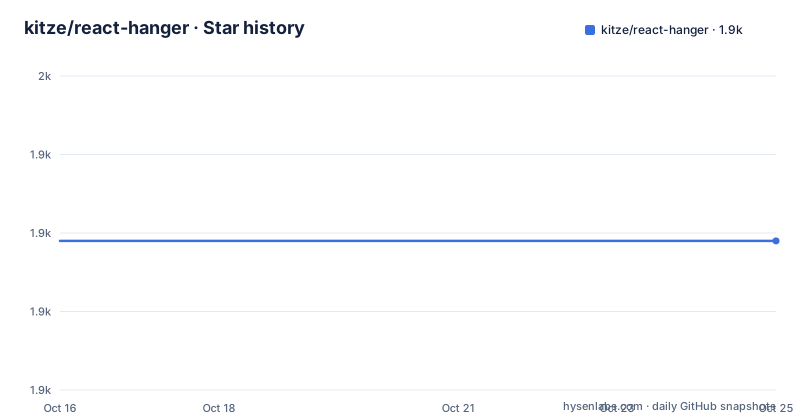
Star history
- kitze/react-hanger1,929 ★ · +0
| Repository | 2026-10-16 | 2026-10-25 |
|---|---|---|
| kitze/react-hanger | 1.9k | 1.9k |
0 Stars in the last 9 days, measured from the daily GitHub snapshot. Compare with other projects
Editorial analysis
Why react-hanger Targets Primitive State Changes
react-hanger addresses a narrow part of React state management: helpers for changing state built from primitive values. Its package description calls them state-changing helpers for “specific to some primitives types,” while the shorter repository description calls it “a collection of useful React hooks.” That wording points away from server data fetching, routing, forms, or application-wide state. The intended users are React developers who want small composable functions around ordinary state transitions rather than a complete state container.
The distinction matters because adopting a hooks package is not equivalent to adopting a state-management architecture. A hook can remove repetitive setter patterns while leaving component ownership, data fetching, persistence, and cross-component coordination unchanged. The README does not identify which primitive categories are covered, such as booleans, numbers, or strings, and it does not describe whether a hook accepts an initial value or returns a state value and setter. Even its one-line description leaves the package boundary uncertain.
The package is aimed at React projects rather than framework-specific applications. Its peer dependencies require `react` and `react-dom` above `16.8.0`, which places it after the introduction of React hooks. It does not claim support for a backend runtime, command-line interface, or server-side React renderer. The repository homepage points to a CodeSandbox, but the README does not explain what that sandbox demonstrates or which hook is exercised there.
What the Repository Layout Confirms About react-hanger
The repository confirms a conventional TypeScript source and release layout. Source code resides in `src/`, tests are defined through `jest.config.js`, and TypeScript compilation uses `tsconfig.json` for ESM output and `tsconfig-require.json` for CommonJS output. The package publishes through a `lib` directory because the `clean` script removes that directory, the two build scripts compile into generated output, and the `postbuild` script runs `copyPackageJsonAndReadme.js`. This supports the conclusion that `src/` is authoring code while `lib/` is generated release content, even though the README does not document that workflow for consumers.
There are two module entry points in `package.json`: `main` points to `./index.js`, while `module` points to `./esm/index.js`. Type declarations are exposed through `./index.d.ts`. That setup gives consumers distinct CommonJS, ESM, and TypeScript-facing entry information. It does not, however, reveal the package's public export names.
The `sideEffects` field is set to `false`. This is a package-level statement that its modules can be treated as free of import-time side effects when consumed by a bundler. It should not be confused with proof that every hook is side-effect free at runtime. React hooks are called during component rendering and can cause state updates; `sideEffects` concerns module evaluation and bundler tree shaking, not the behavior of a hook after it has been imported.
The visible repository includes linting, tests, two TypeScript builds, formatting configuration, and a release command based on `np`. This is more build evidence than API evidence. Since the README is truncated before a usable API reference, it does not confirm how hooks are named, grouped, tested in public examples, or exported.
Installing react-hanger and Reaching a First Real Use
The README does not provide installation steps. It does not show an `npm install` command, a Yarn command, a package-manager version, or a source import. It links to `https://codesandbox.io/s/44m70xm70` as the repository homepage, so that sandbox is the only concrete starting location named by the project. The README does not state what result to expect there or which export the example imports.
Because no import name, hook signature, or returned value is documented in the README, a first-use example would require invention. This article therefore does not present a fabricated component. The shortest defensible path is to open the linked CodeSandbox and inspect whether it still loads with the current CodeSandbox runtime, then locate the actual exported hooks in the generated package metadata or repository source.
For maintainers working from a checkout, the documented package scripts do provide a concrete development workflow. The `build` command compiles both module formats, while `test` invokes Jest against `src`. These commands are repository maintenance steps, not instructions for using react-hanger in an application:
yarn testThis runs the repository's Jest script against `src`. The `package.json` defines that script as `jest src`; it does not claim that the repository or dependency graph has been tested here.
A full package build uses both TypeScript configurations:
yarn buildAccording to `package.json`, this runs `yarn build:esm && yarn build:cjs`, followed by the `postbuild` script. Contributors should expect that step to invoke `copyPackageJsonAndReadme.js`, but the repository files do not describe that script's complete behavior.
React Compatibility, Build Outputs, and Upgrade Cost
The declared peer range is broad: `react` and `react-dom` must both be greater than `16.8.0`. The development dependencies use React `^16.13.1`, while TypeScript declarations refer to React 17 types. That combination does not establish support for every later React release. It shows that the package was developed against a React 16 hooks-capable environment, with React 17 typings available, but it does not document testing against current React versions.
Peer dependencies are appropriate for a library such as this because consumers normally provide React themselves. They also create an adoption check: the target application must already satisfy both peer declarations. Version skew, duplicate React installations, or a React release outside the tested range is not addressed by the README.
Upgrade cost appears low at the package-management level because the package declares `sideEffects` as `false` and publishes both `main` and `module` paths. Those facts reduce the need for custom bundler entry configuration in some projects. They do not eliminate source-code review when the library changes. The named release is `v2.4.5`, published on 2022-10-02, so consumers should inspect the diff between the version already used and the version they intend to select.
The repository's last push was on 2026-10-09, and it is not archived. That establishes recent repository activity, but it does not by itself establish release cadence or compatibility work. The newest listed release remains `v2.4.5` from 2022-10-02, while the earlier releases are `v2.4.0` from 2021-04-22 and `v2.3.2` from 2021-01-27. Because the release history lists only recent releases, it does not establish whether older versions exist or whether maintenance since `v2.4.5` changed public APIs.
Where react-hanger Falls Short for Documentation-Driven Adoption
The central limitation is discoverability. A reader cannot determine from the README which hooks the package exports, what each hook returns, how many times it may be called, or which primitive types it handles. There is also no API table, TypeScript example, error contract, or explanation of equality checks and state update behavior. For a package intended to simplify state changes, those omissions are more serious than missing promotional material.
The README also does not describe interaction with React Strict Mode, batching, derived values, or asynchronous callbacks. That does not prove that these cases fail. It means the public documentation gives no basis for evaluating them. In particular, the package description emphasizes state-changing helpers, but it does not state whether those helpers preserve functional updates, avoid unnecessary renders, or defer updates.
There is no documented migration or rollback process. The `postversion` script can clean and rebuild the package during version control, but that is a maintainer workflow, not an application-level migration guide. Consumers are not told whether hook names or return shapes changed across the listed `2.x` releases.
React's built-in `useState` is the most relevant alternative because it is the baseline mechanism this package augments. The built-in approach requires the application to manage primitive state directly, while react-hanger's stated purpose is to provide specialized helpers for those transitions. The README does not quantify how much code each package removes or demonstrate a case where the extra abstraction is justified. Without that evidence, react-hanger is easier to justify when a team already uses one of its exact helpers than when it is selected as a general-purpose replacement for React state.
MIT Terms and Package Selection Boundaries
The package is licensed under MIT, both in the repository metadata and the repository license classification. That supports use and modification under the license's stated conditions, but this review does not interpret the legal text or provide legal advice. The README's promotional and sponsor sections do not add installation, API, compatibility, or troubleshooting guidance relevant to adoption.
The package is a reasonable candidate for a React and TypeScript codebase that needs a narrowly defined primitive-state helper and can verify the API from source. It is not a sound selection based on the README alone for a team seeking documented examples, migration guidance, or assurance across current React releases. A framework team should also keep `react-hanger` separate from routing, data fetching, and global state concerns unless the source confirms behavior the framework provides itself.
The strongest project-specific adoption signal would be an existing codebase already importing a `react-hanger` hook with a known return shape. In that situation, the MIT license, `sideEffects` setting, dual module paths, and recent repository push provide useful package facts. For a new dependency, the first decision remains narrower: inspect the actual exports in `src/` and confirm their signatures against the React version and state patterns used by the application.
Editorial conclusion
react-hanger may suit an existing TypeScript React project that already knows its exports and supports React versions above 16.8.0. It is a poor first choice for developers choosing a hooks library from public documentation alone. Verify the hook signatures, export paths, React Strict Mode behavior, and compatibility with the current React release before adding `react-hanger` to an application.
Frequently asked questions
How do I install react-hanger?
The README does not give an installation command. It names a CodeSandbox homepage at `https://codesandbox.io/s/44m70xm70`, but it does not document the package-manager setup used there.
What hooks does react-hanger provide?
The README describes a collection of React hooks for primitive state changes but does not list any hook names. Public API names and return shapes are not documented there.
Which React versions are compatible with react-hanger?
`package.json` declares peer dependencies on `react` and `react-dom` greater than `16.8.0`. It does not document testing against a later minimum or maximum React version.
Does react-hanger support TypeScript and ESM?
The package declares `typings` as `./index.d.ts` and `module` as `./esm/index.js`. Its build scripts compile both ESM and CommonJS outputs from TypeScript sources.
What license does react-hanger use?
The repository and `package.json` identify the package as MIT licensed. The license text is stored in the repository's `LICENSE` file.
Official sources
Add this badge to your README
If you maintain this project, the badge below links readers to this analysis and shows its maintenance status from the daily GitHub snapshot. Paste the markdown into your README; add ?metric=license or ?metric=stars to the image URL for a different field.

[](https://hysenlabs.com/projects/kitze-react-hanger)Star history chart for your README
[](https://hysenlabs.com/projects/kitze-react-hanger)Was this useful?