Geneva: a genetic algorithm that evolves packet-level censorship evasion from one side of the connection
automated censorship evasion for the client-side and server-side
At a glance
- What is it?
- Geneva is a University of Maryland research tool that evolves strategies for defeating in-network censors by duplicating, dropping, tampering with and fragmenting packets. It runs on either the client or the server, only on Linux, and not against IP blocking.
- Who is it for?
- Use Geneva if you are a researcher who wants to evolve or replay packet-level evasion strategies against in-network censors, on a Linux machine you control. Do not use it as a daily circumvention tool, because it is not anonymous, does not encrypt, and its traffic is detectable.
- Can I use it commercially?
- Yes. BSD-3-Clause is a permissive licence: you can use, modify and sell software built on it, as long as you keep its copyright and licence notices.
- Is it still maintained?
- Yes. The repository last received commits 35 days ago.
- What is it written in?
- Mainly Python, according to GitHub's language statistics.
Answers come from the project's GitHub data, last synced on November 26, 2026, and from our analysis. They are not legal advice.
Star history
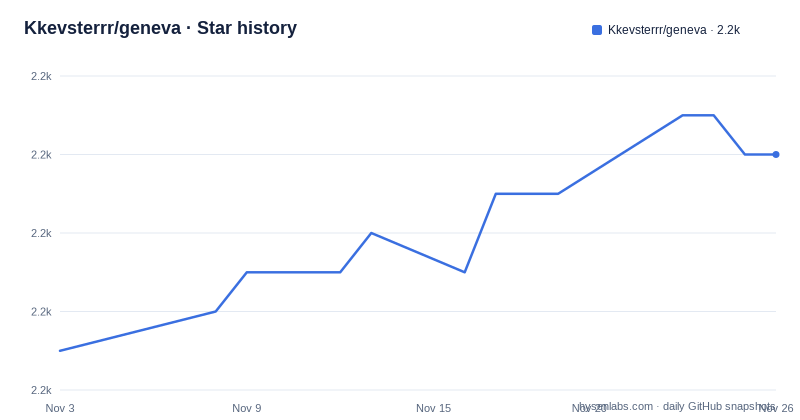
- Kkevsterrr/geneva2,162 ★ · +5
| Repository | 2026-11-03 | 2026-11-26 |
|---|---|---|
| Kkevsterrr/geneva | 2.2k | 2.2k |
5 Stars in the last 23 days, measured from the daily GitHub snapshot. Compare with other projects
Editorial analysis
Evasion runs on one side of the connection, with no outside help
Geneva was designed by researchers at the University of Maryland to defeat censorship by exploiting bugs in censors, such as those in China, India and Kazakhstan. The README contrasts it with solutions like Tor and VPNs, which need assistance from outside the censoring regime. Geneva runs strictly on one side of the connection, either the client or the server.
Its strategies manipulate the network stream to confuse the censor without impacting client and server communication. That makes it effective against many types of in-network censorship. It cannot be used against IP blocking censorship, because there is no packet manipulation that restores a route the censor has cut.
The README is blunt about the audience. Geneva should be considered a research project for researchers, and it is not built with a graphical user interface. The codebase holds the genetic algorithm, the strategy engine, a Python API and a subset of published strategies. A homepage at censorship.ai and documentation at geneva.readthedocs.io carry the longer explanation.
A strategy is a description of packet changes, built from duplicate, drop, tamper and fragment
A censorship evasion strategy is not code. The README calls it a description of how network traffic should be modified, which the engine then carries out. The goal is to modify traffic so the censor cannot censor it while the client and server still communicate.
Four core building blocks make up a strategy. duplicate takes one packet and returns two copies. drop takes one packet and returns none. tamper takes one packet and returns a modified packet. fragment takes one packet and returns two fragments or two segments.
Because duplicate and fragment branch, the actions form a binary tree called an action tree. Each tree has a trigger that says which packets it runs on. Once a trigger fires, the packet enters the tree, and whatever packets emerge from the tree are sent onward. The example strategy in the README triggers on TCP packets with flags PA, duplicates them, and tampers with the data offset and checksum of the copies.
Running the engine on port 80 rewrites iptables and fails on stale rules
The README runs a strategy through engine.py:
# python3 engine.py --server-port 80 --strategy "[TCP:flags:PA]-duplicate(tamper{TCP:dataofs:replace:10}(tamper{TCP:chksum:corrupt},),)-|" --log debugThe debug log shows the engine configuring iptables rules, sending traffic through NFQUEUE with queue numbers 1 and 2 for both tcp and udp. That means the engine changes your firewall state on start.
The warning that follows is specific. If you have stale iptables rules, or other rules that rely on Geneva's default queues, the run will fail, and the fix is to remove those rules.
For several ports, --server-port accepts a range such as 4000:5000, which monitors every port from 4000 to 4000 through 5000, or a list such as 80,443,4444, which monitors only the ports named. Ranges and lists are two different forms, so pick one.
Linux only, Python 3.6, and a netfilterqueue build that breaks on some distributions
Geneva was developed and tested for Centos or Debian based systems. Because of limitations in netfilter and raw sockets, it does not work on OS X or Windows at this time, and it requires python3.6.
The install starts with system packages:
# sudo apt-get install build-essential python-dev libnetfilter-queue-dev libffi-dev libssl-dev iptables python3-pipThen the Python dependencies come from requirements.txt with python3 -m pip install -r requirements.txt. That file pins scapy==2.4.3 and cryptography==3.3.2, which are old pins, and lists netfilterqueue, dnspython, docker, paramiko and others unpinned.
Two distribution notes follow. On Debian 10, some users have reported needing to install netfilterqueue directly from GitHub. On Arch, some users have reported needing a symlink so liblibc.a is available to netfilterqueue. Both are reports from users, not tested guarantees, so expect to debug the build if you are off the Centos or Debian path.
Strategies that work in one country may not work in another
Geneva has found dozens of strategies that work against censors in China, Kazakhstan, India and Iran. Several are included in strategies.md, and that file contains success rates for each individual country.
The README warns that a strategy that works in one country may not work as well in another. It adds that researchers have observed different success rates depending on your exact location. The authors say they have not seen this from their own vantage points, but ask you not to be alarmed if you do, and to contact the team or open an issue so they can track how strategies behave from other places.
The practical reading is that the strategies in the library are published results from specific vantage points, not guarantees. Check the per-country success rates in strategies.md before choosing one, and treat a failure on your network as data to report, not as a bug in your setup.
The disclaimer says Geneva is detectable, not anonymous and does not encrypt
The README includes a Disclaimer. Running these strategies may place you at risk if you use them within a censoring regime. Geneva takes overt actions that interfere with the normal operations of a censor, and its strategies are detectable on the network.
Training raises the exposure further. During the training process Geneva will intentionally trip censorship many times. That is how the genetic algorithm learns, but it is also traffic a censor can see and log.
Geneva is not an anonymity tool, and it does not encrypt any traffic. The README tells you to understand the risks of running Geneva in your country before trying it.
This is the main reason to treat the project as research infrastructure. A person inside a censoring regime who wants safe access is better served by tools with different guarantees, and the README itself places Geneva in a different category from Tor and VPNs.
Layout of the codebase: engine.py, evolve.py, evaluator.py, and a docker directory
The top level shows the two components. evolve.py and evaluator.py sit with the genetic algorithm side, and engine.py is the strategy engine. Directories include actions/, layers/, censors/, plugins/, workers/, docker/, docs/, tests/ and examples/, with examples/context_manager.py as the one example file listed. library.py, strategies.md and citation.bib sit at the root, so you can cite the paper.
The repository is not archived, the last push was on 2026-10-04, and there are no GitHub releases, so you track the master branch. The license is BSD-3-Clause. The README asks users to email [email protected] to say they are using it, with PGP keys on the project website.
One caution on the code. The pins in requirements.txt and the Python 3.6 requirement mean the environment is easier to build in a container or a dedicated virtual machine, and the docker/ directory suggests that route exists, though the README does not describe it.
Editorial conclusion
Use Geneva if you are a researcher who wants to evolve or replay packet-level evasion strategies against in-network censors, on a Linux machine you control. Do not use it as a daily circumvention tool, because it is not anonymous, does not encrypt, and its traffic is detectable. Before running anything, read the Disclaimer, check strategies.md for the country you care about, and confirm you can provide Python 3.6 and netfilter on your system.
Frequently asked questions
What is Geneva, the censorship evasion tool?
Geneva is an artificial intelligence tool from University of Maryland researchers that uses a genetic algorithm to evolve strategies that defeat in-network censorship. It runs on either the client or the server.
Does Geneva work on Windows or macOS?
No. Because of netfilter and raw socket limitations, Geneva does not work on OS X or Windows at this time. It has been developed and tested for Centos or Debian based systems and requires python3.6.
Does Geneva work against IP blocking?
No. The README says Geneva cannot be used against IP-blocking censorship. It targets in-network censorship by manipulating the packet stream.
Is Geneva safe to use inside a censoring country?
The README warns it may place you at risk. Its strategies are detectable, training intentionally trips censorship many times, and Geneva is not an anonymity tool and does not encrypt traffic.
Official sources
Add this badge to your README
If you maintain this project, the badge below links readers to this analysis and shows its maintenance status from the daily GitHub snapshot. Paste the markdown into your README; add ?metric=license or ?metric=stars to the image URL for a different field.

[](https://hysenlabs.com/projects/kkevsterrr-geneva)Star history chart for your README
[](https://hysenlabs.com/projects/kkevsterrr-geneva)Was this useful?