cri-tools: crictl and critest for Kubernetes CRI Node Debugging
CLI and validation tools for Kubelet Container Runtime Interface (CRI) .
At a glance
- What is it?
- cri-tools provides two Go binaries, crictl for live CRI debugging and critest for specification validation, targeting Kubernetes node operators who need to inspect or validate container runtimes directly below the kubelet layer. The project version must match the Kubernetes minor version, and pods created through crictl have no kube-apiserver backing and will be removed by kubelet.
- Who is it for?
- cri-tools fits Kubernetes operators who need node-level container runtime inspection, where kubectl does not reach. critest belongs in the CI pipeline of anyone validating a CRI-compliant runtime before production. The tool is not a workload management interface; crictl-created pods have no kube-apiserver record and kubelet removes them.
- Can I use it commercially?
- Yes. Apache-2.0 is a permissive licence: you can use, modify and sell software built on it, as long as you keep its copyright and licence notices.
- Is it still maintained?
- Yes. The repository last received commits 1 day ago.
- What is it written in?
- Mainly Go, according to GitHub's language statistics.
Answers come from the project's GitHub data, last synced on November 7, 2026, and from our analysis. They are not legal advice.
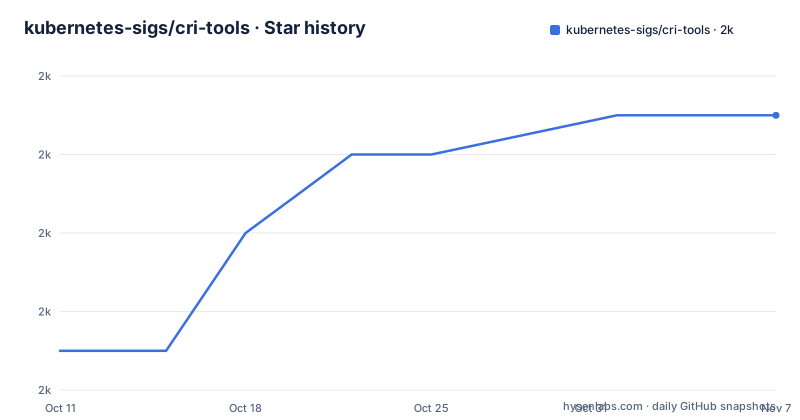
Star history
- kubernetes-sigs/cri-tools2,023 ★ · +6
| Repository | 2026-10-11 | 2026-11-07 |
|---|---|---|
| kubernetes-sigs/cri-tools | 2k | 2k |
6 Stars in the last 27 days, measured from the daily GitHub snapshot. Compare with other projects
Editorial analysis
crictl connects directly to the container runtime socket, bypassing kubelet
When something breaks at a Kubernetes node, kubectl reports pod state as the kube-apiserver sees it. That view passes through kubelet before reaching the container runtime. crictl skips both and calls the Container Runtime Interface directly, giving operators raw container and sandbox state from the runtime itself.
Two tools ship together in this repository. crictl is an interactive CLI for inspecting and manipulating containers and pods at the CRI level. critest runs a structured validation suite against a runtime to confirm it implements the CRI specification correctly. Both tools target people responsible for Kubernetes nodes: platform engineers setting up new runtimes, SREs debugging stuck pods, and runtime developers confirming CRI compliance. A runtime that passes kubelet's basic health checks might still fail on specific CRI calls; crictl surfaces that gap by issuing those calls directly and showing the raw response.
gRPC, OpenTelemetry traces, and the go.mod dependency chain
crictl speaks the CRI protocol over gRPC. The go.mod lists `google.golang.org/grpc v1.84.0` and `k8s.io/cri-api v0.37.1`. The `k8s.io/cri-api` package holds the Protocol Buffer service definitions for the Container Runtime Interface; cri-tools consumes it rather than defining its own protocol. The go.mod also includes `go.opentelemetry.io/otel v1.47.0` and its OTLP gRPC exporter, meaning crictl can emit traces to an OpenTelemetry collector when configured to do so. The Makefile sets CGO_ENABLED to 0 and passes -trimpath via GOFLAGS, producing a statically linked binary with no C runtime dependency and no embedded build paths in stack traces.
One detail a README skim misses: go.mod specifies `go 1.27.0` as the minimum toolchain requirement. The README covers only the wget binary install path and says nothing about Go. Engineers packaging cri-tools from source, or building it inside a CI pipeline, need a Go 1.27 or later toolchain. The install section gives no warning about this requirement, which makes it an invisible prerequisite for anyone building rather than downloading.
Installing crictl and critest on Linux amd64
The project distributes pre-built binaries through GitHub. No package manager installation is documented in the README. To install crictl at v1.37.0:
VERSION="v1.37.0"
wget https://github.com/kubernetes-sigs/cri-tools/releases/download/$VERSION/crictl-$VERSION-linux-amd64.tar.gz
sudo tar zxvf crictl-$VERSION-linux-amd64.tar.gz -C /usr/local/bin
rm -f crictl-$VERSION-linux-amd64.tar.gz
The archive extracts the `crictl` binary into `/usr/local/bin`, ready to call against the configured CRI endpoint. A matching sequence installs critest:
VERSION="v1.37.0"
wget https://github.com/kubernetes-sigs/cri-tools/releases/download/$VERSION/critest-$VERSION-linux-amd64.tar.gz
sudo tar zxvf critest-$VERSION-linux-amd64.tar.gz -C /usr/local/bin
rm -f critest-$VERSION-linux-amd64.tar.gz
The complete command reference for crictl lives in `docs/crictl.md` in the repository. Performance benchmarking instructions are in `docs/benchmark.md`, and the validation test suite documentation is in `docs/validation.md`.
Kubernetes and cri-tools version compatibility
The README contains an explicit compatibility matrix mapping each Kubernetes minor to a corresponding cri-tools minor. For Kubernetes 1.27 and above, all cri-tools builds come from the master branch. Kubernetes 1.8 through 1.15 each have a dedicated branch, created only when a patch for that minor line was planned. The matrix reaches back to v0.1 for Kubernetes 1.7.
Diverging from the recommended pairing is explicitly flagged as a risk: new CRI features may not be fully supported when the two sides differ. Patch cadences diverge as well. Kubernetes patches monthly; cri-tools cuts patch builds only when necessary. When a Kubernetes minor goes End of Life, the matching cri-tools minor is considered end-of-life by the same definition. Current and future milestones are tracked in `docs/roadmap.md`.
critest runs the official CRI validation suite and CI covers containerd and CRI-O
critest accepts a runtime endpoint and runs a structured test suite against it. The test framework is Ginkgo; go.mod lists it as `github.com/onsi/ginkgo/v2 v2.33.0` alongside the gomega matcher library at `github.com/onsi/gomega v1.44.0`. Rather than informal manual checks, runtime developers get a repeatable pass or fail against the actual specification.
The project's own CI runs separate workflows for containerd and CRI-O, visible as the "critest containerd" and "CRI-O" build status badges at the top of the README. A runtime that passes the general build workflow but fails critest would show up there. Anyone writing a new CRI-compliant runtime should treat a critest clean run as a required gate before claiming compatibility, because that is the bar the project sets for its own CI.
crictl-created pods may be removed by kubelet
The README scope section is explicit: managing pods and containers for CRI-compatible runtimes by end-users is listed as outside the project's scope. The reason given is direct: pods created by crictl may be removed automatically by kubelet because of non-existence on the kube-apiserver.
kubelet runs a reconciliation loop. A sandbox pod that has no corresponding Pod object in the apiserver is treated as orphaned and can be garbage-collected. crictl offers no mechanism to register a pod with the apiserver. That makes it a diagnostic tool, not a workload management interface. An operator who starts a container through crictl to probe a runtime configuration should be aware that kubelet may clean it up. Running long-lived workloads through crictl is the wrong use of the tool.
ctr and nerdctl cover containerd's native API rather than the CRI layer
ctr ships with containerd and speaks containerd's own API directly, not the CRI protocol. It gives lower-level access to containerd internals but works only with containerd. nerdctl provides a Docker-compatible command interface on top of containerd, also below the CRI layer. Neither tool connects to CRI-O or validates CRI specification compliance.
crictl works across any CRI-compliant runtime. An operator who needs to inspect both containerd and CRI-O nodes from the same command interface uses crictl rather than maintaining two separate runtime-specific tools. The trade-off is narrower: less access to runtime-specific internals in exchange for consistent behavior across every runtime that passes the CRI contract.
The project carries an Apache-2.0 licence. The last push was on 2026-10-06.
Editorial conclusion
cri-tools fits Kubernetes operators who need node-level container runtime inspection, where kubectl does not reach. critest belongs in the CI pipeline of anyone validating a CRI-compliant runtime before production. The tool is not a workload management interface; crictl-created pods have no kube-apiserver record and kubelet removes them. Verify the minor pairing first: cri-tools minor must match Kubernetes minor on the node. Building from source requires Go 1.27, which go.mod states but the README omits. For containerd-only clusters, runtime-specific tooling may suffice; crictl is right when CRI runtime portability matters.
Frequently asked questions
What is cri-tools used for?
cri-tools provides two binaries: crictl for inspecting and debugging containers and pods at the Kubernetes CRI level, bypassing kubelet and the kube-apiserver, and critest for running the CRI validation suite against any runtime that claims compliance.
How does the cri-tools version relate to the Kubernetes version?
The cri-tools minor version should match the Kubernetes minor version on the node. The README compatibility matrix maps each Kubernetes minor version back to 1.7 to its corresponding cri-tools version. Diverging from that pairing risks incomplete support for new CRI features.
Will pods created with crictl persist after I exit?
No. Pods created through crictl have no corresponding object in the kube-apiserver. Kubelet treats them as orphaned during its reconciliation loop and may remove them automatically. crictl is a diagnostic tool, not a workload management interface.
Does critest work with any container runtime?
critest works with any runtime that implements the CRI gRPC protocol. The project's own CI validates it against containerd and CRI-O as separate workflows, both shown in the README build status badges.
What is the minimum Go version required to build cri-tools from source?
The go.mod file specifies go 1.27.0 as the minimum. The README install section covers only the wget binary path and does not mention this requirement.
Official sources
Add this badge to your README
If you maintain this project, the badge below links readers to this analysis and shows its maintenance status from the daily GitHub snapshot. Paste the markdown into your README; add ?metric=license or ?metric=stars to the image URL for a different field.

[](https://hysenlabs.com/projects/kubernetes-sigs-cri-tools)Star history chart for your README
[](https://hysenlabs.com/projects/kubernetes-sigs-cri-tools)Was this useful?