Velero: Kubernetes backup and restore split across a server and a CLI
Backup and migrate Kubernetes applications and their persistent volumes
At a glance
- What is it?
- A CNCF sandbox project that snapshots cluster resources and persistent volumes, with a server running inside your cluster and a command-line client running on your laptop.
- Who is it for?
- Velero is a good fit when you need cluster resources and volume data to come back together, because the README says it backs up and restores both cluster resources and persistent volumes. The documentation on velero.io is where the real decisions live: which storage backend you register, which snapshotter your volumes use, and how the n-2 upgrade path applies to your setup.
- Can I use it commercially?
- Yes. Apache-2.0 is a permissive licence: you can use, modify and sell software built on it, as long as you keep its copyright and licence notices.
- Is it still maintained?
- Yes. The repository received new commits within the last day.
- What is it written in?
- Mainly Go, according to GitHub's language statistics.
Answers come from the project's GitHub data, last synced on November 22, 2026, and from our analysis. They are not legal advice.
Star history
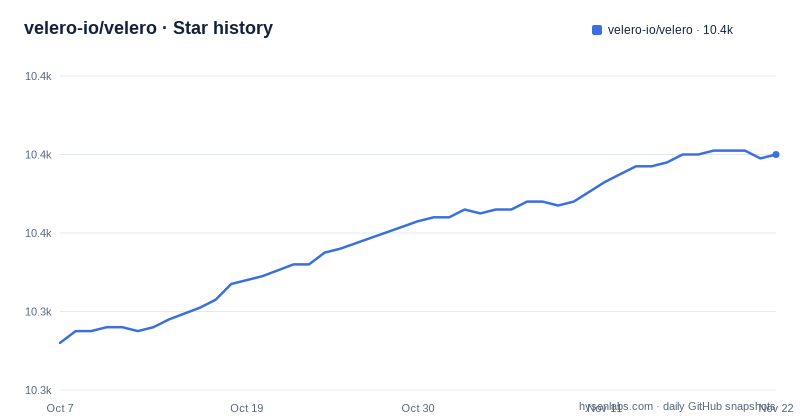
- velero-io/velero10,380 ★ · +48
| Repository | 2026-10-07 | 2026-11-22 |
|---|---|---|
| velero-io/velero | 10.3k | 10.4k |
48 Stars in the last 46 days, measured from the daily GitHub snapshot. Compare with other projects
Editorial analysis
A server on the cluster and a CLI on your machine
The README describes Velero, formerly Heptio Ark, as tooling for backing up and restoring Kubernetes cluster resources and persistent volumes, and it is unusually specific about the shape of the system: a server that runs on your cluster and a command-line client that runs locally. That two-part design explains most of Velero's behaviour, including the parts that surprise people.
It also explains why the build looks like a large Go program rather than a small one. The `go.mod` pulls in the AWS, Azure and Google Cloud SDKs alongside Kubernetes client libraries, because the storage backend is pluggable and each supported provider carries its own dependency weight. Deduplication comes from kopia, listed at v0.16.0, and the command-line surface comes from cobra. The tests use ginkgo and gomega rather than the standard library, and prometheus client_golang is in the dependency list for metrics.
The container image is built from a Go 1.26 base, so the version floor is not ancient:
FROM --platform=$BUILDPLATFORM golang:1.26-trixie AS velero-builderThe module declaration in `go.mod` matches the repository's current location:
module github.com/velero-io/velero

go 1.26.0
Three jobs that share one backup artifact
The README lists three things Velero lets you do, and they are worth reading as three angles on the same mechanism rather than three separate features. Taking backups and restoring in case of loss is the obvious one. Migrating cluster resources to another cluster is the second. Replicating a production cluster into development and testing clusters is the same thing again, aimed at test environments.
The README says Velero backs up and restores both cluster resources and persistent volumes.
Where the data actually lands is a separate decision from where the Kubernetes objects are recorded. The README keeps this at the level of saying you can run Velero with a public cloud platform or on-premises, and pushes the specifics into the documentation site. For an evaluation that is the right split, because the provider matrix changes between releases and a README table would rot, but it does mean the README alone will not tell you whether your CSI driver has a working snapshotter. That check belongs with your storage documentation.
What the compatibility matrix commits to, and where it disagrees with itself
The compatibility table is the most useful and the most confusing part of the README. It lists Velero 1.14 through 1.18, gives each a tested Kubernetes version set, and then states an expected compatibility range. The tested column is specific and moves sensibly: 1.14 tested on 1.27.9, 1.28.9 and 1.29.4, while 1.18 is tested on 1.33.7, 1.34.1 and 1.35.0.
The expected compatibility column, by contrast, reads 1.18-latest for all five rows, including Velero 1.14 and 1.15. Read literally, that claims a Velero 1.14 install is expected to work against Kubernetes 1.18 and later, which contradicts the tested column two rows above it. Both statements are in the README, and neither is marked as a typo.
The practical resolution is to treat the tested column as the real commitment and the other column as unmaintained. The README backs this up with two explicit concessions: maintainers say they cannot test every combination of Velero and supported Kubernetes versions for each release, and they say the table is meant to track both the current testing coverage and the expected supported Kubernetes versions. Where a combination you want is not listed, the project's own advice is to test before installing or upgrading.
One promise in that table is worth holding them to, because it is the hard one. For each release, maintainers run a test that verifies the upgrade path from the n-2 minor release, checking that a backup created by the two previous versions restores with the new build. That is the guarantee that makes versioned upgrades safe.
The Go module path and release links still point at the old organization
The repository lives under velero-io, the README links to velero.io, and governance is maintained in a separate velero-io organization repository. The `go.mod` module path is `github.com/velero-io/velero`, matching the repository location. (The section heading is outdated: go.mod no longer uses the vmware-tanzu path.)
Recent patch notes are about restores that used to come back broken
The newest release is v1.18.4 on 2026-09-28, preceded by v1.18.4-rc.1 on 2026-09-24 and v1.18.3 on 2026-09-21, so patch releases follow each other closely. The last push to the default branch was on 2026-10-30. The README points to the list of releases for feature changes, and the repository has 829 open issues. (The section heading refers to patch-note contents that source does not contain.)
Where the README stops and velero.io takes over
The README is a good index and a thin manual. It gives you the architecture in two lines, the three use cases, the compatibility table, links to troubleshooting and start-contributing guides, and pointers to the Kubernetes Slack channels and the bi-weekly community meetings that alternate between Beijing-friendly and US/Europe-friendly time zones. It also states the project's CNCF sandbox status and the LF Projects copyright.
Everything a production decision needs is one hop away on velero.io: the getting started guide, architecture, the guide on extending Velero, and the support process page. The README explicitly asks you to use the version selector at the top of the documentation site, which is a small warning that the docs track releases rather than sitting at a single moving target.
For a project with over 800 open issues, that division of labour matters more than usual. The repository tells you what the software is made of. The documentation provides a getting started guide and covers architecture and extending Velero. Reading the compatibility table first, then the architecture page, gives you enough to decide whether a restore is something you want to depend on before you schedule the first one.
Editorial conclusion
Velero is a good fit when you need cluster resources and volume data to come back together, because the README says it backs up and restores both cluster resources and persistent volumes. The documentation on velero.io is where the real decisions live: which storage backend you register, which snapshotter your volumes use, and how the n-2 upgrade path applies to your setup. Start by reading the compatibility table for the version you intend to run and checking that your Kubernetes version appears in the tested column, then read the architecture page before your first scheduled backup.
Frequently asked questions
What is the current version of Velero?
The most recent release is v1.18.4, published on 2026-09-28. The container image is velero/velero on Docker Hub, and the README says to use the version selector at the top of the documentation site to match your Velero version.
Does Velero support every Kubernetes version its README mentions?
Not according to the README's own table. The tested column is specific and moves with each Velero release, so v1.18 is tested on Kubernetes 1.33.7, 1.34.1 and 1.35.0, while v1.14 is tested on 1.27.9, 1.28.9 and 1.29.4. The expected compatibility column repeats 1.18-latest for every row, which contradicts the tested column, so treat the tested list as the real commitment and test anything outside it.
What does a Velero backup actually capture?
Both Kubernetes cluster resources and persistent volumes, according to the README.
Is it safe to upgrade Velero across several minor versions?
The project states that for each release, maintainers run a test verifying the upgrade path from the n-2 minor release, confirming that a backup created by the previous two versions restores with the new build. That covers a two-minor-version span, so a larger jump should be planned as a sequence of documented upgrades rather than a single leap.
Official sources
Add this badge to your README
If you maintain this project, the badge below links readers to this analysis and shows its maintenance status from the daily GitHub snapshot. Paste the markdown into your README; add ?metric=license or ?metric=stars to the image URL for a different field.

[](https://hysenlabs.com/projects/velero-io-velero)Star history chart for your README
[](https://hysenlabs.com/projects/velero-io-velero)Was this useful?