Lamatic AgentKit: a registry of 70 agent templates, bundles and Next.js kits
Ready to Deploy Fullstack OpenSource Agentic Apps
At a glance
- What is it?
- Lamatic/AgentKit is a flat catalogue of ready-made agent flows, some with a runnable Next.js front end, built around the Lamatic platform. It is a collection to browse and copy from, not one installable package, and it is unrelated to OpenAI's product of the same name.
- Who is it for?
- Lamatic AgentKit is useful if you already work with Lamatic and want a starting point for a support triage, research, hiring or chat app that you can fork and adapt. It is the wrong repository if you were looking for OpenAI's AgentKit, or for a single package with an installer.
- Can I use it commercially?
- Yes. MIT is a permissive licence: you can use, modify and sell software built on it, as long as you keep its copyright and licence notices.
- Is it still maintained?
- Yes. The repository last received commits 45 days ago.
- What is it written in?
- Mainly TypeScript, according to GitHub's language statistics.
Answers come from the project's GitHub data, last synced on November 25, 2026, and from our analysis. They are not legal advice.
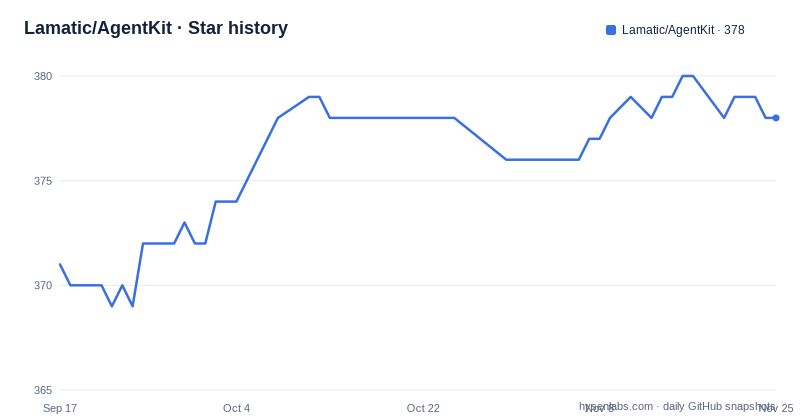
Star history
- Lamatic/AgentKit378 ★ · +7
| Repository | 2026-09-17 | 2026-11-25 |
|---|---|---|
| Lamatic/AgentKit | 371 | 378 |
7 Stars in the last 69 days, measured from the daily GitHub snapshot. Compare with other projects
Editorial analysis
This is Lamatic's AgentKit, not OpenAI's
Searches for AgentKit pull in OpenAI, Coinbase, Google and other products that share the name. This repository belongs to Lamatic, a company that presents itself as an open source SDK, a collaborative studio and serverless deployment, under the headline Stack to Build Reliable AI Agents. The homepage link is git.new/agentkit and the code is TypeScript under the MIT license.
If you want OpenAI's agent builder, nothing here is it. What you get instead is a library of example agents that use Lamatic's tooling. One entry describes a legal assistant working against a Lamatic-connected corpus, which shows that the examples expect a Lamatic account and connection. Treat the kits as templates for that platform rather than as vendor-neutral agent code.
Three entry types share one flat kits directory
All contributions live in a flat kits directory, with no nesting by category. An entry is a template, which is a single flow, a bundle, which is a multi-flow pipeline with no user interface, or a kit, which is a set of flows plus a runnable Next.js app. The type field in the entry's lamatic.config.ts file says which one it is.
The flat layout means a name tells you little. A folder called blog-automation and one called deep-search sit side by side with templates and bundles, and you only learn what you are looking at by reading the configuration. If you need a front end, filter for kits; if you plan to wire flows into your own application, a template or bundle is closer to what you want. The practical advice is to open lamatic.config.ts first, before reading anything else in a folder, because it settles whether you are looking at one flow, a pipeline or a complete app, and so how much work remains for you.
The README catalogue is generated from registry.json
The list of available kits in the README is not hand-written. A block between registry markers is auto-generated from registry.json, and a comment in it warns not to edit by hand. To refresh it, run the update script:
node scripts/update-readme.mjsThe consequence for contributors is that adding a kit means adding its record to registry.json, and any manual change to the generated table is overwritten at the next run. For readers it means registry.json is the more reliable source: the table is a rendering of it. The repository root also holds a highlights.json, a public directory, CONTRIBUTING.md, CODE_OF_CONDUCT.md and a CHALLENGE.md file, plus a CLAUDE.md for AI coding assistants.
Only 22 of 70 entries ship an app, and 42 are single flows
The generated summary reports 70 entries in total: 22 kits that are full apps, 6 bundles that are multi-flow pipelines, and 42 templates that are single flows. Most of the repository is therefore small building blocks.
That has a practical effect. A template is one flow with no interface, so using it means building the surrounding application yourself and deciding how to call the flow. Only the kits include a Next.js app that runs as it stands, with examples such as support triage, code review, deep research, embedded chat, embedded search, hiring automation, a grammar extension and a legal assistant. If you want something you can show a colleague in an afternoon, restrict your search to the kits table, and treat the other 48 entries as parts.
Duplicate names and recycled descriptions make the table unreliable by title
Read the table closely and the names collide. Generative AI appears twice, once at /kits/content-generation and once at /kits/generation, with different descriptions but the same demo address. Legal Assistant appears twice too, from two different authors, one described as a chatbot that summarizes legal context and the other as a research assistant that answers with citations and a standing disclaimer.
Some descriptions look copied. Embedded Search carries the same text as Embedded Chat, and Embedded Sheets carries the same resume-matching text as Hiring Automation. So the description is not always a reliable guide to what a kit does. Go by the path and the contents of the folder, and check the demo before assuming a kit matches its label.
Live demos are author-hosted, and several kits have none
Many kits link to a live demo on vercel.app, such as the ones for code review, deep research, embedded chat and hiring automation. The addresses show that these are separate deployments, some under an individual contributor's own project name.
Other rows show a dash instead. Grammar Assistant, ai-career-copilot, Blog Writing Automation and both Legal Assistant entries have no demo link, so you cannot try them without running them yourself. The catalogue also credits a range of authors, from Lamatic AI to individual contributors, which means quality and maintenance differ from entry to entry. A kit by a single contributor is a snapshot of that person's work, not a product with a support commitment. If a demo link is present, open it before reading code, since a dead or changed demo is also a signal about how much attention the entry gets.
Marketing claims in the description have no figures behind them
The About section promises that you can deploy intelligent AI agents in minutes with enterprise-grade security, and scalable architecture, with smooth integrations as a third promise. The text gives no timing, no security review and no list of integrations to back that up, so it should be read as positioning rather than a measured property.
Individual kit descriptions deserve the same caution. Founder Lens advertises a seven-phase startup research agent that produces a brutally honest investor-grade brief, and the code review kit says it analyzes pull requests for bugs and security vulnerabilities. The legal entries state they are for informational use. None of these descriptions include evaluation results. Treat the output of any kit as a draft that a person still has to check.
No releases, an MIT license, and questions go to Discussions
The repository has no GitHub releases, so there are no tagged versions to pin and no release notes to read. The last push was on 2026-10-12. Because every entry is a folder rather than a versioned package, you pin by commit, and updating means re-reading the folder you copied from.
The license is MIT. For contribution questions the maintainers ask people to use GitHub Discussions instead of Slack, because Discussions are searchable and help future contributors. Bugs go to issues, questions go to the Q and A category, and ideas go to the ideas category. If you copy a kit into your own project, record the commit it came from, since nothing else will tell you later which version you started with. The repository also contains a CHALLENGE.md, which suggests contribution drives that grow the catalogue, so expect the entry count to keep changing as new folders arrive.
Editorial conclusion
Lamatic AgentKit is useful if you already work with Lamatic and want a starting point for a support triage, research, hiring or chat app that you can fork and adapt. It is the wrong repository if you were looking for OpenAI's AgentKit, or for a single package with an installer. Before building on any entry, open its folder, confirm which of the three types it is, and check whether it has a live demo you can try first.
Frequently asked questions
what is agentkit
Lamatic AgentKit is a repository of 70 ready-to-deploy agentic app entries: 22 kits, 6 bundles and 42 templates. The kits include a runnable Next.js app, while templates are single flows.
what does agentkit do
It supplies starting points for agents such as support triage, code review, deep research, hiring automation and embedded chat or search. Each entry is a folder under the kits directory.
What is OpenAI AgentKit?
This repository is not OpenAI's product. It is Lamatic/AgentKit, published by Lamatic under the MIT license, so it will not answer questions about OpenAI's agent builder.
how to install agentkit
It is not a single package. You pick an entry under the kits directory and read its folder. The README catalogue itself is regenerated with node scripts/update-readme.mjs.
Official sources
Add this badge to your README
If you maintain this project, the badge below links readers to this analysis and shows its maintenance status from the daily GitHub snapshot. Paste the markdown into your README; add ?metric=license or ?metric=stars to the image URL for a different field.

[](https://hysenlabs.com/projects/lamatic-agentkit)Star history chart for your README
[](https://hysenlabs.com/projects/lamatic-agentkit)Was this useful?