Latent Box is a curated link collection that argues against being a search engine
A collection of awesome-lists for AI, creativity and art. https://latentbox.com
At a glance
- What is it?
- Twenty-seven hundred stars for a Next.js site whose README spends more time on what it refuses to build than on what it links to, and whose title still says WIP.
- Who is it for?
- Latent Box is a small project with an unusually clear thesis, and the thesis is a refusal. The README rules out another search engine, mass catalogue ingestion, and complex retrieval and user systems, and states the ratio it is aiming for instead: curate a thousand sites so that a hundred are genuinely good enough that people open, try and remember them.
- Can I use it commercially?
- Check first. The repository uses a licence we do not classify automatically, so read its LICENSE file before any commercial use.
- Is it still maintained?
- Yes. The repository last received commits 26 days ago.
- What is it written in?
- Mainly TypeScript, according to GitHub's language statistics.
Answers come from the project's GitHub data, last synced on October 22, 2026, and from our analysis. They are not legal advice.
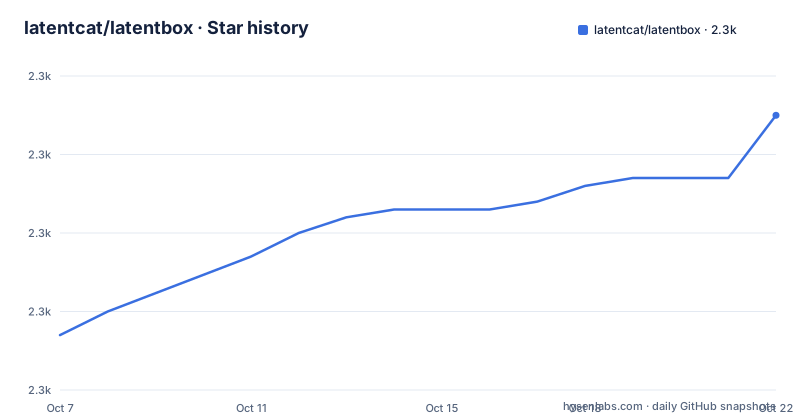
Star history
- latentcat/latentbox2,305 ★ · +28
| Repository | 2026-10-07 | 2026-10-22 |
|---|---|---|
| latentcat/latentbox | 2.3k | 2.3k |
28 Stars in the last 15 days, measured from the daily GitHub snapshot. Compare with other projects
Editorial analysis
The README argues against a search engine
Most resource sites open by explaining what is in them. This one opens by explaining what they are not, and the position is stated three ways across the introduction and its Chinese translation, which are near-parallel rather than a loose paraphrase.
The first point is about the information gap. It says the project does not need another search engine, a massive collection of websites and products, or complex automation, retrieval and user systems, because nobody would look at those. The concrete expectation attached to that is the most useful sentence in the README: when a thousand sites have been curated, a hundred of them should be genuinely good things that users will open, try and remember.
The second point is about breadth of field. It argues that a good product, good technology and a good team all involve a wide range of disciplinary knowledge and professional skills, and hopes the collection covers as many creative fields as possible, aimed at people who enjoy pushing past their own boundaries.
The third point is about maintenance, and it is the honest one. Keeping a curated list current is hard, and the README says the community is the motivation to persist. The response was to open source the whole site on GitHub, set up accounts on X and Xiaohongshu, and start Discord and WeChat groups, with pull requests as the submission path and contributors listed by name.
That framing tells you what kind of project this is before you click anything: a hand-curated catalogue defended on principle against the more common failure mode of directories that go stale.
A Next.js app with MDX, i18n and two UI libraries
The build is a Next.js application named `latentbox` at version 0.1.0, marked private. The dev script runs `next dev -p 6007`, which tells you the project expects port 6007 in development, and the remaining scripts are the standard set: `next build`, `next start`, `next lint --max-warnings=0`, `prettier . --write`, and `prepare` running `husky install`.
The lint script is the notable one. `--max-warnings=0` treats warnings as build failures, which is a stricter default than most templates ship and suggests the maintainers care about keeping the tree clean as contributions arrive.
Content is handled through MDX, with `@next/mdx`, `@mdx-js/loader` and `@mdx-js/react` all present, meaning each entry can be authored as Markdown with embedded React components rather than being hard-coded into page files. The repository tree supports this: `src/`, `public/`, and a `typography.ts` file that points at Tailwind typography for rendered prose.
Internationalisation is real infrastructure rather than an aspiration. `crowdin.yml` sits in the root and a `messages/` directory holds translations, which is consistent with a project run primarily in Chinese with an English README. Given the audience, that is the right choice, since Crowdin handles translation workflow without asking contributors to be fluent in two languages to fix a typo.
The UI layer carries both Radix UI and Headless UI, plus Heroicons, FontAwesome, and React Hook Form with its resolvers. Two component libraries in one project is not necessarily a mistake, but it is worth knowing before you contribute. `components.json` indicates shadcn/ui is configured, and `@paulmillr/qr` suggests entry or profile QR codes are generated somewhere in the flow, likely for the offline community channels.
Contributors are the content strategy
The README's contributors section is an `ALL-CONTRIBUTORS-LIST` block with the standard do-not-remove comment, a markdownlint disable, and a grid of avatars at 14.28% width, which is a seven-column layout that repeats down the table. By the time the material cuts off mid-entry at a contributor whose link is `jhuo.ca`, well over a hundred avatars have been listed.
`.all-contributorsrc` in the tree confirms this is automated from the contributor API rather than maintained by hand, and `CONTRIBUTING.md` sits beside it as the written counterpart.
The scale of that contributor list is the interesting part, because it inverts the usual awesome-list dynamic. In a classic awesome list, one person curates and others submit occasional entries, and the list's value accumulates from the curator's taste. Here, the README explicitly asks people to submit pull requests and add contributor names, which distributes the curation work across the community and turns the contributor list into a record of who did it.
The failure mode of that model is well known: an open submission process eventually produces volume, and volume is exactly what the introduction says it is trying to avoid. The thousand-sites-one-hundred-good ratio is a standard that has to be defended by whoever reviews the submissions, and that review work is the real ongoing cost of this project. It is also, fairly, the most interesting thing about it.
The links in the header give the shape of the outreach: the site itself, an X account, a Discord invite and a Xiaohongshu profile. Four platforms, two of them region-specific, which tells you the audience is split between international and Chinese communities and that submission is genuinely expected through either.
The WIP label and the missing licence tell you something
The README's heading is `Latent Box (WIP!)`, and the exclamation point is in the title rather than a status badge. Projects keep that label in place long after they are demonstrably running, because it is a signal to contributors and visitors that the structure will still change. Given the site is deployed at latentbox.com with a QR dependency and multi-language support, the label is aspirational caution rather than an accurate status report.
The licence field is more consequential. GitHub reports `NOASSERTION` for this repository, which is what the API returns when it cannot classify a licence automatically, and it usually means either no `LICENSE` file at the root or one whose text it does not recognise. In this case the tree does contain a `LICENSE` entry, so a file exists, but the API could not identify it and the README states no licence terms at all.
That matters for a project whose entire value is public curation. If you want to reuse its list data, mirror entries, or fork the site, you are in the awkward position of not knowing from the repository what you are permitted to do. It is a small thing to fix, and it is the first thing a maintainer of a community-submitted resource site should settle, precisely because the community is being asked to contribute work to it.
Everything else about the project's posture is public and generous: full site source on GitHub, MIT-era norms of open contribution, automated contributor attribution, and a contribution guide. The licence is the outlier.
How healthy is it, and what to check before relying on it
The repository has 2,273 stars, 216 forks and 11 open issues, TypeScript, on the `main` branch, with a homepage at latentbox.com and a last push on 2026-09-28. Eleven open issues across 2,273 stars is a very low number for a site that invites submissions, and it points the same way as the contributor count: enough people are contributing that a backlog would be expected, so the low count suggests either a small effective team or active triage.
The topic tags describe the scope precisely: `ai`, `art`, `awesome-list`, `creative-coding`, `design`, `ui` and `ux`. Read together with the description, which calls it a collection of awesome-lists for AI, creativity and art in both English and Chinese and links the site, the project's centre of gravity is generative tooling plus the design and creative-coding tools built around it. That is a narrower and more opinionated field than a general AI directory would be, which is consistent with the stated refusal to build a search engine.
There are no published releases, which is normal for a site rather than a distributed package. The default branch is `main`, `yarn.lock` is committed rather than a pnpm or npm lockfile, and the tooling includes ESLint configuration, Prettier, a Tailwind config and a Next config in the modern `.mjs` form.
What to check before treating it as a reference is freshness rather than existence. A curated list's value is inversely proportional to how stale it is, the site is explicitly a work in progress, and the README's own third pursuit is about maintaining updates. The last push being recent says the project is alive. Whether individual entries are current is something the site itself cannot tell you, and it is the only thing that really matters here.
Editorial conclusion
Latent Box is a small project with an unusually clear thesis, and the thesis is a refusal. The README rules out another search engine, mass catalogue ingestion, and complex retrieval and user systems, and states the ratio it is aiming for instead: curate a thousand sites so that a hundred are genuinely good enough that people open, try and remember them. A Next.js site with MDX content, Crowdin translation and both Radix and Headless UI installed is not a heavier build than that ambition requires. The open question is the one the README itself raises, which is keeping the collection current, and the answer so far has been to open the entire site to pull requests and back it with social accounts and chat groups. Whether that keeps pace with how fast creative tooling churns is the thing to watch.
Frequently asked questions
What exactly is a latent box?
In this repository it is not a technical term, it is the project's own name for a curated collection of links. The README calls Latent Box a reinvented resource site maintained by Latent Cat, a collection of awesome-lists for AI, creativity and art, built with the expectation that of a thousand curated sites a hundred will be genuinely good ones people open and remember.
What technology is the Latent Box site built with?
It is a private Next.js package named `latentbox` at version 0.1.0, using MDX through `@next/mdx` for authored entries, Tailwind with a typography config, shadcn/ui on Radix primitives alongside Headless UI, React Hook Form, FontAwesome and `@paulmillr/qr`, and Crowdin with a `messages/` directory for translations.
Why does this project not want to be a search engine?
The introduction states it explicitly: it does not need another search engine, a massive collection of websites and products, or complex automation, retrieval and user systems, because nobody would look at those. The stated goal is quality over volume, with a hundred genuinely good entries expected out of a thousand curated sites.
How do I submit a link to Latent Box?
The README says content can be shared on any of its platforms, including the X account, Discord, WeChat groups and Xiaohongshu, and that pull requests on GitHub are the direct route, with contributor names added for those who submit.
What licence is Latent Box released under?
The repository tree contains a `LICENSE` file, but GitHub reports the licence as NOASSERTION and the README states no licence terms. If you need to reuse the list data or fork the site, ask the maintainers directly, since the terms are not derivable from the repository as it stands.
Official sources
Add this badge to your README
If you maintain this project, the badge below links readers to this analysis and shows its maintenance status from the daily GitHub snapshot. Paste the markdown into your README; add ?metric=license or ?metric=stars to the image URL for a different field.

[](https://hysenlabs.com/projects/latentcat-latentbox)Star history chart for your README
[](https://hysenlabs.com/projects/latentcat-latentbox)Was this useful?