Magma: an open-source mobile core network platform
Platform for building access networks and modular network services
At a glance
- What is it?
- Magma is a C++ platform for building access networks and modular mobile network services. It targets operators that need cellular infrastructure, federation with existing MNOs, or coverage through Wi-Fi and CBRS, but its deployment still depends on operator-specific configuration and validation.
- Who is it for?
- Magma is appropriate for network operators and infrastructure providers evaluating an open mobile core that can work with existing radio hardware and MNO systems. It is not a turnkey replacement for every commercial core, since the documentation requires environment-specific security and performance validation.
- Can I use it commercially?
- Check first. The repository uses a licence we do not classify automatically, so read its LICENSE file before any commercial use.
- Is it still maintained?
- Yes. The repository last received commits 120 days ago.
- What is it written in?
- Mainly C++, according to GitHub's language statistics.
Answers come from the project's GitHub data, last synced on November 7, 2026, and from our analysis. They are not legal advice.
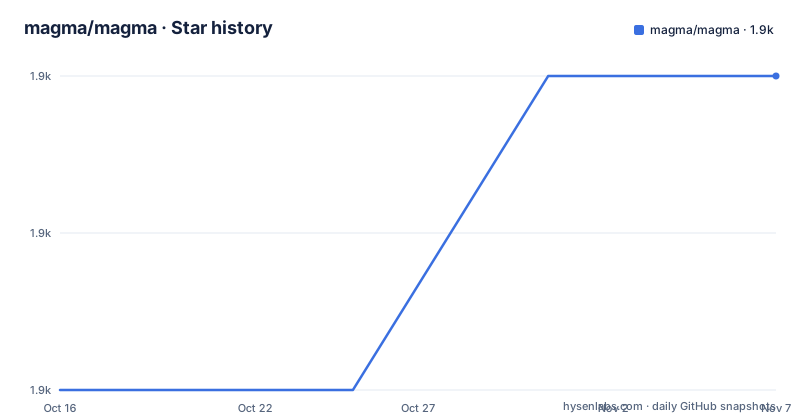
Star history
- magma/magma1,860 ★ · +2
| Repository | 2026-10-16 | 2026-11-07 |
|---|---|---|
| magma/magma | 1.9k | 1.9k |
2 Stars in the last 22 days, measured from the daily GitHub snapshot. Compare with other projects
Editorial analysis
Why Magma targets operators with existing mobile infrastructure
Magma addresses the mobile core network rather than the radio equipment alone. The README describes it as a platform for operators that want to offer cellular service without depending on a single vendor's core implementation. It also names infrastructure providers that need to federate with an existing mobile network operator, or operators with limited licensed spectrum that want additional reach through Wi-Fi and CBRS.
That makes the intended audience fairly specific. Magma is relevant to network engineers, operators, and organizations building or extending access networks. It is not presented as a general-purpose application server or as a replacement for every layer of a cellular deployment. The Access Gateway is intended to work with existing, unmodified commercial radio hardware, so the integration boundary is between the core platform and access equipment rather than a requirement to replace all radios.
The platform also separates policy and network services from centralized configuration and monitoring. That separation may help organizations evolve a network in increments, although the README does not provide deployment instructions, supported hardware matrices, or a complete list of integrations. Those omissions matter when evaluating adoption.
Magma's AGW, Orchestrator, and Federation Gateway roles
The documented architecture has three major components. The Access Gateway, or AGW, provides network services and policy enforcement. In an LTE deployment, the AGW implements an evolved packet core, combining AAA and PGW functions according to the README's description. It sits at the point where access-network traffic needs network control, and it is also where operator policy is applied.
The Orchestrator is described as a cloud service for configuring and monitoring wireless networks securely. It can be hosted on a public or private cloud. The documentation says that platform metrics provide visibility into analytics and traffic flows for wireless users through the Magma web UI. This indicates a control and observability layer above the AGW rather than a second traffic-processing component.
The Federation Gateway connects Magma with the operator's MNO core through standard 3GPP interfaces. According to the README, it proxies between the AGW and the operator network. It supports authentication, data plans, policy enforcement, and charging so that services can remain consistent across the existing MNO network and the expanded network built with Magma. This is the component most directly tied to gradual expansion and infrastructure sharing.
The architecture is also described as access-network agnostic. The README lists cellular and Wi-Fi access, 3GPP generations from 2G through 4G, and upcoming 5G support. The repository topics include 3gpp, 4g, 5g, mobile, and networks, but those topics are not a substitute for a deployment-specific compatibility matrix.
Where to start when installing Magma
The repository does not provide a self-contained installation tutorial in the README. It directs readers to the Magma documentation for deployment, configuration, and usage information, and to the project website for general project information.
A first real use therefore begins with the documentation rather than a guessed command sequence. Start with the deployment guidance, select the access network and MNO integration that match the intended deployment, and identify how the AGW, Orchestrator, and Federation Gateway will be placed. The README gives no supported operating system, hardware list, dependency installation procedure, or minimum resource requirement, so those details must come from the linked documentation or the relevant repository files.
The same caution applies to the first network operation. Before carrying subscriber traffic, verify the documented interfaces and policy behavior for the selected radio equipment and MNO core. The README's Risk section explicitly says that users should test and verify materials against their security and performance requirements.
Magma's extension model and operational trade-offs
Magma is intended to be modular. Its architecture allows different access networks to be supported without requiring every deployment to use the same radio or service arrangement. The repository layout reinforces that this is a broad platform rather than a small standalone binary: it contains directories such as `lte/`, `cwf/`, `feg/`, `orc8r/`, `nms/`, `protos/`, `bazel/`, and `experimental/`.
That breadth creates a clear trade-off. A modular architecture can support federation and multiple access types, but it also gives operators more components, interfaces, and configuration decisions to manage. The README does not state that a small team can deploy Magma without prior mobile networking expertise, nor does it claim that configuration is automatic. The Orchestrator is meant to simplify configuration and monitoring, but the platform still exposes policy, connectivity, and service responsibilities.
The C++ primary language also suggests that engineers should inspect the build and integration surface before selecting it for a constrained environment. The repository includes Bazel files and tooling directories, but the README does not provide build commands. The project should therefore be evaluated as network infrastructure with a substantial software toolchain, not as a lightweight package.
Why Magma may be the wrong choice
Magma is a poor fit when the goal is simply to add a small application service without operating a mobile core. It is also a weak candidate for a team that cannot support the operational responsibilities implied by an AGW, Orchestrator, and Federation Gateway. The documentation does not provide a claim that Magma automatically supports every 3GPP release, every radio vendor, or every MNO core. Compatibility must be checked for the specific deployment.
The Federation Gateway also adds a dependency on an existing operator environment when federation is required. Its value comes from standard 3GPP integration with MNO components, but that same dependency means the project is not a fully independent replacement for every authentication, charging, or policy function in an operator network.
Licensing also requires direct inspection. The repository metadata identifies the license as Other because of a custom GitHub classification, while the README says Magma is BSD licensed and says the EPC originates from OAI under BSD-3-Clause. This is a documentation and repository metadata discrepancy, not a legal conclusion. Teams should read `LICENSE` and the applicable third-party notices before redistribution or incorporation into another product.
Comparing Magma with a commercial mobile core
The practical alternative is an operator-supported commercial mobile core integrated with the same existing radio access network. Magma's documented difference is architectural and licensing-oriented: it is presented as an open-source platform that can work with unmodified commercial radio hardware and can federate with an MNO through standard 3GPP interfaces. A commercial core may provide vendor-supported integration paths, but the README does not document those products or their exact features, so no broader comparison is supportable here.
For an operator choosing between them, the relevant questions are concrete. Does the deployment need a new core across cellular, Wi-Fi, or CBRS? Must it coexist with an existing MNO for authentication, plans, policy, and charging? Can the team support the platform's AGW, Orchestrator, and Federation Gateway? The README supports those concerns, but does not answer implementation compatibility or support terms.
Magma's last push was on 2026-07-11, while the listed releases are `v1.9.0` from 2025-05-16, `v1.8.0` from 2022-09-22, and `v1.7.0` from 2022-03-29. That record shows the latest listed release is newer than the two preceding releases, but it does not by itself establish upgrade compatibility or long-term support for any deployment.
Editorial conclusion
Magma is appropriate for network operators and infrastructure providers evaluating an open mobile core that can work with existing radio hardware and MNO systems. It is not a turnkey replacement for every commercial core, since the documentation requires environment-specific security and performance validation. Before adoption, verify the operator interfaces, radio integration, federation behavior, deployment requirements, and terms in the repository LICENSE file.
Frequently asked questions
What problem does Magma solve?
Magma provides an open-source mobile core network solution for operators and infrastructure providers. Its documented goals include reducing vendor lock-in, supporting federation with existing MNOs, and adding reach through Wi-Fi and CBRS.
What are the three major components of Magma?
The three components are the Access Gateway, Orchestrator, and Federation Gateway. They respectively provide network services and policy enforcement, cloud-based configuration and monitoring, and integration with an MNO core through standard 3GPP interfaces.
Does Magma work with commercial radio hardware?
The README states that the Access Gateway works with existing, unmodified commercial radio hardware. It does not provide a complete list of compatible models, so a specific radio integration still needs verification.
Official sources
Add this badge to your README
If you maintain this project, the badge below links readers to this analysis and shows its maintenance status from the daily GitHub snapshot. Paste the markdown into your README; add ?metric=license or ?metric=stars to the image URL for a different field.

[](https://hysenlabs.com/projects/magma-magma)Star history chart for your README
[](https://hysenlabs.com/projects/magma-magma)Was this useful?