FlipOff: a browser split-flap board that turns any TV into a flip display
Free split-flap display emulator for any TV. The classic flip-board look, without the $3,500 hardware.
At a glance
- What is it?
- FlipOff is a free vanilla JavaScript split-flap emulator you open from index.html. It nails the flip-board look and sound, but the README leaves licence, persistence and deployment questions open.
- Who is it for?
- Adopt FlipOff if you want a retro split-flap board on a spare screen and you are comfortable editing js/constants.js by hand: clone the repository, open index.html, click once for audio, and press F. Do not adopt it if you need a scheduler, a CMS, remote message updates or a documented licence file, because the README describes none of those and the repository shows no LICENSE file at the top level.
- Can I use it commercially?
- Not without permission. GitHub finds no licence file in the repository, and without a licence all rights are reserved by default: you may read the code but not reuse it. Check the README, or ask the authors, before using it.
- Is it still maintained?
- Activity is slowing. The repository last received commits 7 months ago.
- What is it written in?
- Mainly JavaScript, according to GitHub's language statistics.
Answers come from the project's GitHub data, last synced on November 15, 2026, and from our analysis. They are not legal advice.
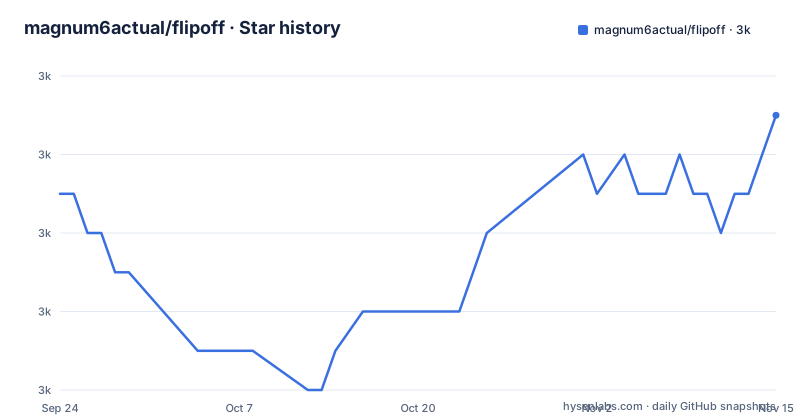
Star history
- magnum6actual/flipoff3,011 ★ · +2
| Repository | 2026-09-24 | 2026-11-15 |
|---|---|---|
| magnum6actual/flipoff | 3k | 3k |
2 Stars in the last 52 days, measured from the daily GitHub snapshot. Compare with other projects
Editorial analysis
What FlipOff is, and the problem it removes
A mechanical split-flap board is a grid of physical tiles, each of which rotates through a stack of characters until it lands on the one it needs. Airports and train stations still run them. Buying one for a living room is not realistic: the README puts the hardware at $3,500 and mentions a $199 fee attached to some alternative. FlipOff is the software answer to that gap. It is a single-page web app that draws a flip-board on screen and animates it, so the only hardware you need is a screen you already own and a browser that can go fullscreen. The audience is narrow but clear: people who want an ambient retro display on a TV or large monitor, and who are willing to edit a JavaScript constants file to put their own text on it. There are no accounts, no subscriptions and no backend. The README states that you open index.html and go, and that the app works offline with zero external dependencies. That last claim is the interesting one, because it is what separates FlipOff from a hosted widget: the whole thing is static files.
How the tile animation and sound actually work
The mechanism is described in the README and is visible in the file layout. Board.js manages the grid and orchestrates transitions. Tile.js holds the animation logic for a single tile. Each tile is an independent element, and when a new message arrives it can run a scramble sequence: rapid random characters with colored backgrounds, then the final character. The important detail is that only tiles whose content changes between messages animate. A real mechanical board behaves the same way, because a tile already showing the right letter does not need to move. That selective animation is what keeps the effect from looking like a generic CSS transition. Sound is handled separately by SoundEngine.js, which the README says uses the Web Audio API. The audio itself is a single recorded clip of a real split-flap transition, embedded as base64 in js/flapAudio.js, and it plays once per message change to sync with the visual. MessageRotator.js runs the rotation timer, KeyboardController.js maps keys, and constants.js holds the configuration: grid size, colors, quotes and timing values such as SCRAMBLE_DURATION and STAGGER_DELAY. The trade-off in this design is that the audio is one clip, not per-tile or per-character, so a large grid and a small grid sound identical. The README does not claim otherwise.
Running FlipOff locally and getting the first message on screen
There is no package to install. The README's Quick Start is four steps: clone the repo, open index.html in a browser or serve it with any static file server, click anywhere to enable audio, and press F for fullscreen TV mode. The repository confirms the shape of this: index.html sits at the top level next to css/, js/ and screenshot.png, with no package.json, no build config and no dependency manifest. If you prefer a server, the README gives this exact command, which serves the directory on port 8080:
python3 -m http.server 8080
# Then open http://localhost:8080
After that, the keyboard shortcuts in the README are Enter or Space for the next message, Arrow Left for the previous one, Arrow Right for the next one, F to toggle fullscreen, M to toggle mute and Escape to exit fullscreen. Clicking the page first matters: browsers block audio until a user gesture, which is why the README lists the click as a separate step rather than folding it into opening the page. To put your own text on the board, open js/constants.js and edit the messages list. The same file exposes GRID_COLS and GRID_ROWS for the board dimensions and SCRAMBLE_DURATION and STAGGER_DELAY for timing. Change the messages, reload the page, and the board picks them up, because there is no build step between the source files and what the browser loads.
Where FlipOff stops being the right tool
FlipOff is a display, not a message system. Every message lives in js/constants.js, which means changing what the board shows requires editing a file and reloading the page. If you want to push a score, a train time or a queue number to the screen from another process, the README describes no API, no websocket, no polling endpoint and no file-watching behaviour. You would be building that yourself on top of a project that was not designed for it. The second limitation is state. The README does not document persistence: it does not say whether the current message index survives a reload, and nothing in the file structure suggests a storage layer. Treat the rotation as starting fresh each time the page loads unless you verify otherwise. Third, the licence situation is unresolved in the repository itself. The README ends with a License section reading "MIT, do whatever you want with it", but the top-level entries are .gitignore, README.md, css/, index.html, js/ and screenshot.png. There is no LICENSE file. A README line is a statement of intent, not the same artifact as a licence file, and anyone embedding this in a product should treat that gap as something to resolve rather than assume. Finally, this is an emulator. If the point of the project for you is mechanical authenticity, a browser animation and a recorded clip are a reproduction, not the object.
FlipOff against Vestaboard and the real hardware
The obvious comparison is Vestaboard, which appears in the related searches for this project. Vestaboard is a physical split-flap display you buy, mount and connect to an app or API; the value is the object on the wall and the message pipeline behind it. FlipOff inverts both halves. There is no object, only a screen you already own, and there is no pipeline, only a constants file. That difference cuts in both directions. FlipOff costs nothing and runs on hardware you have, which is why the README frames it against a $3,500 board and a $199 fee. But a physical board keeps displaying when the browser crashes, does not need a click to enable audio, and does not depend on a TV staying awake. If your goal is a permanent installation that other people can send messages to, a hosted service or a physical board is the more direct route. If your goal is the look on a screen you already own, on a weekend, with no account and no bill, FlipOff is the shorter path. The README's own framing makes that choice explicit rather than pretending the two are interchangeable.
Maintenance, upgrades and what the repository does not tell you
The last push to the default branch was on 2026-03-26. The repository is not archived. The repository has no published GitHub releases, so there is no version number to pin and no changelog to read. Upgrades are therefore a git pull, and because the project is vanilla HTML, CSS and JS with no build tools and no npm, there is no dependency tree to update and no lockfile to break. That is the real maintenance argument for FlipOff: the surface area is small, and the failure mode of an upgrade is a diff in files you can read. The cost is on the other side. Without releases or a changelog, you cannot tell what changed between two pulls except by reading the diff yourself, and without a LICENSE file at the top level the licence question rests on a README sentence. If you fork FlipOff for anything beyond personal use, add the licence file yourself rather than relying on the README's wording, and keep your customisations in js/constants.js so a pull does not overwrite them. Note that constants.js is also where the grid size and timing live, so a pull that changes that file can collide with your edits. This is a general observation about the layout, not legal advice.
Editorial conclusion
Adopt FlipOff if you want a retro split-flap board on a spare screen and you are comfortable editing js/constants.js by hand: clone the repository, open index.html, click once for audio, and press F. Do not adopt it if you need a scheduler, a CMS, remote message updates or a documented licence file, because the README describes none of those and the repository shows no LICENSE file at the top level. Before you commit a screen to it, open js/constants.js and confirm that GRID_COLS, GRID_ROWS, SCRAMBLE_DURATION and STAGGER_DELAY match your display, then serve it with python3 -m http.server 8080 rather than opening the file directly if audio misbehaves.
Frequently asked questions
What is FlipOff and what does it do?
FlipOff is a free, open-source web app that emulates a classic mechanical split-flap display, the kind found at train stations and airports. It runs fullscreen in any browser and turns a TV or large monitor into a retro display. The README describes it as pure vanilla HTML, CSS and JS with no frameworks, no build tools and no npm.
How do I install FlipOff?
There is nothing to install. The README's Quick Start is to clone the repo, open index.html in a browser or serve it with any static file server, click anywhere to enable audio, and press F for fullscreen TV mode. It also gives python3 -m http.server 8080 as a local server option.
How do I change the messages FlipOff displays?
Edit js/constants.js, which the README lists as the place for messages, grid size, timing and colors. GRID_COLS and GRID_ROWS set the board dimensions, and SCRAMBLE_DURATION and STAGGER_DELAY control the animation timing. There is no build step, so a reload picks up the change.
Does FlipOff need an internet connection or an account?
No. The README states there are no accounts and no subscriptions, and that the app works offline with zero external dependencies. The repository has no package manifest or dependency files at the top level, which is consistent with that claim.
What licence is FlipOff released under?
The README's License section says MIT and "do whatever you want with it", but the top-level repository entries listed are .gitignore, README.md, css/, index.html, js/ and screenshot.png, with no LICENSE file present. Treat the README wording as the only licence statement available in the repository.
Official sources
Add this badge to your README
If you maintain this project, the badge below links readers to this analysis and shows its maintenance status from the daily GitHub snapshot. Paste the markdown into your README; add ?metric=license or ?metric=stars to the image URL for a different field.

[](https://hysenlabs.com/projects/magnum6actual-flipoff)Star history chart for your README
[](https://hysenlabs.com/projects/magnum6actual-flipoff)Was this useful?