Manticore Search treats search as a SQL database, not a Java service
Open-source search database for full-text, vector, and hybrid search with real-time indexing and SQL.
At a glance
- What is it?
- A C++ search engine with two storage engines, vector search inside the table definition, and benchmark claims pinned to a version two majors behind the current release.
- Who is it for?
- Manticore Search rewards an evaluation that starts with your workload rather than its feature list. Two storage engines means the first question is whether your data fits in RAM, and the columnar path is the one built for when it does not.
- Can I use it commercially?
- Yes, with conditions. GPL-3.0 is a copyleft licence: if you distribute software that includes it, you must release that software's source code under the same licence. Running it internally without distributing it does not trigger that obligation.
- Is it still maintained?
- Yes. The repository received new commits within the last day.
- What is it written in?
- Mainly C++, according to GitHub's language statistics.
Answers come from the project's GitHub data, last synced on November 25, 2026, and from our analysis. They are not legal advice.
Star history
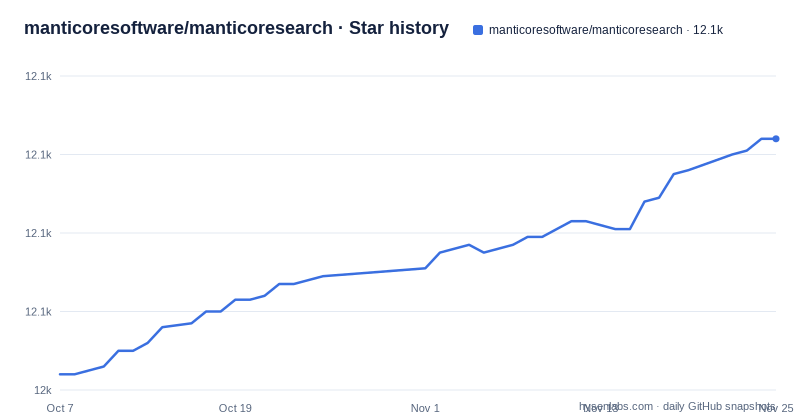
- manticoresoftware/manticoresearch12,104 ★ · +60
| Repository | 2026-10-07 | 2026-11-25 |
|---|---|---|
| manticoresoftware/manticoresearch | 12k | 12.1k |
60 Stars in the last 49 days, measured from the daily GitHub snapshot. Compare with other projects
Editorial analysis
A search engine whose interface is SQL
The repository description is unusually specific for a search project: an open-source search database for full-text, vector and hybrid search with real-time indexing and SQL. Four capabilities in one sentence, and the last one is the load-bearing choice. SQL is the interface, and the README says it plainly, describing Manticore Search as SQL-first and MySQL-compatible, with SQL as the native syntax used through your preferred MySQL client.
That decision has consequences for everything else. There is no Java or Go service to deploy alongside your application, no REST layer to translate between your query builder and an internal DSL, and no schema registry to keep in sync. The language is C++, which tells you where the engineering went. The repository carries 12,026 stars, 643 forks and 652 open issues, and GitHub reports the license as GPL-3.0. A `component-licenses/` directory at the root suggests the project tracks the licences of what it vendors. The homepage is manticoresearch.com, and the README links the documentation on a separate manual subdomain, although the repository also has `manual/` and `doc/` directories.
Two storage engines, two different products
The single most useful thing in the README is that Manticore offers two storage layouts, and they are aimed at different problems.
Row-wise storage is described as fast for small, medium and large datasets. That is the default-shaped option, and it is what you get when your index fits comfortably in memory. Columnar storage is credited to a separate project, the Manticore Columnar Library, and is described as handling datasets too large to fit in RAM.
So when you evaluate this, the first question is not which engine is faster in the abstract. It is whether your data fits in memory. If it does, the row-wise path is the simpler one and the columnar work is irrelevant to you. If it does not, the columnar path is the product.
Vector search moved inside the table definition
The README's feature list is the clearest statement of where the project is heading, and auto-embeddings and conversational search sit near the top of it.
Auto-embeddings with automatic chunking generate vectors from text and can split long documents into fixed-size, recursive or sentence-based chunks stored in a `float_vector_array`. The README is direct about why that matters, saying it makes relevant sections searchable without chunking on your side. This is a real change in where the work happens. Vector pipelines usually mean an embedding call, a splitter, a batch job and a place to keep the intermediate state. Here the column type is part of the table, so the splitting is a property of the storage rather than a step in your code.
Hybrid search combines full-text and vector retrieval in a single query, which is the mode most teams actually want, since pure vector search loses exact matches and pure keyword search loses paraphrase. Conversational search goes one step further, letting existing vectorized tables answer questions with KNN retrieval, conversation history and LLM-backed responses through a SQL `CALL CHAT` statement or the HTTP JSON `/search` endpoint.
What none of this changes is the boundary. Embedding still means sending text somewhere and paying for it.
Reading the benchmark numbers honestly
The README leads with speed claims, and they are specific: 340x faster than MySQL 9.7.1 and 6.51x faster than Typesense 27.1 on 1.1 million Hacker News comments, 3.85x faster than a tuned Elasticsearch 9.4.3 on 100 million-plus comments, 2.02x faster than that Elasticsearch on 1.7 billion NYC taxi rides, and 1.71x faster than ClickHouse 26.6.1.1193 on the dashboard's default 10 million-log selection.
Two details matter more than the multiples.
First, every one of those comparisons is against Manticore Search 27.1.5, while the newest release in this repository is release-29.9.0 from 2026-09-11. The benchmark describes a build two majors behind the current one. That does not make it wrong, and faster code does not usually get slower, but it does mean the figures describe a version you cannot install from these tags. Read them as a claim about direction, not as a measurement of the build you would deploy.
Second, the README says so itself, noting that results are workload-specific and pointing readers at the linked dashboard to select queries matching their own workload. The ingestion comparison is the most useful of the set, because it reports resources rather than a ratio: the same 10 million Nginx logs took 5 minutes 46 seconds against 10 minutes 15 seconds, on 1.02 versus 3.80 CPU cores, with 3.98 GB versus 36.98 GB of RAM, and 0.41 MB read against 322.14 MB. A roughly ninefold difference in average RAM is the kind of number that changes an architecture decision, and it is worth checking against your own row sizes.
The release notes as a maintenance signal
Three recent tags show the shape of the project's upkeep, and the naming convention is worth noting: the tags are prefixed, so you get release-29.9.0 rather than a bare 29.9.0.
release-29.9.0 landed on 2026-09-11, release-29.0.2 on 2026-08-14 and release-28.6.6 on 2026-07-31.
The last push to the repository is dated 2026-11-02, about seven weeks after the newest tag, so the main branch is active between tags.
For a project whose pitch is that you can use your existing MySQL client, expect to inherit some gaps between the client's SQL and Manticore's.
What is vendored, and what you would build yourself
The repository root shows a C++ project that carries its dependencies as submodules rather than fetching them at build time. `.gitmodules` is present, and the tree includes `libicu/`, `libre2/` and `libstemmer_c/`, which are the text-matching pieces a search engine cannot do without. `deps.txt` sits alongside them as the declared dependency list.
The build is CMake plus a `configure` script, with `CMakeLists.txt` at the root and `cmake/` holding the module files:
CMakeLists.txt
configure
INSTALL
deps.txt
example.sql
The testing story is visible in the file names. `test/` holds the suite, `docker-compose-test.yml` suggests the suite runs against containers, and there are scripts named `smoke.sh`, `smokeci.sh`, `memcheck.sh` and `valgrind`, along with an `mcl` entry. `memdocker.sh` and `docker-compose-test.yml` point at a container-based path for the memory checking work. Documentation lives in `manual/` and `doc/`, distribution packaging in `dist/` and `installer/`, and `galera_packaging/` hints at the clustering story.
One oddity worth flagging: a `.gitlab-ci.yml` at the root alongside a `.github/` directory. Continuous integration is configured on both GitLab and GitHub for the same project, which is either a deliberate mirror or a leftover, and either way it tells you the project has outgrown a single forge. The root also carries `116.conf`, a configuration file with a number in its name that no documentation in the repository explains.
Editorial conclusion
Manticore Search rewards an evaluation that starts with your workload rather than its feature list. Two storage engines means the first question is whether your data fits in RAM, and the columnar path is the one built for when it does not. Two things deserve a close look before you commit. The benchmark figures in the README were measured against version 27.1.5 while the newest tag here is release-29.9.0 from 2026-09-11, so run your own comparison on the build you would actually deploy rather than quoting those multiples. What the repository does make clear is the shape of the thing: a database you talk to with SQL, licensed GPL-3.0, with 652 open issues against 12,026 stars and a release cadence of roughly one tag a month.
Frequently asked questions
What is Manticore Search?
An open-source search database written in C++ that handles full-text, vector and hybrid search with real-time indexing and SQL. It is MySQL-compatible, so you query it with SQL through your preferred MySQL client instead of translating to a separate query language.
How is Manticore Search different from Elasticsearch?
The README positions Manticore as an alternative to Elasticsearch and reports it as 3.85x faster than a tuned Elasticsearch 9.4.3 on 100 million-plus Hacker News comments, and 2.02x faster on 1.7 billion NYC taxi rides. Those figures were measured against Manticore 27.1.5 while the current tag is release-29.9.0, so the comparison describes an older build.
What is the difference between row-wise and columnar storage in Manticore?
Row-wise storage is intended for small, medium and large datasets that fit in memory, while columnar storage, provided by the separate Manticore Columnar Library, is for datasets too large for RAM.
How do you install Manticore Search?
The README points to the downloads page at manticoresearch.com/install and the documentation at manual.manticoresearch.com. From source, the root carries a `configure` script and `CMakeLists.txt`, and the tree includes an `installer/` directory.
Does Manticore Search support vector and hybrid search?
Yes. Auto-embeddings with automatic chunking generate vectors from text and can split long documents into fixed-size, recursive or sentence-based chunks stored in a `float_vector_array`, and hybrid search combines full-text and vector retrieval in one query. Conversational search is available through SQL `CALL CHAT` and the HTTP JSON `/search` endpoint.
Official sources
Add this badge to your README
If you maintain this project, the badge below links readers to this analysis and shows its maintenance status from the daily GitHub snapshot. Paste the markdown into your README; add ?metric=license or ?metric=stars to the image URL for a different field.

[](https://hysenlabs.com/projects/manticoresoftware-manticoresearch)Star history chart for your README
[](https://hysenlabs.com/projects/manticoresoftware-manticoresearch)Was this useful?