midudev/midudev: A Profile README Updated by JavaScript
This is my personal repo for README. It gets automatically updated to fetch latest videos, photos and articles from my blog.
At a glance
- What is it?
- midudev/midudev is a personal GitHub profile repository that stores a README presentation and includes a JavaScript script for updating its content from the creator's media and blog. It is best suited to a single-owner profile page, not a reusable README framework or a general content publishing system.
- Who is it for?
- Adopt this repository when you are recreating midudev's personal profile workflow and are comfortable maintaining a custom JavaScript updater with one owner. Do not treat it as a general README template or assume that its media fetches are configurable without checking the undocumented workflow.
- Can I use it commercially?
- Not without permission. GitHub finds no licence file in the repository, and without a licence all rights are reserved by default: you may read the code but not reuse it. Check the README, or ask the authors, before using it.
- Is it still maintained?
- Yes. The repository received new commits within the last day.
- What is it written in?
- Mainly JavaScript, according to GitHub's language statistics.
Answers come from the project's GitHub data, last synced on November 7, 2026, and from our analysis. They are not legal advice.
Star history
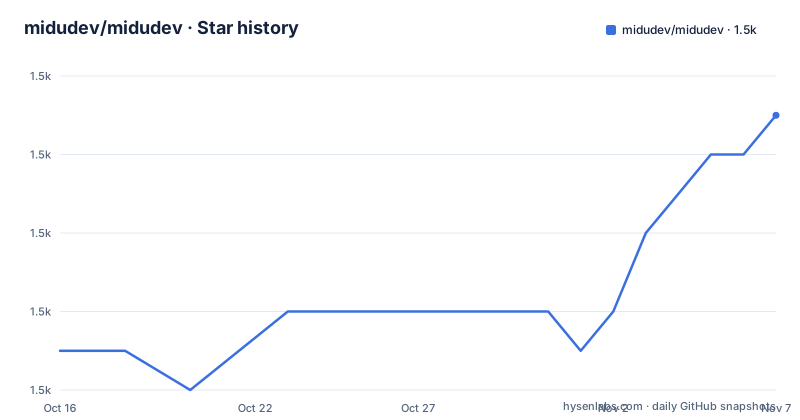
- midudev/midudev1,479 ★ · +6
| Repository | 2026-10-16 | 2026-11-07 |
|---|---|---|
| midudev/midudev | 1.5k | 1.5k |
6 Stars in the last 22 days, measured from the daily GitHub snapshot. Compare with other projects
Editorial analysis
A profile README with a content update boundary
This repository is not a documentation library. Its stated purpose is to maintain a personal GitHub profile README for midudev. The repository description says that the README is automatically updated to fetch the latest videos, photos and articles from the author's blog, while the repository layout includes `README.md`, `src/`, `package/`, `assets/` and automation directories.
The visible README is a profile page rather than a reusable package API. It introduces midudev, links to Twitch, YouTube, Instagram and Twitter, and displays sections for the latest videos on the primary and secondary YouTube channels. Each video is represented as linked thumbnail HTML pointing to a YouTube URL. That makes the first use case quite specific: maintaining a visual profile page that reflects recent creator activity.
The repository should not be confused with a general-purpose GitHub profile README generator. Its metadata identifies it as `midudev README GitHub profile`, and the README uses midudev's own channels and image assets. Engineers adopting it would be adapting a personal automation repository, not installing a documented framework with a stable public API. The repository has no GitHub releases, so the source tree and package manifest are the available starting points.
The JavaScript update entry point
The clearest documented mechanism is the `update-readme` script in `package.json`:
"scripts": {
  "update-readme": "node src/index.js"
}
This establishes the execution boundary. Running the package script starts `src/index.js` under Node.js, and that entry point is responsible for the update workflow. The repository layout also contains `package/`, which may contain supporting data or code, but the repository listing does not reveal its internal files. The README does not describe the exact functions, requests or generated regions.
The result is committed through the normal repository workflow. Since `README.md` is a top-level file and the package script is named `update-readme`, the design appears to separate generated profile content from the automation that refreshes it. The assets directory stores the social and Twitch graphics used by the README. The visible HTML uses relative asset paths such as `assets/twitch.svg`, so a fork would need to preserve those files and review any account-specific URLs.
The repository manifest declares `"type": "module"`, so JavaScript files are treated as ES modules by Node.js. That setting matters for contributors who extend `src/index.js` or any imported modules. The exact implementation cannot be assessed from the README, however, and no data source, authentication scheme, retry policy or write strategy is documented there.
Installation and first profile update
The README does not provide installation instructions, a Node.js version, package-manager command or required environment variables. The repository contains `pnpm-lock.yaml`, which indicates a pnpm-oriented dependency lockfile, but that does not by itself document the intended setup command. The only explicit executable entry point is the package script shown above, whose underlying command is `node src/index.js`.
A first use therefore begins by cloning this repository and reviewing `package.json`, `src/index.js` and the supporting `package/` directory. The `update-readme` script can then be invoked through the package manager used by the maintainer, but the README does not state whether the preferred command is `pnpm run update-readme`, `npm run update-readme`, or another wrapper. That distinction should be resolved from the repository's workflow files rather than guessed.
Before treating generated content as final, inspect the resulting diff in `README.md`. The expected visible shape is the profile header, social links, image assets and latest-video sections. If the updater also fetches photos or articles, those parts are not shown in the README, so their exact output cannot be predicted without reading the implementation.
Content coupling makes forks account-specific
The main engineering constraint is tight coupling between code, accounts and presentation. The README embeds absolute links to midudev's YouTube channels and social profiles, and the repository name and description also identify a particular personal profile. A fork can reuse the structure, but changing the visible output requires locating every hard-coded account URL, image source, video identifier and section label.
The current HTML also relies on YouTube thumbnail URLs containing video identifiers. Those identifiers are visible in the README, including links such as `https://youtu.be/CvdkF52Ms1w` and `https://youtu.be/yVCsfwd0kO0`. The code that selects and replaces those identifiers is not shown in the repository listing, so the refresh mechanism should not be assumed to discover videos through a documented API.
This design is reasonable for one owner who controls the source accounts and accepts visual changes in the profile page. It is less suitable for a shared template used by many users, because a general implementation would need configurable identities, content sources, selectors, asset paths and update rules. None of those configuration surfaces are documented in the repository description or README.
Maintenance and license implications
The repository is not archived, and its last push was on 2026-10-16. That indicates a recent repository state, but the absence of a GitHub release means there is no documented release cadence or upgrade path to follow. Maintenance work would involve reviewing external content sources and checking the generated Markdown and HTML when those sources change. The cost of upgrading is therefore tied to custom source code and remote service behavior rather than a published version line.
The `package.json` declares `"license": "ISC"`, while the repository metadata labels the license as unknown. For an engineering decision, the package manifest is the concrete license statement to review, but it does not answer questions about reused assets or external service terms. The README contains image assets and links to third-party platforms, so a fork should check asset provenance separately instead of assuming that the package license covers every visible file. This is a repository hygiene consideration, not legal advice.
The only declared development dependency is `eslint` at version `10.12.0`, with `eslint.config.js` at the repository root. That suggests linting is part of the contributor toolchain, although `package.json` does not document a lint script. There is also no release publication process to audit.
Choosing between this repository and a static profile
The real alternative is a static GitHub profile README maintained by hand. A static page avoids a Node.js execution step, external fetch dependencies and code-generated diffs. It is simpler when the profile rarely changes, when account data is already curated manually, or when a contributor does not want media retrieval to influence repository updates.
midudev/midudev takes the opposite approach. Its package script centralizes the refresh operation in `src/index.js`, which is useful when new videos, photos and blog articles need to appear repeatedly without editing the Markdown by hand. The trade-off is additional maintenance: the updater, its external sources and its assumptions about profile content become part of the profile page's operating surface.
The repository is therefore a better fit for a personal automation project than for an organization seeking a stable README component. The README does not document a rollback procedure, failure handling or API limits, so those details must be checked in the source before depending on automatic updates.
Editorial conclusion
Adopt this repository when you are recreating midudev's personal profile workflow and are comfortable maintaining a custom JavaScript updater with one owner. Do not treat it as a general README template or assume that its media fetches are configurable without checking the undocumented workflow. Before adoption, inspect src/index.js, verify the required credentials and external data sources, and confirm that the resulting markup fits your GitHub profile and content sources.
Frequently asked questions
How do I update the midudev GitHub profile README?
The package manifest defines `update-readme` as `node src/index.js`. The README does not provide the full setup command or explain how the script discovers and writes content.
Does midudev/midudev provide a reusable GitHub README template?
It is identified as a personal repository for midudev's README and contains account-specific profile content and assets. It is not presented as a configurable template for other users.
What JavaScript tooling does midudev/midudev use?
The package is an ES module and declares `eslint` version `10.12.0` as its development dependency. The `package.json` does not include a lint script or a documented Node.js version.
Official sources
Add this badge to your README
If you maintain this project, the badge below links readers to this analysis and shows its maintenance status from the daily GitHub snapshot. Paste the markdown into your README; add ?metric=license or ?metric=stars to the image URL for a different field.

[](https://hysenlabs.com/projects/midudev-midudev)Star history chart for your README
[](https://hysenlabs.com/projects/midudev-midudev)Was this useful?