ai-business-skills: 144 bilingual marketing skills for Claude Code and other agents
138 bilingual AI marketing skills (69 VN + 69 Global) for Claude Code, OpenCode, Codex, VS Code. Four role SOP packs — content, design, performance, leader ops — plus strategy, personal brand, AI avatar, dropshipping, design master, knowledge library. 4 regions (US/EU/SEA/LATAM) + Vietnam 2025-2026. Companion: opa-kit.
At a glance
- What is it?
- A Vietnamese-first prompt library that ships 144 marketing skills, 6 agents and 19 workflows as installable files for Claude Code, OpenCode, Codex and VS Code. The judgement: the structure is the product, and the Vietnam-specific content is the part you cannot get elsewhere.
- Who is it for?
- Adopt it if you run marketing for a Vietnamese SME, agency or creator business and you already work inside Claude Code or a similar agent, because the VN cluster and the 2025-2026 Vietnam benchmarks are the part of this repository that is hardest to assemble yourself. Skip it if you want a marketing platform with a UI, scheduled execution or analytics, since nothing here runs on its own.
- Can I use it commercially?
- Yes. MIT is a permissive licence: you can use, modify and sell software built on it, as long as you keep its copyright and licence notices.
- Is it still maintained?
- Yes. The repository last received commits 21 days ago.
- What is it written in?
- Mainly PowerShell, according to GitHub's language statistics.
Answers come from the project's GitHub data, last synced on November 25, 2026, and from our analysis. They are not legal advice.
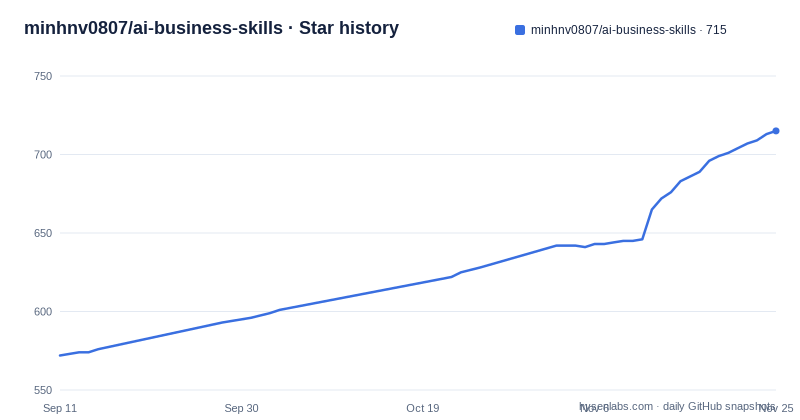
Star history
- minhnv0807/ai-business-skills715 ★ · +143
| Repository | 2026-09-11 | 2026-11-25 |
|---|---|---|
| minhnv0807/ai-business-skills | 572 | 715 |
143 Stars in the last 75 days, measured from the daily GitHub snapshot. Compare with other projects
Editorial analysis
The problem is prompt sprawl, not missing prompts
Most people doing marketing with an AI agent already have prompts. What they do not have is a consistent way to decide which prompt applies, what context it needs, and what a finished output looks like. ai-business-skills addresses that by shipping the prompts as files with a routing layer on top. The README describes the intent directly: it turns one marketing request into a routed workflow, context first, then the right skill cluster, then an agent or workflow when the job spans multiple steps. The intended user is narrow and identifiable: a Vietnamese SME or agency, a global SMB, a founder or coach building a personal brand, or someone running dropshipping. The repository is bilingual by design, with a skills/vi/ cluster and a skills/en/ cluster, and the marketing content carries regional benchmarks for the US, EU, SEA, LATAM and Vietnam across 2025 and 2026. This is a library for people who already have an agent open, not for people looking for a tool to install and click.
How routing works: context, cluster, agent, workflow
The system map in the README shows the data flow. A user request enters a foundation context layer stored as .agents/*.md files, which the README labels as product, audience, positioning, proof and objections. A mode router then sends the request to either the VN cluster or the Global cluster. From there, 6 universal agents handle role-based routing across strategy, content, design, performance, channels and personal brand. When a job spans multiple steps, one of the 19 workflows takes over, and the output is a plan, copy, brief, report, SOP or dashboard. The README also gives a second decision tree for entry points, mapping strategy questions to skills like 00 plan, 10 reverse KPI and 31 offer design, and content questions to 01 calendar, 04 video script, 05 ad copy and 30 design master. The interesting design choice is the context layer sitting in front of everything. A skill that writes ad copy is cheap to produce. A shared context file that every skill reads is the part that keeps output from drifting between sessions, and it is why the repository is organized as a system rather than a folder of prompts.
Installing it: two commands and a directory
The quick start is short. On macOS or Linux, clone the repository, change into it, and run bash install.sh --global, which the README says places 144 skills into ~/.claude/skills/marketing/. On Windows the equivalent is .\install.ps1 -Global. PowerShell is the primary language of the repository, which is consistent with the Windows-first install path. The README then suggests a test prompt in Claude Code, asking for a marketing plan for an AI course with a target of 100 students in 30 days, and states that the skill 00-ke-hoach-mkt activates on its own and produces a detailed .md file containing Vietnam 2025-2026 benchmarks, three KPI scenarios, budget allocation, a weekly timeline and a risk matrix. Treat that as the documented example rather than a verified output.
The VN cluster is the part with no obvious substitute
Generic marketing prompt collections are abundant and mostly interchangeable. What is harder to find is a library that treats Vietnam as a first-class market rather than a translation target. The README states that the VN cluster contains 74 skills while the Global cluster contains 69, and the version note for v3.6.0 describes 33 Global mirror skills completing parity for 4 roles, following v3.5.0 which added 33 VN skills, a knowledge/ directory and a design-producer agent. So the two clusters are not symmetric. The VN side carries content the Global side does not, and the parity work described in v3.6.0 is explicitly about the four role SOP packs (content, design, performance, leader ops), not about every skill. If you market into Vietnam, that asymmetry works in your favor. If you market only into the US or EU, you are paying the maintenance cost of a bilingual repository to use roughly half of it.
Where it stops: no execution, no scheduling, no measurement
This is a file library for an agent, and it has the failure modes of one. The output is described as plans, copy, briefs, reports, SOPs and dashboards, which in context means generated documents, not live reporting. If your actual problem is that campaign performance data never reaches the person who writes the next brief, this repository does not close that loop. The other limitation is verification. The README claims Vietnam 2025-2026 benchmarks and three KPI scenarios inside the plan output, but it does not say where those benchmark figures come from, how they were collected, or when they expire. A skill that emits a budget allocation and a KPI scenario is only as good as the numbers behind it, and a dated benchmark set ages. Before you put any of those figures in front of a client, check the source inside the skill file itself.
Compared with a general prompt library, the difference is the routing layer
The obvious alternative is a general-purpose prompt collection, or simply writing your own prompts into a project-level instructions file. The difference in approach is structural. A prompt collection gives you text you paste. ai-business-skills gives you a directory tree with a mode router, a context layer in .agents/*.md, role agents in agents/, multi-step sequences in workflows/ and a knowledge/ folder the README describes as foundation thinking to upload into role-based AI projects. That structure is what makes a request route to 00-ke-hoach-mkt instead of to whichever prompt you happen to remember. It is also what makes the repository heavier to adopt: you inherit someone else's taxonomy, numbering scheme and file layout. A hand-written project instruction file is faster to start and drifts less, but it will not give you 19 pre-built workflows or a VN and Global split. The honest comparison is that this repository trades flexibility for coverage, and coverage is only worth it if you recognize the taxonomy it imposes.
Maintenance, licensing and the version churn to expect
The repository is MIT licensed, which permits commercial use, modification and redistribution provided the copyright notice and permission notice are retained. That is a permissive license, and it is worth noting because the content is marketing material you may want to resell or embed in client work. This is not legal advice, and if you redistribute the skills inside a product you should read the LICENSE file rather than a summary. On maintenance, the release history shows a fast cadence: v3.0.0 in May 2026 as a rebrand with a dual-edition and three-module structure, v3.1.0 the next day adding Design Master bilingual and multi-platform onboarding, v3.2.0 two days later described as Anthropic pattern alignment and marked additive, and the README badge now at v3.6.0 with a note of zero breaking changes. Additive releases are cheap to absorb, but a rebrand at v3.0.0 means earlier installs may have used different paths. If you forked or edited skill files, plan on re-applying those edits at each minor version.
Editorial conclusion
Adopt it if you run marketing for a Vietnamese SME, agency or creator business and you already work inside Claude Code or a similar agent, because the VN cluster and the 2025-2026 Vietnam benchmarks are the part of this repository that is hardest to assemble yourself. Skip it if you want a marketing platform with a UI, scheduled execution or analytics, since nothing here runs on its own. Before installing, open skills/vi/ and skills/en/ and confirm that the two clusters cover the same jobs, because the README badge says 144 skills while the system map still labels the clusters 74 and 69, and that gap is the first thing you should resolve.
Frequently asked questions
How do I install ai-business-skills?
Clone the repository, then run bash install.sh --global on macOS or Linux, which copies the skills into ~/.claude/skills/marketing/. On Windows use .\install.ps1 -Global. The repository also ships validation scripts in both shell and PowerShell so you can check the pack after installing.
How does an ai-business-skills skill get activated?
Each skill is a single SKILL.md with frontmatter triggers and a workflow body, and the agent switches one on when your message contains a trigger keyword. There is no manual command and no router to configure, so adding a skill means adding a file.
How many skills does ai-business-skills contain?
The published numbers disagree. The repository description says 138, split 69 Vietnamese and 69 global, while the README subtitle, its section heading, and the quick start comment all say 144, and the system diagram shows a 74-skill Vietnamese cluster against 69 global. None of the figures is marked approximate.
Can ai-business-skills write code or technical specs?
No, and the repository says so directly. It excludes building product code, writing technical PRDs or specifications in favour of a separate technical documentation tool, and deploying production infrastructure in favour of your own DevOps workflow. It covers marketing planning, campaign briefs, copy, personal brand, competitor analysis, design, dropshipping, and an AI marketing operating system.
Official sources
Add this badge to your README
If you maintain this project, the badge below links readers to this analysis and shows its maintenance status from the daily GitHub snapshot. Paste the markdown into your README; add ?metric=license or ?metric=stars to the image URL for a different field.

[](https://hysenlabs.com/projects/minhnv0807-ai-business-skills)Star history chart for your README
[](https://hysenlabs.com/projects/minhnv0807-ai-business-skills)Was this useful?