Mirror Networking for Unity: two player counts, a feature table with Beta rows, and a 2014 start date
#1 Open Source Unity Networking Library
At a glance
- What is it?
- MirrorNetworking/Mirror is an MIT-licensed C# networking library for Unity. This article goes through what its feature table promises, which rows are still Beta or Development, and where the project's own numbers disagree with each other.
- Who is it for?
- Choose Mirror if you build a Unity game and want an MIT-licensed netcode library with Interest Management, per-component authority and swappable transports already built in. Do not build around lag compensation, encryption, Mirror Guard or Unreliable Mode before checking their Beta and Development status in the current docs, and do not repeat the player-count claims, because the project states two different figures.
- Can I use it commercially?
- Yes. MIT is a permissive licence: you can use, modify and sell software built on it, as long as you keep its copyright and licence notices.
- Is it still maintained?
- Yes. The repository last received commits 8 days ago.
- What is it written in?
- Mainly C#, according to GitHub's language statistics.
Answers come from the project's GitHub data, last synced on November 25, 2026, and from our analysis. They are not legal advice.
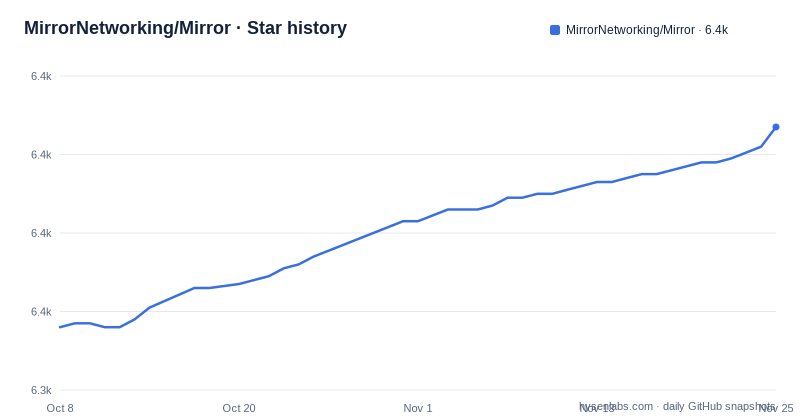
Star history
- MirrorNetworking/Mirror6,407 ★ · +51
| Repository | 2026-10-08 | 2026-11-25 |
|---|---|---|
| MirrorNetworking/Mirror | 6.4k | 6.4k |
51 Stars in the last 48 days, measured from the daily GitHub snapshot. Compare with other projects
Editorial analysis
The pitch gives 300 to 700 million players in one place and over 100 million in another
Mirror opens with the claim that it is used by 300 - 700 million players. Further down, the features table has a Battle Tested row that says Mirror serves over 100 million players. Both lines sit in the same README, and a reader quoting either one is quoting only half of the project's own wording.
The other numbers are easier to check. Mirror says it powers over 1000 Steam games and links to a SteamDB page sorted by rating, and it names Population: ONE as a major hit. It says the library has been battle tested since 2014 for 12 years and counting, and the Long Term Support row repeats the 2014 start. The Community row puts the Discord at nearly 15.000 developers.
None of these figures come with a method. There is no statement of how players are counted, whether the number covers peak concurrency or lifetime installs, or who measured it. The SteamDB link is the only claim a reader can verify without trusting the authors.
The description line on GitHub calls it the number one open source Unity networking library, which is a ranking with no source either. Treat the numbers as marketing and read the code and the test page instead.
Transports are modular, and the visible list ends at UDP, TCP, Websockets, Steam and Relay
The Transports row reads UDP, TCP, Websockets, Steam, Relay and more, and it is marked Stable. The intro also calls Mirror modular and links to a low-level transports section further down the page. Swapping the transport is how a project moves between a LAN prototype, a WebGL build that needs Websockets, and a Steam release.
The table names only these, and the words and more promise others without naming them. If your target needs a specific platform service, check the docs on the GitBook site before committing.
One consequence of the modular design shows up in a different row. The Allocation Free claim carves out an exception: free of runtime allocations and no GC, except transports. A transport is the one layer a project can replace, so the zero-GC promise covers Mirror's own code and does not travel with whichever transport you pick.
Batching is the other transport-adjacent item. It is listed as minimizing message overhead via batching automatically, so there is no setup step to enable it, and the table gives no knob for tuning it.
Authority is set per component with SyncDirection, and the world is split by Interest Management
The SyncDirection row promises server and client authority per component with one click. Most netcode asks you to pick an authority model for a whole object. Here the choice is made on each networked component, so a player prefab can let the client own movement while the server owns health.
Interest Management is described as Spatial Hashing and a Distance Checker to partition the world. Those are the two named mechanisms, and both are marked Stable. Partitioning matters once a scene holds more entities than any one client needs to hear about, and the table gives no player or entity limits for either method.
Child Components is a separate row: put networked components on anything. A networked behaviour does not have to sit on the root object of a prefab.
Transform and Physics sync are built in and Snapshot Interpolation is listed as perfectly smooth movement for all platforms and genres. That wording is a claim, not a measurement, and the table gives no latency or tick-rate conditions under which the smoothness holds.
Latency Simulation is the practical tool in this group. It simulates latency, packet loss and jitter locally, so these authority and interpolation settings can be tried on one machine before a real network is involved.
IL post processing is why [Rpcs] and [Commands] cost nothing at runtime, and why builds depend on it
The IL Post Processing row says Rpcs and Commands carry zero overhead because of IL post processing. In Unity terms, Mirror rewrites compiled assemblies after the C# compiler runs, which is how a plain method marked [Command] ends up with generated sending code. The RPCs and SyncVars row adds that synced vars and remote function calls are built in and safe.
The flip side is that your project's behaviour depends on a build step you do not write. A compile that succeeds in your editor but is not processed will not behave like a processed one. When a Command fails to arrive, the first suspect is whether post processing ran on that assembly, and the table does not describe any diagnostic for that.
The Allocation Free row is worded narrowly and is worth reading twice. It says free of runtime allocations and no GC, except Transports. For games with tight frame budgets that is the headline performance claim, and it is stated for Mirror's code only.
Both rows are marked Stable, along with Batching and Latency Simulation. Of the 11 rows in the first group, all carry the Stable label, including the optional Two Click Hosting row that builds and pushes from the Unity Editor to the cloud through a plugin guide on the docs site.
Lag Compensation, Encryption and Cheat Detection are Beta, and Unreliable Mode is still in Development
The features table has a Status column, and four rows are not Stable. Lag Compensation rolls back state to see what the player saw during input, and it is Beta. Encryption promises end-to-end communication security, and it is Beta. Cheat Detection says that Mirror Guard safely detects Melon Loader and more, and it is also Beta.
Unreliable Mode is further back. It is described as a Quake style Unreliable SyncMode for any component, and its status is Development, the lowest label in the table.
These labels have concrete consequences. A competitive shooter that depends on rollback hit detection is leaning on a Beta feature. A game that handles accounts or payments and expects end-to-end encryption from the library is leaning on a Beta feature too. Mirror Guard names one cheat tool, Melon Loader, so a detection claim cannot be read as covering every cheating method.
The Stable API row sits just below, promising long term stability for 10 years instead of new versions. That promise and the Beta labels coexist: stability is claimed for the API, while four features are explicitly not at the Stable label. Check each Beta feature's page in the GitBook docs for what may still change before building a game around it.
The release numbers say v96, and the last push was 2026-10-19
The repository is not archived. Its last push was on 2026-10-19. The three most recent releases are v96.11.1 and v96.11.2, both on 2026-08-22, and v96.11.3 on 2026-09-17. The README markets itself with a Stable API for 10 years instead of new versions, and the release tags are at major version 96. Those two facts do not contradict, since a stable surface can still ship many numbered releases, but the tag number alone tells you nothing about how much changed between them.
Two releases landed on the same day in August, about half an hour apart, and the next came almost four weeks later. The release list does not show whether the first of the August pair was withdrawn or superseded.
The Long Term Support row says Mirror has been maintained since 2014 with an optional LTS version. If long support matters to your studio, ask the maintainers who ships the LTS version, what it costs and which tags it follows.
The license is MIT, and the Free and Open Source row repeats that there are no restrictions, to minimize risk. For a commercial game that is the clear point in Mirror's favor.
The README gives no install command, and the repository is a full Unity project
The badges at the top link to the Unity Asset Store listing for Mirror, the GitBook docs, a Unity forum thread, a Trello board, the release page, an AppVeyor CI page and the Discord. Those links are the starting points for a newcomer.
The top-level layout explains why a plain clone is not a drop-in package. Assets, Packages and ProjectSettings sit at the root, which is the shape of a complete Unity project. Next to them are CONTRIBUTING.md, SECURITY.md, FUNDING.yml, funding.json, LICENSE, appveyor.yml, .codecov.yml, .releaserc.yml, setversion.ps1, remote_statistics.txt and a .mcp.json file.
The repository is C#, the primary language, and MIT-licensed.
The pitch also says the library works for all types of games, even small MMORPGs, and the General Purpose row says it supports all genres. The only game named is Population: ONE. If your genre needs a feature outside the table, the table is all the evidence there is until you read the docs.
Editorial conclusion
Choose Mirror if you build a Unity game and want an MIT-licensed netcode library with Interest Management, per-component authority and swappable transports already built in. Do not build around lag compensation, encryption, Mirror Guard or Unreliable Mode before checking their Beta and Development status in the current docs, and do not repeat the player-count claims, because the project states two different figures.
Frequently asked questions
Does Mirror Networking still exist?
Yes. The repository is not archived, its last push was on 2026-10-19, and the latest release listed is v96.11.3 from 2026-09-17.
What license does Mirror Networking use?
Mirror is MIT licensed. Its features table says it comes without any restrictions, to minimize risk.
Which Mirror Networking features are not Stable?
Lag Compensation, Encryption and Cheat Detection are marked Beta, and Unreliable Mode is marked Development. The other listed features are marked Stable.
Which transports does Mirror Networking support?
The features table lists UDP, TCP, Websockets, Steam and Relay and more, and marks transports Stable. Mirror describes itself as modular and links to a low-level transports section.
Official sources
Add this badge to your README
If you maintain this project, the badge below links readers to this analysis and shows its maintenance status from the daily GitHub snapshot. Paste the markdown into your README; add ?metric=license or ?metric=stars to the image URL for a different field.

[](https://hysenlabs.com/projects/mirrornetworking-mirror)Star history chart for your README
[](https://hysenlabs.com/projects/mirrornetworking-mirror)Was this useful?