mkshare3.github.io: a daily-updated list of free proxy subscription links
Daily sharing of free proxy nodes and subscription links (airports): SSR, V2Ray, Clash, Shadowrocket, and Quantumult X subscriptions, plus free censorship-circumvention tools, Android/iPhone VPN configs, Telegram proxies, SOCKS5, and tips for accessing ChatGPT.
At a glance
- What is it?
- mkshare3.github.io is a single README on GitHub Pages that republishes free Clash, v2rayN and Shadowrocket subscription links alongside promotion for a paid proxy service. The engineering content is thin, and the trust cost is high.
- Who is it for?
- Use mkshare3.github.io only as a throwaway way to test free proxy nodes, never for traffic you would mind an unknown operator seeing. Do not treat it as a project to depend on or contribute to, because it is a single README that points at third-party servers and funnels toward a paid service.
- Can I use it commercially?
- Not without permission. GitHub finds no licence file in the repository, and without a licence all rights are reserved by default: you may read the code but not reuse it. Check the README, or ask the authors, before using it.
- Is it still maintained?
- Yes. The repository last received commits 19 days ago.
- What is it written in?
- GitHub does not report a main language for this repository.
Answers come from the project's GitHub data, last synced on November 7, 2026, and from our analysis. They are not legal advice.
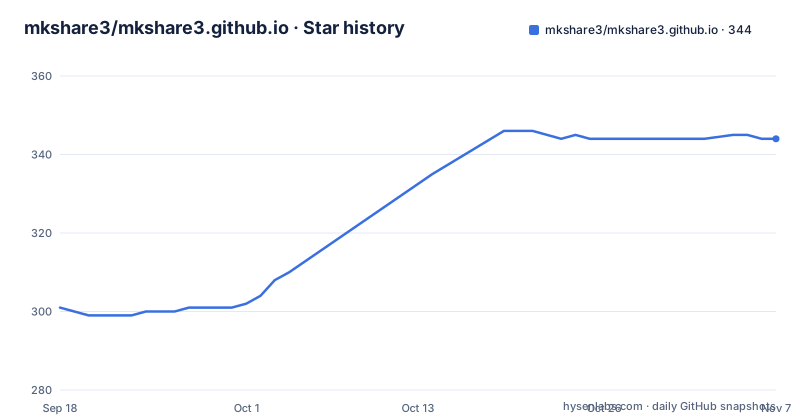
Star history
- mkshare3/mkshare3.github.io344 ★ · +43
| Repository | 2026-09-18 | 2026-11-07 |
|---|---|---|
| mkshare3/mkshare3.github.io | 301 | 344 |
43 Stars in the last 50 days, measured from the daily GitHub snapshot. Compare with other projects
Editorial analysis
What the repository actually contains
Strip away the formatting and mkshare3.github.io is one file: a README that GitHub Pages serves as a web page. The repository tree lists README.md and nothing else. Its content is a set of subscription links for proxy clients, refreshed with a timestamp (the README shows a last update of 2026-08-21 20:55:49), wrapped in promotional text and a referral to a paid proxy service the author calls an airport. There is no code, no build, no configuration schema. Calling this an open source project stretches the term. It is a distribution point for links, published through a Git repository. Who is it for? People on heavily filtered networks who want a free proxy subscription they can paste into a client without paying. That audience is real, and so are the trade-offs.
How the subscription links reach Clash, v2rayN and Shadowrocket
The mechanism is the subscription URL convention that proxy clients already understand. A client such as Clash, v2rayN or Shadowrocket fetches a URL, receives a list of server entries in the format it expects, and fills its node list from that response. The README publishes a single subscription URL, hosted on a third-party domain (mcsslk.xyz), and offers it for all three clients, which means one endpoint serves a format each can read. You paste that URL into the client's subscription screen and it pulls the current nodes. The README says the nodes are speed-tested and updated in real time, which you cannot verify from the repository. Nothing here is built by the project. The servers live behind that external domain, and the repository is only the page that points at them.
Using a published subscription without paying
There is no installation in the software sense. The README's own instructions amount to three moves: install a proxy client, open its subscription or profile screen, and add the subscription URL the README publishes, which is the same for all three clients:
https://CFpxbl.mcsslk.xyz/20701a1073ae305a61b1094cb6bb477aAfter the client fetches that subscription, its node list fills with the current servers, and you pick one to route traffic through it. The README documents no configuration file to edit and no API; the subscription URL is the only value you supply. That is the honest state of the project: it is a link you subscribe to, not a program you configure. Because the same URL is offered for Clash, v2rayN and Shadowrocket, a single client is enough to test whether the nodes respond before you commit to anything.
The trust problem with anonymous rotating nodes
This is where a review has to be blunt. When you route your traffic through a proxy you do not control, the operator of that proxy can see the destinations you connect to, and for unencrypted connections, the content. Free public nodes shared through an anonymous README give you no operator identity, no privacy policy and no accountability. The nodes rotate, so a server that behaves today may be gone or replaced tomorrow. The README pairs the free links with a referral to a paid service, which is the actual business model: the free list is a funnel. None of this makes the links unusable, but it sets the risk. For anything sensitive, an untrusted shared proxy is the wrong tool, and the project offers nothing to reduce that risk, because there is nothing in the repository except the links themselves.
Free shared links versus a paid airport or a self-hosted server
The README itself lays out the alternative, and it is worth taking seriously. It argues that self-hosting a proxy on a rented VPS, once a common approach, has grown unreliable as filtering has improved and provider IP ranges get blocked, sometimes within weeks, with paid IP changes offering no guarantee. Its recommendation is a paid provider with a large IP pool and custom obfuscation, which is also the service it refers you to. So the real comparison is three-way: free shared links (no cost, no trust, unstable), a self-hosted VPS (full control, real maintenance burden, increasingly blocked), and a paid provider (a cost, but more IP capacity and someone to rotate blocked addresses). This repository sits at the free-and-unstable end. Its content is a reasonable way to test whether such nodes work for you before paying, and a poor foundation to depend on.
No license, no source, and a single tracked file
The repository carries no license file, which for a page of links matters less than for code, but still leaves reuse rights unstated. There is no source to audit, no releases, and the only tracked file is README.md. Maintenance shows as a timestamp in the README (2026-08-21) and a last push on the same date, rather than a version history you can inspect. Treat this the way you would treat any anonymous link aggregator: the update cadence is whatever the author chooses, the links can change without notice, and there is no channel to report a broken or hostile node beyond the external service being promoted.
Editorial conclusion
Use mkshare3.github.io only as a throwaway way to test free proxy nodes, never for traffic you would mind an unknown operator seeing. Do not treat it as a project to depend on or contribute to, because it is a single README that points at third-party servers and funnels toward a paid service. If you need reliability, the README's own argument points you to a paid provider or a self-hosted VPS; if you need privacy, confirm your client uses an encrypted protocol and assume the node operator can log everything else.
Frequently asked questions
What is mkshare3.github.io?
It is a single README hosted on GitHub Pages that republishes free proxy subscription links for Clash, v2rayN and Shadowrocket, alongside promotion for a paid proxy service. It contains no software, only links.
How do I use the subscription links?
Install a proxy client such as Clash, v2rayN or Shadowrocket, open its subscription screen, and add the URL the README publishes. The client then fetches the current node list from that external server.
Is it safe to use these free nodes?
The nodes are operated by an unknown third party who can observe your connection destinations and any unencrypted content. Treat the links as untrusted and avoid routing sensitive traffic through them.
Does mkshare3.github.io have a license?
No. The repository ships no license file and tracks only README.md, so reuse rights are unstated and there is no source code to audit.
Official sources
Add this badge to your README
If you maintain this project, the badge below links readers to this analysis and shows its maintenance status from the daily GitHub snapshot. Paste the markdown into your README; add ?metric=license or ?metric=stars to the image URL for a different field.

[](https://hysenlabs.com/projects/mkshare3-mkshare3-github-io)Star history chart for your README
[](https://hysenlabs.com/projects/mkshare3-mkshare3-github-io)Was this useful?