go-cqhttp: the OneBot implementation its own author asked you to leave
A lightweight, natively cross-platform Go implementation of cqhttp.
At a glance
- What is it?
- A Go rewrite of the CQHTTP protocol bridge for QQ bots, carrying an explicit abandonment notice from its maintainer.
- Who is it for?
- go-cqhttp is a well-built implementation of a protocol that its maintainer has walked away from, and the README says so in the second paragraph rather than the footer. The repository is still there, the 10,630 stars are still there, and the code is still readable if you want to understand how a QQ protocol bridge is put together.
- Can I use it commercially?
- Yes, with strict conditions. AGPL-3.0 is a network copyleft licence: if people use a modified version over a network, for example as a hosted service, you must offer them its source code under the same licence.
- Is it still maintained?
- Yes. The repository last received commits 37 days ago.
- What is it written in?
- Mainly Go, according to GitHub's language statistics.
Answers come from the project's GitHub data, last synced on November 25, 2026, and from our analysis. They are not legal advice.
Star history
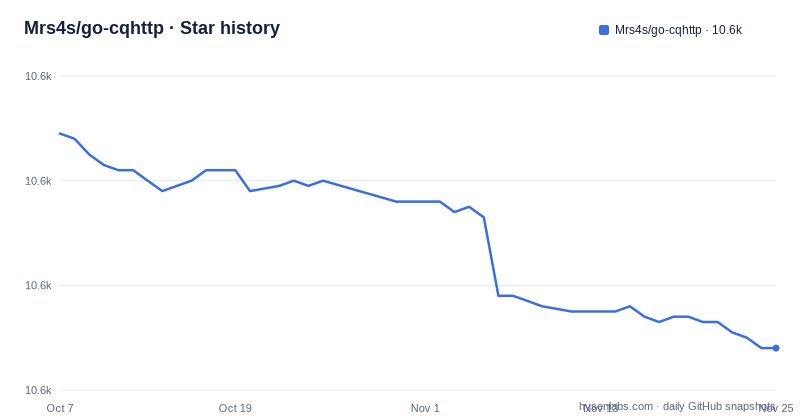
- Mrs4s/go-cqhttp10,588 ★ · -41
| Repository | 2026-10-07 | 2026-11-25 |
|---|---|---|
| Mrs4s/go-cqhttp | 10.6k | 10.6k |
-41 Stars in the last 49 days, measured from the daily GitHub snapshot. Compare with other projects
Editorial analysis
The abandonment notice sits above the documentation links
The most important content in this README is two sentences long and appears before the compatibility section. It states that because QQ has been steadily tightening its defences against protocol libraries and keeps changing its encryption schemes, the maintainers no longer have the capacity to continue, and recommends that bot developers migrate to the headless NTQQ project as soon as possible. A migration issue is linked directly from that paragraph.
This placement is worth noting because it is the opposite of how abandonment is usually communicated. It is not in an archived banner, not at the bottom of a changelog, not behind a deprecation notice in the docs site. It is the first substantive paragraph after the row of documentation, download and quick start links, placed before the compatibility section.
The repository is not archived. The last push was 2026-10-20 and the project has 314 open issues against 10,630 stars. The most recent tagged release is v1.2.0 from October 2023, about three years before the last push.
The distinction matters if you are evaluating this for production. There is a difference between a maintained project you have decided not to use, and an unmaintained one. This is the second, and the README is upfront about it.
OneBot v11, four transports and a pile of extensions
The compatibility claim is specific: go-cqhttp implements the large majority of OneBot v11, with some extensions on top. The protocol has four transport modes and the README confirms all four. HTTP API, reverse HTTP POST, forward WebSocket and reverse WebSocket. That means a bot framework written against OneBot can talk to this implementation over whichever transport it prefers without the bridge author having to guess.
The extension list is where the Go implementation diverges usefully from the specification. Reverse WebSocket multi-point connection and HTTP POST multi-point reporting let several consumers attach to one bot instance. Message recall events, parsing and sending reply messages, and parsing and sending merged forwards are all listed as extensions rather than standard features. Changing a group name is supported too.
Then there are the CQ codes, the string-encoded message segments, and this is where the project is unusually complete. The README splits them into two tables: those conforming to the OneBot standard, including face, record, video, at, share, music, reply, forward, node, xml and json; and extensions or slight deviations, including image, redbag, poke, node, cardimage and tts. `CQ:cardimage` is described in the README as a kind of XML image message, and `CQ:tts` is text to speech. Neither exists in the standard.
If you are writing a bot framework and want to be sure you are not missing a capability, that second table is the checklist. It is a real amount of functionality beyond the specification, and it is the main reason to prefer this implementation over a minimal one if you need the extras.
The sign server is where the protocol fight shows up in the code
The go.mod lists the dependencies. `github.com/fumiama/go-base16384` and `github.com/fumiama/go-hide-param` are among the direct dependencies, `github.com/wdvxdr1123/go-silk` handles the SILK audio codec used for voice messages, and `github.com/fumiama/imgsz` reads image dimensions. Alongside those sit ordinary infrastructure choices: logrus for logging, gjson for JSON, testify for tests, goleveldb and a mongo driver for the database layer, plus sqlite and yaml.
The Dockerfile shows how it ships. A Go 1.20 alpine builder produces a statically linked binary, then a final alpine image installs ffmpeg, coreutils, shadow, su-exec and tzdata, creates an unprivileged user, and defaults the timezone to Asia/Shanghai with an explicit UID and GID of 99 and 100.
Reading the codebase as a protocol reference
There is a reasonable case for keeping this repository around even if you never run it. The top level holds `server/`, `modules/`, `pkg/`, `coolq/`, `db/`, `internal/`, `global/` and `cmd/` directories beside `main.go`.
The `.goreleaser.yml` and `scripts/` directory indicate a conventional release pipeline, and `.golangci.yml` shows linting is configured. The `docs/` directory holds the extension API documentation linked from the README as `docs/cqhttp.md`, and the live documentation site sits at docs.go-cqhttp.org.
So the repository splits cleanly into two things. The running service is not something to start new work on.
What the ecosystem moved to instead
The maintainer's notice points to the headless NTQQ project as the migration target. There is also a related ecosystem around Mirai, the Java bot framework go-cqhttp's client library derives from, and the OneBot protocol has become the de facto standard that lets a bot framework swap implementations without rewriting anything.
What you give up in the move is the extension set, and that is the real trade to evaluate. `CQ:tts` text to speech, `CQ:cardimage`, the poke and redbag codes, and merged forward message handling are all implemented here. Whether the successor implements them is worth checking against your bot's actual requirements rather than assuming, because those extensions are where implementations differ most.
For anyone still running go-cqhttp in production today, the practical advice is that, since the protocol continues to change, a deployment that works this month is not evidence that it will work next quarter.
Editorial conclusion
go-cqhttp is a well-built implementation of a protocol that its maintainer has walked away from, and the README says so in the second paragraph rather than the footer. The repository is still there, the 10,630 stars are still there, and the code is still readable if you want to understand how a QQ protocol bridge is put together. What has gone is the maintenance that would have handled the next encryption change. Read the migration issue before you plan anything new.
Frequently asked questions
Which Go version does go-cqhttp use?
go-cqhttp is written in Go, and its Go version is visible in go.mod, which declares go 1.20, and in the Dockerfile, which builds from golang:1.20-alpine.
Is go-cqhttp still maintained?
No, and the README says so directly. It states that because QQ keeps changing its encryption schemes the maintainers can no longer continue the project, and recommends migrating to the headless NTQQ project. The repository is not archived and the last push was 2026-10-20, but the most recent tagged release is v1.2.0 from October 2023.
What protocol does go-cqhttp implement?
OneBot v11, which it reports as covering the large majority of, with extensions on top. It supports four transports: HTTP API, reverse HTTP POST, forward WebSocket and reverse WebSocket, and it adds extension CQ codes including cardimage, tts, poke and redbag that are not part of the standard.
What licence does go-cqhttp use?
The repository metadata lists AGPL-3.0.
Official sources
Add this badge to your README
If you maintain this project, the badge below links readers to this analysis and shows its maintenance status from the daily GitHub snapshot. Paste the markdown into your README; add ?metric=license or ?metric=stars to the image URL for a different field.

[](https://hysenlabs.com/projects/mrs4s-go-cqhttp)Star history chart for your README
[](https://hysenlabs.com/projects/mrs4s-go-cqhttp)Was this useful?