OpenVoice: Instant Voice Cloning with Granular Style Control, Now MIT Licensed
Instant voice cloning by MIT and MyShell. Audio foundation model.
At a glance
- What is it?
- OpenVoice is an audio foundation model from MIT and MyShell that clones a reference voice's tone while allowing independent control over emotion, accent, and other style parameters. V2 adds native multilingual support, and both V1 and V2 are MIT licensed, but the repository offers little operational guidance beyond a pointer to docs.
- Who is it for?
- Adopt OpenVoice if you need instant voice cloning with separate control over tone and style, especially for multilingual or cross-lingual use, and if the MIT license suits your commercial plans. Do not adopt it if you require a fully documented, production-ready pipeline or if you cannot afford to dig through the docs/USAGE.md and docs/QA.md files for setup details.
- Can I use it commercially?
- Yes. MIT is a permissive licence: you can use, modify and sell software built on it, as long as you keep its copyright and licence notices.
- Is it still maintained?
- Probably not. The repository last received commits 19 months ago, on April 19, 2025.
- What is it written in?
- Mainly Python, according to GitHub's language statistics.
Answers come from the project's GitHub data, last synced on November 15, 2026, and from our analysis. They are not legal advice.
Star history
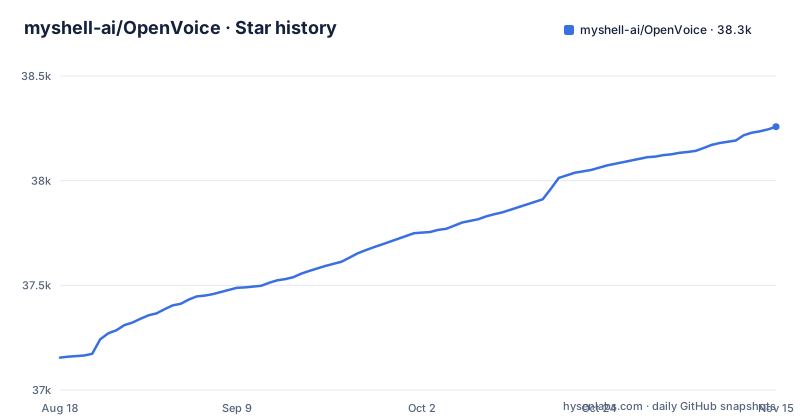
- myshell-ai/OpenVoice38,258 ★ · +1,103
| Repository | 2026-08-18 | 2026-11-15 |
|---|---|---|
| myshell-ai/OpenVoice | 37.2k | 38.3k |
1,103 Stars in the last 89 days, measured from the daily GitHub snapshot. Compare with other projects
Editorial analysis
What OpenVoice Actually Solves
OpenVoice solves a real problem: voice cloning that preserves the speaker's identity while letting you adjust delivery. OpenVoice decouples these dimensions. The project is aimed at developers and researchers who need a voice cloning foundation they can embed in an app or service. The MIT license, which has covered both V1 and V2 since April 2024, removes a common barrier to commercial adoption. If you have ever tried to clone a voice and then tweak the accent without losing the speaker's character, OpenVoice is designed for that exact workflow.
The Mechanism: Tone and Style Are Separate Paths
The mechanism is not fully documented in the README. The paper is the primary source. The reference speaker's voice can be transferred to a language the speaker never used. The README says the training data does not need to include the language of either the reference or the generated speech. If you are evaluating the model, you should read the paper to see how they achieve that separation, because the repository gives you no architecture diagram.
Getting It Running: Commands and Config from the Docs
To run OpenVoice, you must navigate to the docs. The README says 'Please see usage for detailed instructions.' That is the only command-related guidance. You will need to clone the repo, then read docs/USAGE.md for the detailed instructions. The QA doc collects common questions and answers. If you are used to pip install openvoice, you will be disappointed. This is a research codebase, not a packaged library. The MIT license means you can integrate it into your own project, but you will have to handle the wiring yourself. The lack of GitHub releases and the placeholder version 0.0.0 in setup.py further suggest that the project is distributed as source, not as a stable package.
A Genuine Limitation: Documentation Gap and Version Ambiguity
The documentation gap is the most concrete limitation. The README is a summary, not a manual. The setup commands live in docs/USAGE.md rather than in the README. The version situation needs care: the README describes V1 and V2, with V2 (April 2024) including all V1 features, while setup.py declares version 0.0.0. This is a real problem for reproducibility. If you want to use OpenVoice, you must read the docs and the QA file. That is a cost, but it is not a dealbreaker if the model's capabilities match your needs.
The Alternative: Coqui TTS and VITS-Based Systems
The alternative is to use the base projects directly. OpenVoice's advantage is the separation of tone and style, which those base models may not provide out of the box. If you are comfortable reading papers and digging through code, OpenVoice is a strong choice. The README gives you the names of the base projects, so you can look at them to understand what OpenVoice adds.
Maintenance and License: What the MIT License Actually Means Here
The MIT license is a clear benefit, but it comes with a caveat: no warranty, no support. The README says free for commercial use, but it does not provide a support channel. The QA doc is the only form of help. The maintenance status is unclear. The repository has no GitHub releases, and the last push was on 2025-04-19. That is a yellow flag. The project may be stable, but you cannot confirm active development. The license allows you to modify the code, so you can fix bugs yourself. But you must be prepared to do that. The README says the implementation is based on TTS, VITS, and VITS2. The README does not specify a version pinning strategy. For a production system, you should pin your dependencies and fork the repo if necessary.
Who Should Adopt It and What to Verify First
Adopt OpenVoice if you need instant voice cloning with separate style control and cross-lingual support, and if the MIT license fits your business model. Do not adopt it if you need a turnkey solution with clear setup steps. The README's lack of installation commands is a sign that you will need to read the docs carefully. Before you start, verify the version on the main branch, the contents of the docs, and the model download process. Run a test with a short reference audio to evaluate tone cloning accuracy. The QA doc might save you time on common issues. Because the implementation is based on TTS, VITS, and VITS2, you should also check the licenses of those projects, though the MIT license on OpenVoice itself is permissive. The maintenance status is uncertain, so plan to fork and pin dependencies if you use it in production. The core capability is strong, but the packaging is not.
Editorial conclusion
Adopt OpenVoice if you need instant voice cloning with separate control over tone and style, especially for multilingual or cross-lingual use, and if the MIT license suits your commercial plans. Do not adopt it if you require a fully documented, production-ready pipeline or if you cannot afford to dig through the docs/USAGE.md and docs/QA.md files for setup details. Before adopting, verify the exact installation steps, model download locations, and any dependency conflicts with your existing Python environment, as the README itself does not provide those specifics.
Frequently asked questions
is openvoice free
Yes. The README states that OpenVoice V1 and V2 are MIT licensed and free for both commercial and research use, and that this has applied to both versions since April 2024. The repository carries a LICENSE file at its root.
What is open voice?
It is a voice cloning model from MyShell and MIT that clones a reference tone colour and generates speech from text, with granular control over voice style including emotion, accent, rhythm, pauses, and intonation. It also does zero-shot cross-lingual cloning, where neither the generated language nor the reference language needs to be in the training dataset.
how to use openvoice
The README contains no command and defers to docs/USAGE.md for detailed instructions, with docs/QA.md for common questions. The repository root also carries three notebooks, demo_part1.ipynb, demo_part2.ipynb, and demo_part3.ipynb, which appear to be demos of the model.
how to install openvoice
The README shows no install command. The packaging metadata declares a distribution named MyShell-OpenVoice requiring Python 3.9 or higher, with fourteen pinned dependencies in setup.py, and requirements.txt adds openai and python-dotenv on top of the same fourteen.
openvoice vs xtts
The README makes no comparison and names no alternative. What it credits is three upstreams the implementation is built on, coqui-ai TTS, VITS, and VITS2, which is a different relationship from a competitor comparison.
Official sources
Add this badge to your README
If you maintain this project, the badge below links readers to this analysis and shows its maintenance status from the daily GitHub snapshot. Paste the markdown into your README; add ?metric=license or ?metric=stars to the image URL for a different field.

[](https://hysenlabs.com/projects/myshell-ai-openvoice)Star history chart for your README
[](https://hysenlabs.com/projects/myshell-ai-openvoice)Was this useful?