Namma Yatri publishes a ride-hailing platform under AGPL-3.0 and sends you to two sub-READMEs to build it
A Direct-to-Driver open mobility platform powering the next-generation of mobility applications in India.
At a glance
- What is it?
- nammayatri/nammayatri is the source repository behind a zero-commission, driver-centric mobility platform in India. The top-level README states values and goals, and the build steps sit in Backend and Frontend.
- Who is it for?
- Read this repository if you work on mobility software, open data or public-interest platforms and want to study a large Haskell codebase built around drivers instead of commissions. It is a poor fit if you want a drop-in ride-hailing kit, because the top-level README gives no install commands and defers to Backend and Frontend.
- Can I use it commercially?
- Yes, with strict conditions. AGPL-3.0 is a network copyleft licence: if people use a modified version over a network, for example as a hosted service, you must offer them its source code under the same licence.
- Is it still maintained?
- Yes. The repository received new commits within the last day.
- What is it written in?
- Mainly Haskell, according to GitHub's language statistics.
Answers come from the project's GitHub data, last synced on November 26, 2026, and from our analysis. They are not legal advice.
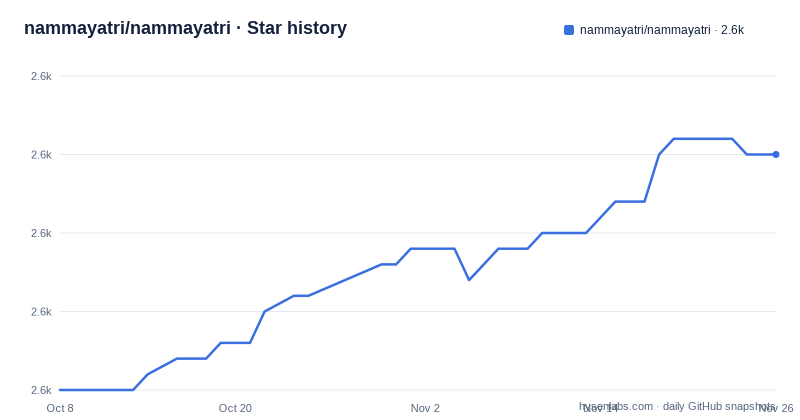
Star history
- nammayatri/nammayatri2,585 ★ · +15
| Repository | 2026-10-08 | 2026-11-26 |
|---|---|---|
| nammayatri/nammayatri | 2.6k | 2.6k |
15 Stars in the last 49 days, measured from the daily GitHub snapshot. Compare with other projects
Editorial analysis
Zero commission is the first of five stated principles
Namma Yatri describes itself as an open and driver-centric mobility platform, and the README opens with five principles. Zero Commission means no commission fees for drivers. Open means open data platforms, open code and open networks. Optimize means reaching population scale growth with utility-like pricing by continuously optimizing maps, cloud and development costs while keeping reliability and a rich user experience. Multimodal means supporting various modes of transport. Shared Transport means promoting shared mobility to reduce traffic congestion, lower costs and cut carbon emissions.
The framing is that one person can serve millions: auto drivers carry people every day, and indirectly serve many customers over time. The README says the project is an effort to enable the careers of those who serve one-to-one.
The repository description calls it a Direct-to-Driver open mobility platform powering the next generation of mobility applications in India.
Five core values put ownership with drivers and citizens
The core values section reads as a statement of how the platform wants to be governed. Community-first says mobility must be owned by the community of citizens and drivers. Citizens as owners says both drivers, who invest in vehicles, and citizens, who pay for the service, should own the platform, without intermediaries dictating terms or prices.
Open Platform promises that data and roadmap will be open for feedback. Tech and People are enablers says mobility is an engineering problem and that both technology and human involvement are needed. Sustainable Growth rules out tactics such as discounts and incentives in favor of initiatives that are financially, environmentally and psychologically sustainable.
These are commitments in prose. The README does not point to code that enforces any of them, so the repository tells you what the project intends and leaves the verification to the code.
The README gives no build commands and hands off to Backend and Frontend
A reader looking for a quickstart will not find one at the top level. The Project Setup section says instructions to build and run the project are in the sub-project directories, and it links the Backend README at its getting-started anchor and the Frontend README.
That is the real entry point. The top-level README has no install command, no required tool versions and no description of services, so any estimate of effort has to come from those two files.
The repository listing gives hints about the toolchain. There is a flake.nix and flake.lock, an om.yaml, .envrc.backend and .envrc.frontend files, and a .hlint.yaml, in a repository whose primary language is Haskell. A .psc-ide-port file also appears at the top level. The README itself does not explain any of these, so treat them as clues about where to look.
What else sits in the repository root besides Backend
The top level holds more than code directories. There are NammaTagConcept.md and INVOICE_GENERATION_IMPLEMENTATION.md, which are design notes by name. A toll-combinations directory and a buildtime-analysis directory sit beside docs. An ondc_build_diff.patch file is also present.
For translation, there is a crowdin.yml, a crowdinTranslationGenerator.py script and a crowdin_python_generator_configuration.json. The README does not describe them, so the file names are the only evidence that translations are managed through Crowdin.
The repository also carries .cursorrules, .clinerules, .cursor and .claude directories and a CLAUDE.md, which are configuration files for AI coding assistants. If you contribute with an assistant, those files are where the project's conventions for it live, and you can read them before your first patch.
Public ride data, linked from the README, stands in for a benchmark
The Milestone and Growth section says the platform is demonstrating its effectiveness and scalability with an ever-increasing number of rides, and links a real-time open data page at nammayatri.in/open. The two snapshots described are a dashboard overview of total rides completed, registered users, searches and drivers' earnings, and daily trends of searches, completed trips, drivers' earnings, registered users and enabled drivers.
The README gives no figures in text. It does not state a ride count, a city list or a driver count, so any number you want has to come from the linked dashboard.
That design follows the stated Open principle: the traction data is public and is meant to be checked. The corollary is that the repository holds no performance claim you can cite from the README alone.
Contributions are welcome in five forms, and questions go to GitHub Discussions
The contributing section lists the accepted forms: bug reports, code patches, documentation updates, feature requests, and notifications of breaking changes in dependencies. It asks you to read docs/CONTRIBUTING.md before you start.
Questions and ideas go to the nammayatri organization's GitHub Discussions. The README states the aim as an open development platform for the mobility stack where anyone can inspect and contribute.
Notifications of breaking changes in dependencies is an unusual item to list. In a Haskell codebase managed with Nix, as the flake files suggest, a dependency that changes can break a build, and the project says it wants to hear about that.
The README says nothing about response times for pull requests or a review process, so those are not promised.
Maintenance: last push 2026-10-25, AGPL-3.0, last tag in February 2024
The repository is not archived. Its last push was on 2026-10-25, and the license is AGPL-3.0. The recent tagged releases are v23.0.0 (Rentals & Spec Fixes) on 2024-02-13, v21.0.0 (Rentals & Intercity Release) on 2024-02-11 and v20.0.0 (Prod Release For Rentals, GRPC & Spec V2 Changes) on 2024-02-07.
Those tags cluster in one week in early 2024, and none is newer. If you pin to a release, you pin to that period, while the default branch main carries later work.
The AGPL-3.0 license matters to anyone planning to run a modified version as a service. Read LICENSE and take advice before you deploy a fork, because the README adds no commentary on what the license requires of operators.
Editorial conclusion
Read this repository if you work on mobility software, open data or public-interest platforms and want to study a large Haskell codebase built around drivers instead of commissions. It is a poor fit if you want a drop-in ride-hailing kit, because the top-level README gives no install commands and defers to Backend and Frontend. Before planning anything, read the AGPL-3.0 text in LICENSE and the two sub-READMEs, and note that the latest tagged release is v23.0.0 from 2024-02-13.
Frequently asked questions
What is Namma Yatri?
Namma Yatri is an open and driver-centric mobility platform for India. The repository describes it as a Direct-to-Driver open mobility platform with zero commission for drivers.
How is Namma Yatri different from Uber?
The README makes no comparison with Uber. It states its own principles instead: zero commission for drivers, open data and code, shared transport, and ownership by drivers and citizens.
How do I use the Namma Yatri app?
This repository is the platform's source code, not an end-user guide. The README sends developers to the Backend and Frontend READMEs for instructions to build and run the project.
Official sources
Add this badge to your README
If you maintain this project, the badge below links readers to this analysis and shows its maintenance status from the daily GitHub snapshot. Paste the markdown into your README; add ?metric=license or ?metric=stars to the image URL for a different field.

[](https://hysenlabs.com/projects/nammayatri-nammayatri)Star history chart for your README
[](https://hysenlabs.com/projects/nammayatri-nammayatri)Was this useful?