You-Dont-Know-JS (Portuguese translation): what the nao-sabemos-js fork actually contains
📗📒 (PT-Br translation) JS Book Series.
At a glance
- What is it?
- A volunteer, author-authorized Brazilian Portuguese translation of Kyle Simpson's You Don't Know JS book series, hosted as Markdown in a single GitHub repository. It is a reading and translation project, not a JavaScript library, and the licence terms restrict redistribution.
- Who is it for?
- Adopt this repository if you read Brazilian Portuguese and want the You Don't Know JS material offline or in a diffable Markdown form, or if you want to contribute translation fixes through CONTRIBUTING.md.
- Can I use it commercially?
- Check first. The repository uses a licence we do not classify automatically, so read its LICENSE file before any commercial use.
- Is it still maintained?
- Yes. The repository last received commits 153 days ago.
- What is it written in?
- Mainly JavaScript, according to GitHub's language statistics.
Answers come from the project's GitHub data, last synced on November 15, 2026, and from our analysis. They are not legal advice.
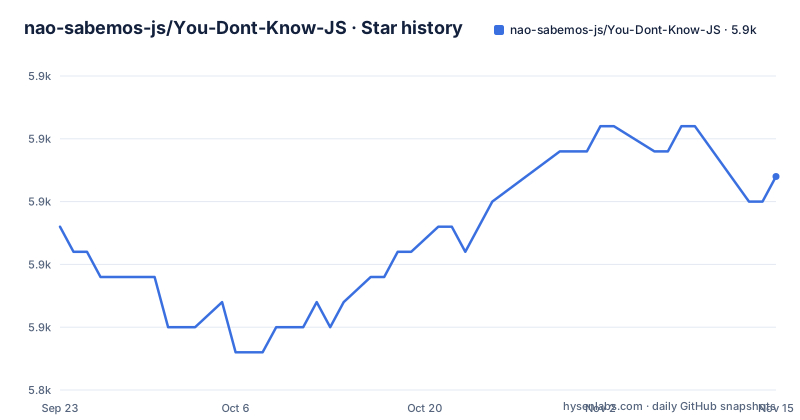
Star history
- nao-sabemos-js/You-Dont-Know-JS5,856 ★ · +2
| Repository | 2026-09-23 | 2026-11-15 |
|---|---|---|
| nao-sabemos-js/You-Dont-Know-JS | 5.9k | 5.9k |
2 Stars in the last 53 days, measured from the daily GitHub snapshot. Compare with other projects
Editorial analysis
What the nao-sabemos-js fork is, and who it is for
This repository is a Brazilian Portuguese translation of the You Don't Know JS book series by Kyle Simpson. The README states that the translation is authorized by the author and was started by Cezar Augusto, that it is voluntary, and that its only goal is to make the book content available to the community in Portuguese. The default branch is named portuguese-translation, which tells you what the maintainers expect pull requests to target.
The audience is narrow and specific. It is for developers who already read Portuguese comfortably and want to study JavaScript mechanics (scope, closures, this, prototypes, types, grammar, async) in that language rather than in English. It is also for people who want to contribute translation fixes, since the README says that if you know English or have read an already translated part and found an error, they want your help, with the details in CONTRIBUTING.md.
It is not a package you install into a project. There is no runtime, no build step described in the README, and no npm artifact mentioned. The repository is a set of Markdown books, and the useful unit of consumption is a chapter file.
Repository layout: six books, one directory each
The top-level entries map directly onto the six titles in the first edition of the series: up & going/, scope & closures/, this & object prototypes/, types & grammar/, async & performance/, and es6 & beyond/. Each of those directories contains the translated book, with the README linking to a per-book README such as the anchor for "Iniciando" or "Escopos & Closures".
Alongside the books sit CONTRIBUTING.md, CONTRIBUTORS.md, LICENSE.txt, PULL_REQUEST_TEMPLATE.md, WORDREFERENCE.md, preface.md, .all-contributorsrc, and a kickstarter-survey-site/ directory. WORDREFERENCE.md is worth noting: a translation project that keeps a terminology reference file is doing the thing that keeps translated technical prose consistent across chapters, and it is the first file a new translator should read.
The README links each title to its O'Reilly product page and gives the same instruction for all six: read online for free, and buy the English edition. That combination is the whole distribution model. The translation is a reading convenience layered on top of a commercially published book, not a replacement for it.
Reading the translated Markdown on your own machine
There is no install procedure in the README, because there is nothing to install. The repository is Markdown plus images, so the practical setup is a clone of the translation branch and a text editor or Markdown viewer. The branch name matters: the default branch is portuguese-translation, so a plain clone lands on the translated content, and a checkout of another branch would not.
The README itself does not give a clone command, so the only repository-supplied path you have to work with is the directory listing. The top-level entries are the table of contents:
lsThat listing is what you navigate by: the six book directories named above, plus CONTRIBUTING.md, CONTRIBUTORS.md, LICENSE.txt, PULL_REQUEST_TEMPLATE.md, WORDREFERENCE.md, preface.md, .all-contributorsrc, and kickstarter-survey-site/. From there, open the book you want. The README links each book's own README, and those are the entry points with the chapter navigation.
One practical detail the README exposes through its own links: the directory names contain spaces and ampersands. The README writes them as up\%20&\%20going/ and scope\%20&\%20closures/, which is the URL-encoded form GitHub needs in a web link, not the form a shell wants. On the command line, quote the path.
Contributing a translation fix, and the limits of the contribution model
The README points contributors to CONTRIBUTING.md and states the terms plainly: by contributing translations, you agree to the free disclosure of the translated content on GitHub. It also says the content cannot be made available outside this environment in any form, including sale or redistribution, and that all rights are reserved to the author and O'Reilly.
There is a second agreement buried in the README that contributors should read before opening a large pull request. If you contribute additional content rather than typo fixes, you agree to grant a non-exclusive licence allowing your content to become part of the series whenever the author and O'Reilly judge it appropriate. The README frames this as making the lawyers happy. It is a real term, not a formality, and it is the kind of clause that surprises people who assume a translation pull request is purely a community contribution.
The README also sets expectations about what kind of fix is worth sending. Improvements to grammar are welcome but, in the README's own words, will probably be picked up in the normal publication process and so are not necessarily as important for this repository. Substantive corrections to snippets and explanations are the higher-value contributions.
Where this repository is the wrong tool
The most important limitation is edition. The README describes the first edition of the series as now complete, and this repository covers that edition, not the second edition, You Don't Know JS Yet. If you are looking for the newer material, this translation is not it, and no amount of reading the branch will change that.
The second limitation is the licence. The README places the work under Creative Commons Attribution-NonCommercial-NoDerivs 3.0 Unported and states that the translated content may not be distributed outside this environment, including by sale or redistribution. A NoDerivs licence is an awkward fit for a translation project by construction, which is presumably why the README adds the explicit authorization from the author and the separate statement of reserved rights instead of relying on the licence text alone. If your use case involves republishing, mirroring, bundling into a course, or printing, this is the wrong source, and the README says so directly.
The third limitation is completeness. The README does not publish a per-chapter or per-book translation status, and the repository has no published releases. A file existing in a book directory does not tell you how much of the corresponding English section it contains. Treat chapter coverage as something you verify by opening the file.
How it differs from the upstream English repository
The obvious alternative is the upstream getify/You-Dont-Know-JS repository, which the README links to through the author's GitHub profile and which is the source text this project translates. The difference in approach is not stylistic. Upstream is the canonical, English, author-maintained source that feeds the O'Reilly publication process; this fork is a downstream, volunteer, language-specific derivative whose stated purpose is availability in Portuguese.
That difference has practical consequences. Upstream is where corrections to the original explanations land first, and where the second edition lives. This fork inherits fixes only when someone translates and merges them. If you read English, upstream gives you the authoritative text and the newer edition. If you read Portuguese, this fork gives you the first edition in your language, with the terminology consistency that WORDREFERENCE.md is meant to enforce.
There is also a difference in what you can do with the text. Upstream is the reference point for the series; this fork carries the additional README restrictions on redistribution outside GitHub. Choosing between them is therefore a question of language and permitted use, not of quality.
Maintenance, licence and what to check before you rely on it
The repository is not archived, and the last push was on 2026-06-15. The README describes a volunteer effort with no release schedule and no published releases. There is no version number to pin and no changelog to read. Updating means pulling the branch again and diffing the Markdown, which is straightforward precisely because the content is plain text.
On licensing, the README states two things that need to be read together: the work is under Creative Commons Attribution-NonCommercial-NoDerivs 3.0 Unported, and, based on the author's authorization, the translated content cannot be distributed outside GitHub in any form including sale or redistribution, with all rights reserved to the author and O'Reilly. Copyright is stated as 2013-2015 Kyle Simpson. This is not legal advice, and the combination of a NoDerivs licence with an authorized translation is exactly the kind of arrangement you should read yourself rather than take secondhand.
Before you rely on it for study or for a team, do three things: open the specific chapter you need and confirm it is translated, read CONTRIBUTING.md if you plan to send changes so you understand the non-exclusive licence grant, and check the O'Reilly links in the README if you need the published English edition.
Editorial conclusion
Adopt this repository if you read Brazilian Portuguese and want the You Don't Know JS material offline or in a diffable Markdown form, or if you want to contribute translation fixes through CONTRIBUTING.md. Do not adopt it if you need the second edition, the English source text, or a licence that permits redistribution: the README states the content cannot be made available outside GitHub in any form, including sale or redistribution, and all rights remain with the author and O'Reilly. Before relying on it, open the first chapter of the book you need and check whether the corresponding English section has been translated, because the README does not publish a per-chapter completion status.
Frequently asked questions
What is the You Don't Know JS series?
It is a series of books that goes deep into the core mechanisms of the JavaScript language, according to the README. The README states that the first edition of the series is now complete, and it lists six titles: Up & Going, Scope & Closures, this & Object Prototypes, Types & Grammar, Async & Performance, and ES6 & Beyond.
Is the nao-sabemos-js You-Dont-Know-JS repository the same as the English original?
No. It is a Brazilian Portuguese translation of the series, authorized by author Kyle Simpson and started by Cezar Augusto, with the default branch named portuguese-translation. The README states the translation is voluntary and exists to make the book content available to the community in Portuguese.
How do I read the Portuguese translation of You Don't Know JS?
The README links each of the six titles to a per-book README where the chapters can be read online for free. The repository is Markdown plus images, so you can also read the files in a text editor or Markdown viewer, quoting the directory names because several contain spaces and ampersands.
Can I redistribute or sell the translated content from this repository?
The README states that the content cannot be made available outside this environment in any form, including sale or redistribution, and that all rights are reserved to the author and O'Reilly. The work is also listed under Creative Commons Attribution-NonCommercial-NoDerivs 3.0 Unported.
How can I contribute to the You Don't Know JS Portuguese translation?
The README points to CONTRIBUTING.md for the guide, and says contributions are welcome from people who know English or who have read a translated part and found an error. It also notes that by contributing you agree to the free disclosure of your translated content on GitHub.
Official sources
Add this badge to your README
If you maintain this project, the badge below links readers to this analysis and shows its maintenance status from the daily GitHub snapshot. Paste the markdown into your README; add ?metric=license or ?metric=stars to the image URL for a different field.

[](https://hysenlabs.com/projects/nao-sabemos-js-you-dont-know-js)Star history chart for your README
[](https://hysenlabs.com/projects/nao-sabemos-js-you-dont-know-js)Was this useful?