work-from-anywhere: a daily list of location-independent roles
A daily curated list of jobs that allow working from anywhere.
At a glance
- What is it?
- Nithur-M/work-from-anywhere is a repository of Markdown files listing jobs that can be done from any country, curated by hand from company careers pages rather than scraped from job boards. It is a dataset rather than a tool, updated daily, with no automation and no licence file.
- Who is it for?
- Use this repository as a reading list if you are a software engineer looking for a role that is not tied to one country or time zone, and if you are comfortable checking the company careers page yourself before applying. Do not build tooling on top of it: the files are updated by hand, the primary language of the repository is not even recorded, and there is no licence file at the root, so the legal basis for redistributing or scraping the listings is unresolved.
- Can I use it commercially?
- Not without permission. GitHub finds no licence file in the repository, and without a licence all rights are reserved by default: you may read the code but not reuse it. Check the README, or ask the authors, before using it.
- Is it still maintained?
- Yes. The repository last received commits 1 day ago.
- What is it written in?
- GitHub does not report a main language for this repository.
Answers come from the project's GitHub data, last synced on November 7, 2026, and from our analysis. They are not legal advice.
Star history
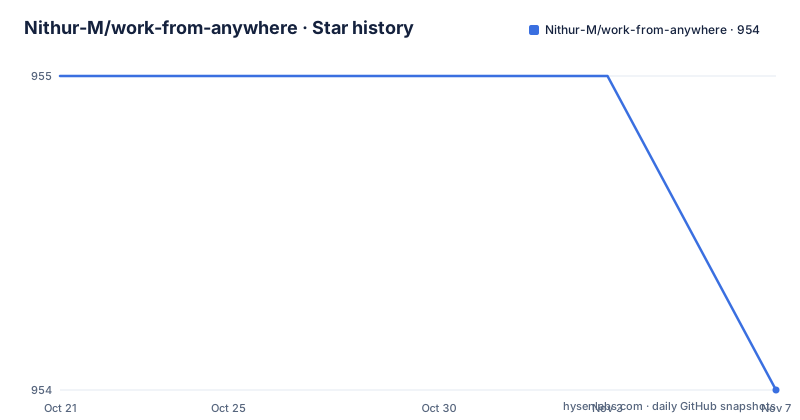
- Nithur-M/work-from-anywhere954 ★ · -1
| Repository | 2026-10-21 | 2026-11-07 |
|---|---|---|
| Nithur-M/work-from-anywhere | 955 | 954 |
-1 Stars in the last 17 days, measured from the daily GitHub snapshot. Compare with other projects
Editorial analysis
The filter is the whole point
The project describes itself as a daily curated list of location independent jobs, and the README is explicit about the filter it applies. Most remote jobs only let you work from a specific country or time zone, and this repository lists only jobs you can truly do from anywhere.
That single distinction separates this list from the general remote job boards it grew out of. The author states the reasoning directly: there are multiple remote job boards out there, but most remote jobs allow employees to work remotely from only a specific location, which is why the repository exists.
The audience is visible in the repository topics as well, developer, jobs, remote-work and software-engineering, and in the category list, which is entirely software and product roles: backend, data science, developer, DevOps, frontend, fullstack, product manager, project manager, quality assurance, site reliability engineer, software engineer, and UI/UX designer.
So the useful framing is that this is a curated index, not a job marketplace. It narrows an enormous noisy category down to a property that is hard to check at scale, which is exactly the kind of filtering that a human doing it every day can add value with.
Curated from careers pages rather than from job board feeds
The most useful sentence in the README describes the collection method. The author used to curate fully work from anywhere remote jobs from feeds like RemoteOk and WeWorkRemotely, but over time learned that it is a huge waste of time for job seekers to hop between multiple sites to apply to jobs, and is now curating jobs directly from company careers pages.
That is a change of pipeline, not of presentation. The earlier approach consumed aggregators, which inherit the location restriction problem from their own listings. Going to company careers pages means the location condition is read from the employer's own wording, which is where it is actually stated.
There is a trade-off that the README does not spell out. Reading a handful of careers pages a day is manual work, and manual work at that cadence is slow to publish and easy to get wrong in a different way, since a single employer page can be ambiguous about whether a role is open to applicants in your country or merely remote within its hiring region. The README offers no way to audit how a given entry was classified.
For a reader, the practical implication is that entries are a starting point rather than a verified fact. The value is in having the list narrowed at all; the verification step is still yours.
Thirteen Markdown files, one per role family
The data is stored as plain Markdown files at the repository root, one per category, and the README links each one. backend-jobs.md, data-science-jobs.md, developer-jobs.md, devops-jobs.md, frontend-jobs.md, fullstack-jobs.md, product-manager-jobs.md, project-manager-jobs.md, quality-assurance-jobs.md, site-reliability-engineer-jobs.md, software-engineer-jobs.md and ui-ux-jobs.md are all listed as Job Categories.
The format has an advantage over a database-backed board: it diffs cleanly, it works in a browser on GitHub without any tooling, and every entry is visible without a page load. For a reader who wants to skim, that is the whole product.
The categories overlap, and that is a design choice worth naming rather than a defect. A fullstack engineer is also a backend engineer and a frontend engineer, and a developer role might reasonably sit under either developer-jobs.md or software-engineer-jobs.md. Splitting by category rather than by seniority means a search for backend roles also returns people who would describe themselves as fullstack, which widens the funnel at the cost of some noise.
The split between developer jobs and software engineer jobs is the one that would benefit from a stated rule. The README does not define the boundary, so a reader comparing two files has to infer it from the entries.
The file tree has drifted from the category list
The top level of the repository contains more files than the README's category list links to, and that divergence is worth pointing out.
Alongside the linked files there are design-jobs.md, devops-and-sysadmin-jobs.md, product-jobs.md and software-developer-jobs.md. None of those four appears in the Job Categories list in the README, and design-jobs.md in particular looks like an earlier or parallel naming of what the README calls UI/UX Designer Jobs.
The likely mechanism is mundane. The repository is edited by hand every day, so a new file gets created when a batch of roles arrives that does not fit an existing category, and the README's index is updated less often than the data. The consequence for a reader is that the README index is not a complete map of what is available, and browsing the tree gives a fuller picture than the README suggests.
It is also a signal about the maintenance model. A repository whose index and data can drift apart is one where a human is doing the editing, which matches the README's claim that the list is updated daily and the absence of any generation tooling in the repository.
The website is the front door, the repository is the dataset
The README points at realworkfromanywhere.com in several places, and the badge shows a version of 0.1.0, which suggests the badge is more decorative than meaningful. The site carries the newsletter signup, the hiring page for employers and the sponsor banner.
The split is clear from the structure of the README. There is a Twitter account for Remote Work From Anywhere, a link to the site, a call for companies to post jobs on the site, and a newsletter for weekly delivery of the best work from anywhere jobs. The repository itself is the underlying list.
That matters for what you are adopting. If you want a job, the site and the newsletter are the intended experience. If you want to consume the data programmatically, the repository is the only thing that offers a stable, versioned shape, and it is a shape of Markdown files with no schema, no API and no machine-readable format.
The README also links out to a separate AI jobs board, MoAIJobs, for readers who are looking for remote AI roles specifically.
Sponsorship sits inside the README
A large part of the README is a sponsored section for Zapply, described as an extension that autofills job applications, a job board, user accounts with multiple profiles for different resume types, and application tracking with streaks and commitment awards. The section links to the site through a sponsored path.
Placing the sponsor in the README rather than only on the site means anyone who reads the list on GitHub sees it. That is a legitimate choice, and sponsorship is how a project like this pays for its daily manual labour. It also means the list and the sponsor have an interest in the same audience.
For a reader who wants to be careful, the practical points are simple. The entries and the sponsor are separate sections, so it is easy to see which is which, and the sponsor is disclosed rather than disguised. What the README does not offer is any statement about how listings are selected, so there is no published rule to point at if you wanted to argue that a job was included or omitted for commercial reasons.
If you forward this list to someone, that disclosure travels with it, which is a reasonable default.
No licence, no releases, and no automation
Three facts about the repository itself matter for anyone thinking of building on it.
First, there is no licence file in the tree. The top level contains README.md, an assets directory and the job Markdown files, and nothing that states terms of use. The project is published without an explicit licence, which means the default position under copyright law applies, and reuse of the listings for anything other than reading is not clearly permitted. This is worth raising with the author rather than assuming.
Second, the repository has no GitHub releases and no tagged versions, so there is no way to pin a known-good snapshot of the list. The badge claims a version of 0.1.0 but the history shows no corresponding release.
Third, the primary language is not even recorded for the repository, and there is no scripts directory, no workflow file that fetches anything, and no schema for a listing. The list is maintained by hand. The README says it is updated daily and the last push was on 2026-10-20, so the maintenance is real and current, but it is not automatable from what the repository shows, and a fresh clone gives you a snapshot with no way to update it except pulling.
Those three together mean this repository is best treated as a reading list and a starting point, not as a data source with a contract.
Editorial conclusion
Use this repository as a reading list if you are a software engineer looking for a role that is not tied to one country or time zone, and if you are comfortable checking the company careers page yourself before applying. Do not build tooling on top of it: the files are updated by hand, the primary language of the repository is not even recorded, and there is no licence file at the root, so the legal basis for redistributing or scraping the listings is unresolved. Verify first that the Markdown files are still being refreshed, since the README claims daily updates and the last push was on 2026-10-20, that the sponsor placement in the README is disclosed to anyone you forward the list to, and that the role you are looking at is genuinely location-independent rather than remote within one country.
Frequently asked questions
What is the work-from-anywhere repository and how is it updated?
It is a daily curated list of location independent jobs, split into Markdown files by role. The README says jobs are now curated directly from company careers pages, and the last push was on 2026-10-20.
How does this job list differ from a general remote job board?
Most remote jobs only allow working from a specific country or time zone, and this repository lists only jobs you can truly do from anywhere. The author used to curate from feeds like RemoteOk and WeWorkRemotely before moving to company careers pages.
What job categories does the work-from-anywhere repository cover?
The README lists backend, data science, developer, DevOps, frontend, fullstack, product manager, project manager, quality assurance, site reliability engineer, software engineer and UI/UX designer jobs, each in its own Markdown file.
Can I reuse the job listings from this repository?
The repository contains no licence file, so the terms for reuse beyond reading are not stated. The LICENSE file is absent from the top level, which holds only the README, the assets directory and the job Markdown files.
Official sources
Add this badge to your README
If you maintain this project, the badge below links readers to this analysis and shows its maintenance status from the daily GitHub snapshot. Paste the markdown into your README; add ?metric=license or ?metric=stars to the image URL for a different field.

[](https://hysenlabs.com/projects/nithur-m-work-from-anywhere)Star history chart for your README
[](https://hysenlabs.com/projects/nithur-m-work-from-anywhere)Was this useful?