sysmon-modular: the directory names are event IDs, and the only release is a commit hash
A repository of sysmon configuration modules
At a glance
- What is it?
- This repository stores Sysmon telemetry as small XML modules arranged in folders named after event numbers, and ships a Go tool written against the standard library alone to merge them. The single published release is called after a commit, the tool still calls itself version 1.0, and the ready to use profiles are not in the default branch at all.
- Who is it for?
- This is the repository to read if you want Sysmon telemetry as a reviewable diff rather than as one large XML file that nobody dares touch, and the standard library only Go tool is the reason it can be audited at all. Two practical points come out of the documentation.
- Can I use it commercially?
- Yes. MIT is a permissive licence: you can use, modify and sell software built on it, as long as you keep its copyright and licence notices.
- Is it still maintained?
- Yes. The repository last received commits 42 days ago.
- What is it written in?
- Mainly Go, according to GitHub's language statistics.
Answers come from the project's GitHub data, last synced on November 24, 2026, and from our analysis. They are not legal advice.
Star history
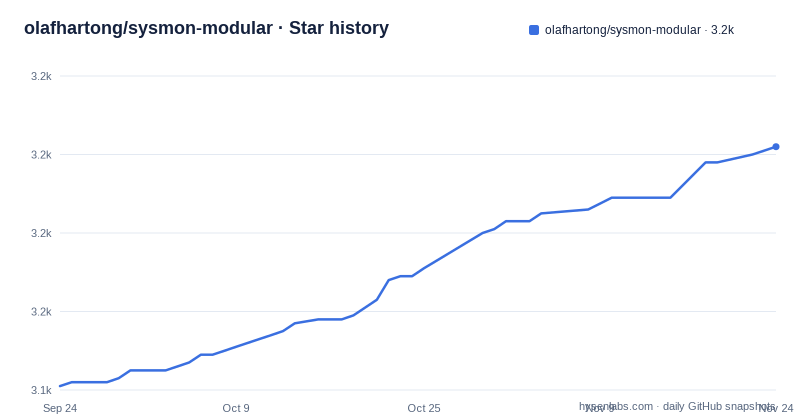
- olafhartong/sysmon-modular3,202 ★ · +61
| Repository | 2026-09-24 | 2026-11-24 |
|---|---|---|
| olafhartong/sysmon-modular | 3.1k | 3.2k |
61 Stars in the last 61 days, measured from the daily GitHub snapshot. Compare with other projects
Editorial analysis
The top level is a list of Sysmon event numbers
The directory names are the design of the project. There is a folder for process creation, one for file create time, one for network connection initiated, one for process ended, one for driver loaded into kernel, one for image load, one for create remote thread, one for raw access read, one for process access, one for file create, one for file create stream hash, one for DNS query, one for file delete, one for clipboard change, one for process tampering, one for file delete detected, one for file executable detected, and one for the registry events. Three of them cover more than one event and are named as ranges, 12_13_14 for the registry group, 17_18 for pipes and 19_20_21 for WMI. The numbering has holes in it, with 4, 16, 27 and 28 absent, and the customisation directory is numbered zero. So a module can be found by the event number in the documentation without opening anything.
The only release is named after a commit, published at the push time
There is exactly one release in this repository, and its name is a commit hash. The tag is configs-082cba578667, the title is Generated Sysmon configurations with the same hash in brackets, and it was published at 2026-09-18T08:03:40Z, which is the same timestamp as the most recent commit on the default branch master. So the release is not a version of the software, it is a snapshot of generated output tied to one commit, and the tooling has no release train of its own. That design is deliberate in one respect at least: the consolidated XML files are described as distributed as release assets instead of being stored in the repository. The consequence for anyone browsing the source is that the default branch contains no ready to deploy configuration.
Two example profiles stay in the repository
If the release assets are the distributable form, the two configurations that remain in the repository are the exceptions, and both are described in a way that warns you off using them casually. The research configuration is called extremely verbose collection for short, controlled research sessions, with a note that it can consume substantial CPU, memory and logging capacity and that a lighter configuration should be loaded when the investigation is complete. The MDE-augment configuration is selected collection intended to complement Microsoft Defender for Endpoint with less overlap, and it is explicit that it does not enable every Sysmon event. Both are meant to be read and rebuilt rather than shipped. The rebuild path is a separate guide inside the customisation directory, referenced by the README for reviewing the exclusion list.
Three profiles, and one of them is a volume trap
The release publishes three consolidated profiles with a column that states each one's collection goal. Balanced is described as the regular starting configuration, without FileDelete archiving. Balanced with FileDelete adds FileDelete collection and file archiving, with a note to account for the archive's disk requirements. Excludes only is called a very verbose profile built from exclusion modules, with a warning to expect substantial event volume and tune before production use. All three are generated for four targets, Sysmon 15.21, 14.16, 13.34 and 12.03, and the versioned filenames carry the target, so the unversioned names are aliases for 15.21. The release also carries prebuilt tools, an ATT&CK Navigator layer derived from the balanced 15.21 configuration, and a SHA256SUMS manifest.
The tool still calls itself version 1.0
The build version of the Go tool starts at 1.0 and is defined in a version file, and local and release builds include it automatically. Both `version` and `--version` print sysmon-modular 1.0, and the same string appears in top-level and command-specific help, so the number is meant to be visible everywhere. Overriding it takes a linker flag, with -X main.buildVersion used in the documented build command. So there are two version numbers in one binary and they mean different things: the build version identifies the tooling, while a separate `--sysmon-version` argument selects which Sysmon executable the output targets. A tool at 1.0 whose only release is named after a commit hash is telling you to pin by release, not by version.
Standard library only, and six prebuilt targets
The build requirement is Go 1.22 or newer, and the README states that the tool uses only the Go standard library. There is no third party module in that sentence, which means a reviewer can read the whole generator without auditing anyone else's dependencies. Because of that, prebuilt binaries are published for six targets: Windows x64 and ARM64, Linux x64 and ARM64, and macOS on Intel and Apple silicon. Go is not required to use them. The download is saved as a file inside a tooling directory in the checkout, with a .exe suffix on Windows, and on Linux and macOS it needs one chmod to become executable:
chmod +x tooling/sysmon-modularThe source build is a single command from the repository root, and there is a run form for executing without building:
go -C tooling build -o "$PWD/tooling/sysmon-modular" ./cmd/sysmon-modularTwo text files are the entire configuration interface
Generating a configuration starts with editing two files in the customisation directory, an example include list and an example exclude list, which select the collection you want, and then running the generator. Everything else in the project follows from that: the release profiles are merged from the same modules, the excludes only profile is described as built from exclusion modules, and the Defender augmentation profile has its own exclusion list with a guide for rebuilding and reviewing it. The examples in the README run from the repository root and call the binary by a path inside tooling. Worth knowing when you copy them: the generating example in that section begins with an invocation of ./tooling/sysmon, while the binary is named sysmon-modular everywhere else in the same document, including the prebuilt asset names and the version string.
Every configuration is described as a starting point
One paragraph is the project's own advice and it is worth quoting in spirit rather than literally. Every configuration is a starting point, to be reviewed and tuned for your applications, endpoint roles, detection needs and logging budget before being deployed widely, with a manageable set of profiles for workstations, servers and domain controllers, and with behaviour measured on representative machines. That last clause is the important one: the repository ships no benchmark and makes no performance claim, it asks you to produce your own numbers. The foundation is credited in the same spirit, to SwiftOnSecurity's original configuration, which the README says inspired this project and remains part of its foundation. Licensing is MIT, with the licence stored as a lowercase license.md at the root.
Editorial conclusion
This is the repository to read if you want Sysmon telemetry as a reviewable diff rather than as one large XML file that nobody dares touch, and the standard library only Go tool is the reason it can be audited at all. Two practical points come out of the documentation. Pick the profile by its collection goal, not by its name, because the excludes only profile is explicitly a high volume one and the research profile is documented as something to unload when the investigation ends. And pin a release rather than tracking latest, since the profile files are release assets rather than files in a branch, and the filename is what tells you which Sysmon version you are getting.
Frequently asked questions
what is sysmon modular
It is a configuration repository for Microsoft Sysinternals Sysmon. Small XML modules make it easier to select, review and maintain telemetry, and the sysmon-modular Go tool builds configurations from those modules and helps validate, analyse and compare them.
Where do I download a ready made sysmon-modular configuration?
From the latest GitHub Release, as release assets rather than from the repository. The three profiles are sysmonconfig.xml, sysmonconfig-with-filedelete.xml and sysmonconfig-excludes-only.xml, and the release also carries prebuilt tools, an ATT&CK Navigator layer and a SHA256SUMS manifest.
Do I need Go installed to use sysmon-modular?
Not if you use a prebuilt binary. Six targets are published, Windows, Linux and macOS in x64 and ARM64 flavours, saved as tooling/sysmon-modular and made executable with chmod +x on Linux and macOS. Building from source requires Go 1.22 or newer.
How do I know which Sysmon version a sysmon-modular profile targets?
The filename carries it, with names like sysmonconfig-14.16.xml, and all three profiles are generated for 15.21, 14.16, 13.34 and 12.03. The unversioned names are aliases for 15.21, and the tool has a separate --sysmon-version argument for choosing the target executable.
Which sysmon-modular profile should I use for a normal deployment?
The README describes Balanced as the regular starting configuration without FileDelete archiving, and warns that the excludes only profile is very verbose with substantial event volume. It also asks you to review and tune before deploying widely and to measure on representative machines.
Official sources
Add this badge to your README
If you maintain this project, the badge below links readers to this analysis and shows its maintenance status from the daily GitHub snapshot. Paste the markdown into your README; add ?metric=license or ?metric=stars to the image URL for a different field.

[](https://hysenlabs.com/projects/olafhartong-sysmon-modular)Star history chart for your README
[](https://hysenlabs.com/projects/olafhartong-sysmon-modular)Was this useful?